
By Connie Reguli, J.D.
As a family law attorney defending parents against over aggressive state agencies for three decades, I have always worked with parents on how to defend themselves in court. These days, parents contact me from all over the country and say that their court-appointed attorneys are not preparing them for court and are not even allowing them to speak in the courtroom. Parents, sadly, do not have all of the constitutional protections that are provided to criminals, like Miranda rights and the right to confront their accuser, however, the ability to speak and be heard in dependency cases is precious and paramount to winning for parents.
On May 10, 2024, the Kansas Supreme Court released an opinion in the criminal case of State of Kansas v. John R. Cantu which found that the trial court judge had denied the constitutional rights of criminal defendant Cantu by removing him from the witness stand and striking his testimony. Cantu’s convictions were reversed.
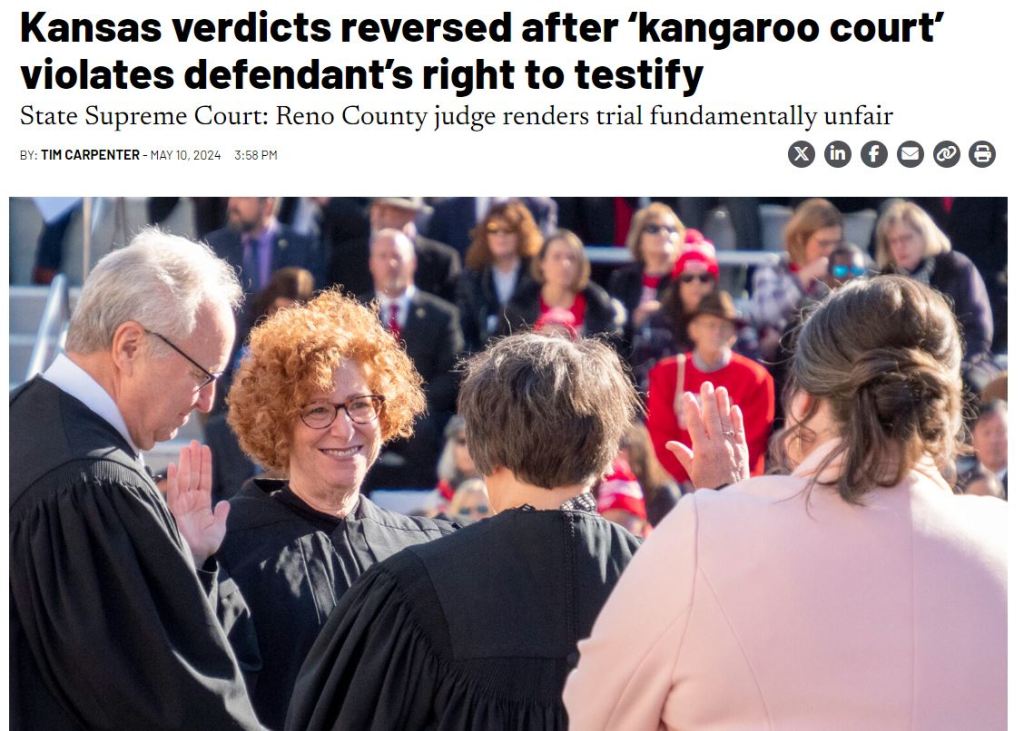
This case is worth the read, and begins like this:
Facts and Procedural History
State of Kansas v. John R. Cantu, Supreme Court of Kansas, May 10, 2024
John R. Cantu was charged in Reno County District Court with two counts of felony stalking, two counts of violation of protection from stalking orders, criminal damage to property, criminal trespass, and felony criminal threat. State v. Cantu, 63 Kan. App. 2d 276, 276, 528 P.3d 265 (2023). He was tried before a jury, and he testified on his own behalf as the sole defense witness. On direct examination, Cantu denied all of the allegations against him and gave an uncorroborated alibi for his whereabouts on the night in question. The substance of Cantu’s direct testimony and his demeanor on the stand appear to have been overall appropriate. He responded to all of his counsel’s questions directly with one interruption and one irrelevant comment. There was no admonishment from the judge or objection from the State during his direct examination. Yet a very different situation unfolded on cross-examination.
The State’s cross-examination of Cantu was cut short when the judge removed him from the stand on grounds that he was being uncooperative. Early in the State’s questioning of Cantu, he interrupted the prosecutor by attempting to explain a previous answer, after which he ignored multiple admonishments from the judge to wait for a question. During a back-and-forth exchange with the judge, Cantu repeatedly asked if he was limited to answering only “yes” or “no,” but the judge ignored his question. Instead, after several warnings, the judge removed Cantu from the stand and, at the prosecutor’s request, struck his entire testimony from the record.
The following transcript excerpt depicts the relevant exchange:
“[STATE]: You would agree that there was a protection from stalking that was filed against you, correct?
“[DEFENDANT]: No.
“[STATE]: You also agree?
“[DEFENDANT]: For the record, for the record—
“COURT: You need to wait for a question.
“[DEFENDANT]: I didn’t finish.
“COURT: You need to wait for a question.
“[DEFENDANT]: I didn’t finish answering the first one.
“COURT: I said it two times now. You need to wait for a question.
“[DEFENDANT]: She asked if I agreed.
“COURT: Sit back and wait for a question.
“[DEFENDANT]: May I be allowed to explain? Do I have to say yes or no?
“[STATE]: Mr. Cantu?
“COURT: Mr. Cantu, if you don’t cooperate I’m going to ask you to go back to the table.
“[DEFENDANT]: May I ask a question?
“COURT: You need to listen to the questions.
“[DEFENDANT]: Am I supposed to respond yes or no?
“COURT: Go sit at the table right now. Absolutely right now.
“[DEFENDANT]: I don’t understand. Can I object to this?
“COURT: Sit at your table.
“[DEFENDANT]: I mean, she asked me a question.
“COURT: Officers, would you remove Mr. Cantu from the courtroom?
“[DEFENDANT]: Is this going to be on the record? Dawn Hicks—my water. You—
“DEPUTY: Grab your water.
“[COUNSEL]: Is that sufficient, Your Honor?
“COURT: If Mr. Cantu will remain compliant it is. Otherwise I will require his removal. He’s indicating by his posture and returning to his seat that he will remain compliant. Do you have any other evidence.”
The transcript record shows the judge warned Cantu four times to wait for or listen to the prosecutor’s question before ordering him removed. The record also shows the judge repeatedly ignored Cantu’s questions about how he was allowed to respond to the prosecutor’s questions. Upon the prosecutor’s motion and in front of the jury, the judge ordered Cantu’s entire testimony stricken from the record, justifying this decision on grounds that “Mr. Cantu would not cooperate when I told him to only answer questions on cross-exam. I believe the State’s request is valid. His testimony is stricken.” The court made no further record of Cantu’s conduct while he was on the stand, such as his body language, demeanor, or tone of voice.
Aside from granting the State’s motion to strike Cantu’s testimony in the presence of the jury, the judge did not specifically explain how the jury should treat Cantu’s stricken testimony. But at the close of evidence and before jury deliberations, the court issued written instructions to the jury which explicitly advised: “In your fact finding you should consider and weigh everything admitted into evidence. This includes testimony of witnesses, admissions or stipulations of the parties, and any admitted exhibits. You must disregard any testimony or exhibit which I did not admit into evidence.”
Cantu was convicted by the jury and sentenced to 24 months in prison. Thankfully, Cantu and a brave attorney filed on appeal raising the issue that “the court’s decision to strike his entire testimony from the record deprived him of his constitutional right to testify, which was structural error requiring automatic reversal.”
The Cantu opinion explains the right to testify and provides a history of precedential opinions:
The right to testify on one’s own behalf at a criminal trial is a fundamental right grounded in multiple provisions of the United States Constitution. Rock v. Arkansas, 483 U.S. 44, 49-55, 107 S. Ct. 2704, 97 L. Ed. 2d 37 (1987); Ferguson v. Georgia, 365 U.S. 570, 582, 81 S. Ct. 756, 5 L. Ed. 2d 783 (1961). In Rock v. Arkansas, the United States Supreme Court found this right is guaranteed by the Due Process Clause of the Fourteenth Amendment and the Compulsory Process Clause of the Sixth Amendment, and necessarily implied by the Fifth Amendment privilege against self-incrimination. 483 U.S. at 51-53. These constitutional provisions apply to state proceedings through the Fourteenth Amendment. See Washington v. Texas, 388 U.S. 14, 17-19, 87 S. Ct. 1920, 18 L. Ed. 2d 1019 (1967) (incorporating the Sixth Amendment Compulsory Process Clause); Malloy v. Hogan, 378 U.S. 1, 6, 84 S. Ct. 1489, 12 L. Ed. 2d 653 (1964) (incorporating the Fifth Amendment’s protection against compelled self-incrimination).
At its most basic level, the right to testify allows a defendant to respond directly to the State’s charges by “present[ing] his own version of events in his own words.” Rock, 483 U.S. at 52. Thus, the Court has identified the right to testify as one in a bundle of minimum due process rights guaranteed by the Fourteenth Amendment that are essential to a fair trial. Rock, 483 U.S. at 51 (listing a criminal defendant’s basic due process rights at trial as including, at a minimum, the right to confront witnesses, to offer testimony, and to be represented by counsel) (quoting In re Oliver, 333 U.S. 257, 273, 68 S. Ct. 499, 92 L. Ed. 682 [1948]).
The Court has also found the right to testify derives from the Sixth Amendment’s Compulsory Process Clause, which grants a defendant the right to call favorable, material witnesses. Rock, 483 U.S. at 52 (noting “the most important witness for the defense in many criminal cases is the defendant himself”). In this way, the Court recognized the right to testify is part of the broader personal right to present a defense, designating it as even more fundamental than the right of self-representation. 483 U.S. at 52 (citing Faretta v. California, 422 U.S. 806, 819, 95 S. Ct. 2525, 45 L. Ed. 2d 562 [1975]).
Finally, the Court has interpreted the Fifth Amendment’s privilege against self-incrimination as implying an affirmative right to testify. Rock, 483 U.S. at 52-53 (“’Every criminal defendant is privileged to testify in his own defense, or to refuse to do so.’”) (quoting Harris v. New York, 401 U.S. 222, 230, 91 S. Ct. 643, 28 L. Ed. 2d 1 [1971]).
FOR CANTU, THIS WAS NOT A HARMLESS ERROR.
The appellate court held that denying the right to testify was a constitutional error, but it was harmless. The Kansas Supreme Court said that “structural errors” occur where the error at issue compromised the fundamental fairness of the trial mechanism, both from the perspective of the court’s function and the defendant’s right to due process. In this case, the judge’s decision to remove Cantu from the witness stand and strike his entire testimony was a structural and reversible error.
The Court largely relied on the analysis provided by the United States Supreme Court in Illinois v. Allen, 397 U.S. 337, 343 (1970) which permitted the removal of the defendant from the courtroom for disruptive behavior, but cautioned that even “once lost, the right to be present can, of course, be reclaimed as soon as the defendant is willing to conduct himself consistently with the decorum and respect inherent in the concept of courts and judicial proceedings.” The Cantu opinion concluded that courts are to ‘indulge every reasonable presumption against the loss of a defendant’s constitutional rights.” Citing Allen.
WHY IT MATTERS
This case provides a detailed analysis of the constitutional right to testify in order to defend oneself, however, there is an element of the jury trial process that is ignored in this opinion. That is the effect on the jury of the judge’s arrogant and corporal treatment of the defendant in the courtroom. The jury enters into the criminal justice process believing that it will be fair and honest and that the judge is the person in the room with the greatest intelligence, the most deference to the constitutional rights of the defendant, and the most empowered by the people. In many ways this is incorrect and often the judges are NOT the most intelligent in the room, however that is not the point today. When the jury experiences a judge criticizing a witness or defendant in the courtroom, it makes a distinct negative psychological impact on their impression of the person testifying. Judges know this. You can see it in your observations of them. I have seen it myself.
Cantu is important and the ruling here should race across the country to apply to criminal and dependency cases. After all, dependency cases are quasi-criminal and each parent is facing allegations that are also defined in the criminal code. The results are similar. While a criminal court can take away your freedom, a dependency court can separate you from your children forever, remove their lineage, and take away their birth name. Both are devastating.
Connie Reguli, J.D. worked with families for three decades in Tennessee until falsely charged with a fake crime invented by a corrupt judge and district attorney. Those charges were reversed and a civil rights lawsuit has been filed. Reguli et al, v. Hetzel, et al, Case No. 3:24-cv-00541. Follow on Facebook, YouTube, TikTok, LinkedIn, and Instagram for more. Facebook. Connie Reguli and Family Forward Project.


 Radical Tennessee - Radically Accountable and Radically Free