Our Grassroots Journey April 2025

By Connie Reguli JD

April 6 2025

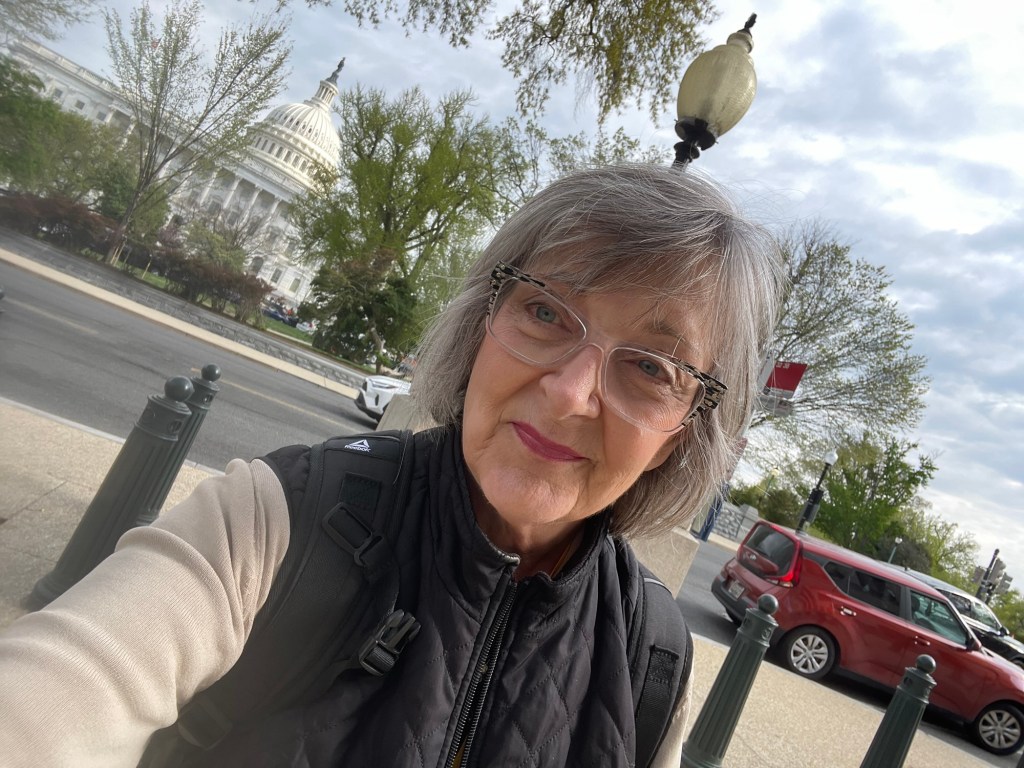
Okay I made it to DC. Up at 4. Nashville. Atlanta. One hour to get a coffeee at the airport. Second leg of flight sat by the baby. I always chose the baby. After all I am a grandma. Her daddy is a lobbyist. That was convenient. Got a grumpy flight attendant who told me he did not have time for me. I was rescued by the man across the aisle. I try to stay invisible when I fly. I don’t want to be the person that the crew talks about later…”there was that one woman…”. Rescue stranger also has vitiligo so we engaged in a brief exchange while unloading the plane. Reagan in its usual packed noisy chaotically organized frame of mind. Waiting for our Alabama warrior Terri LaPoint before we head across the bridge. Let’s see what this week holds.

MONDAY APRIL 7

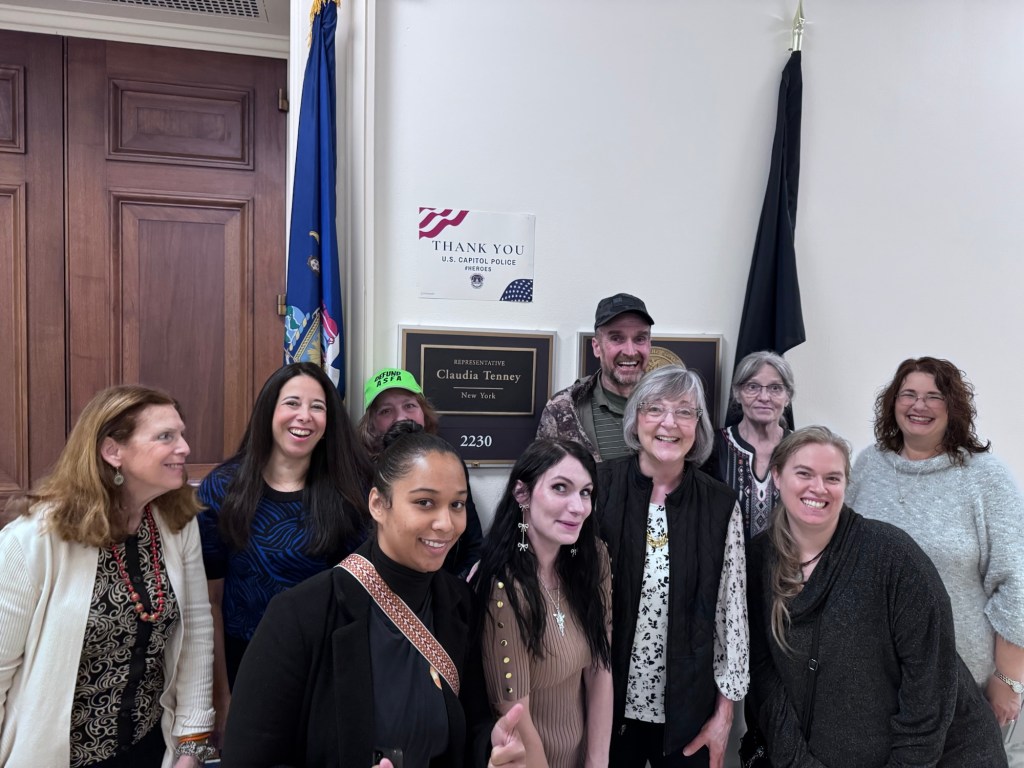
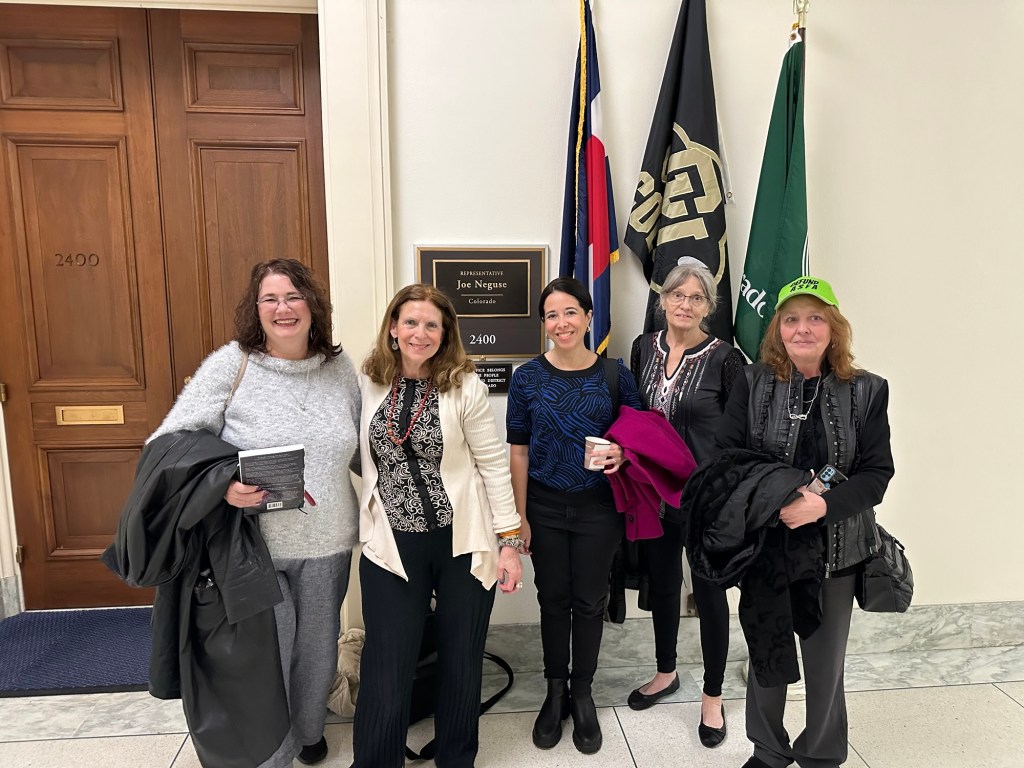
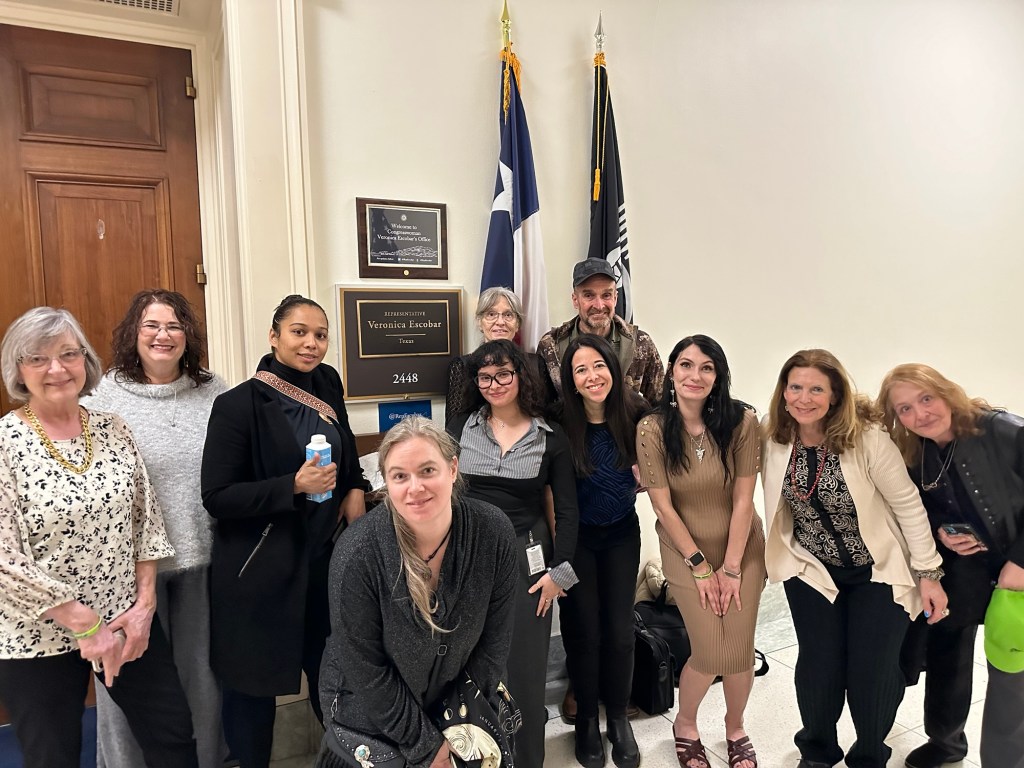
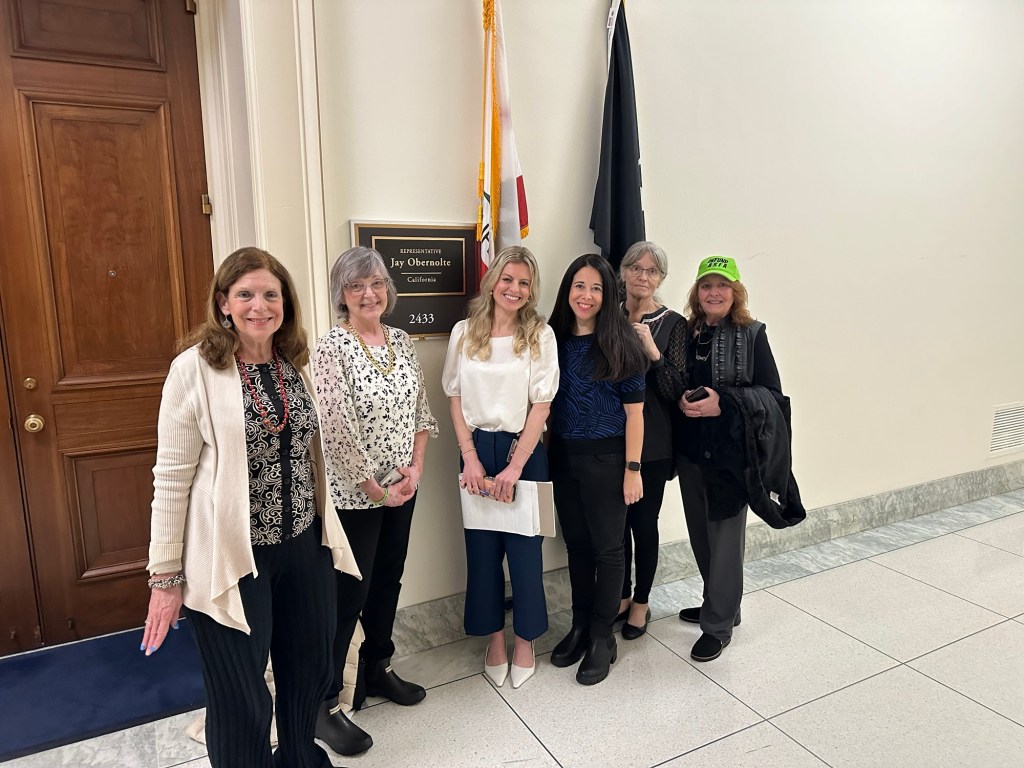
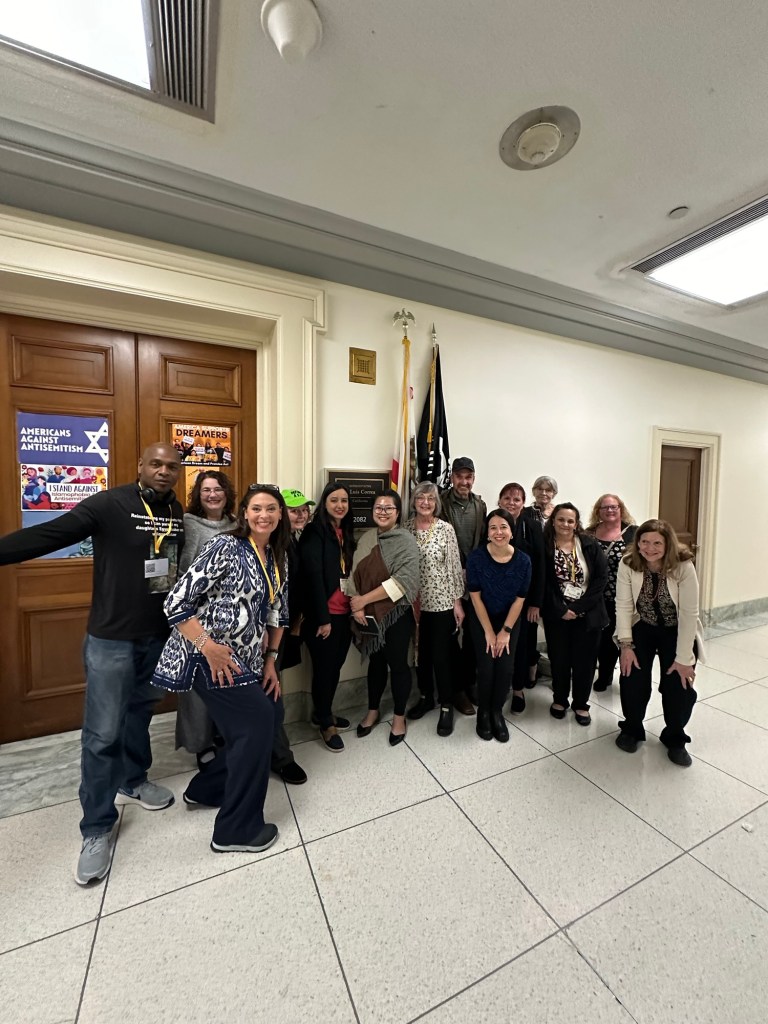
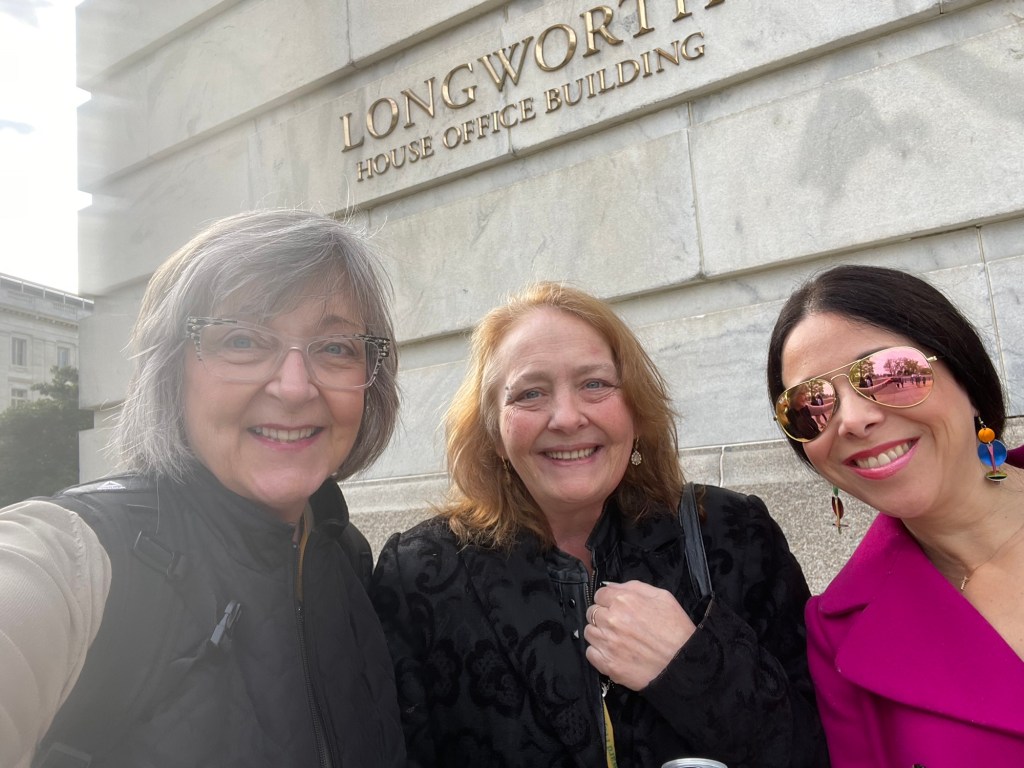
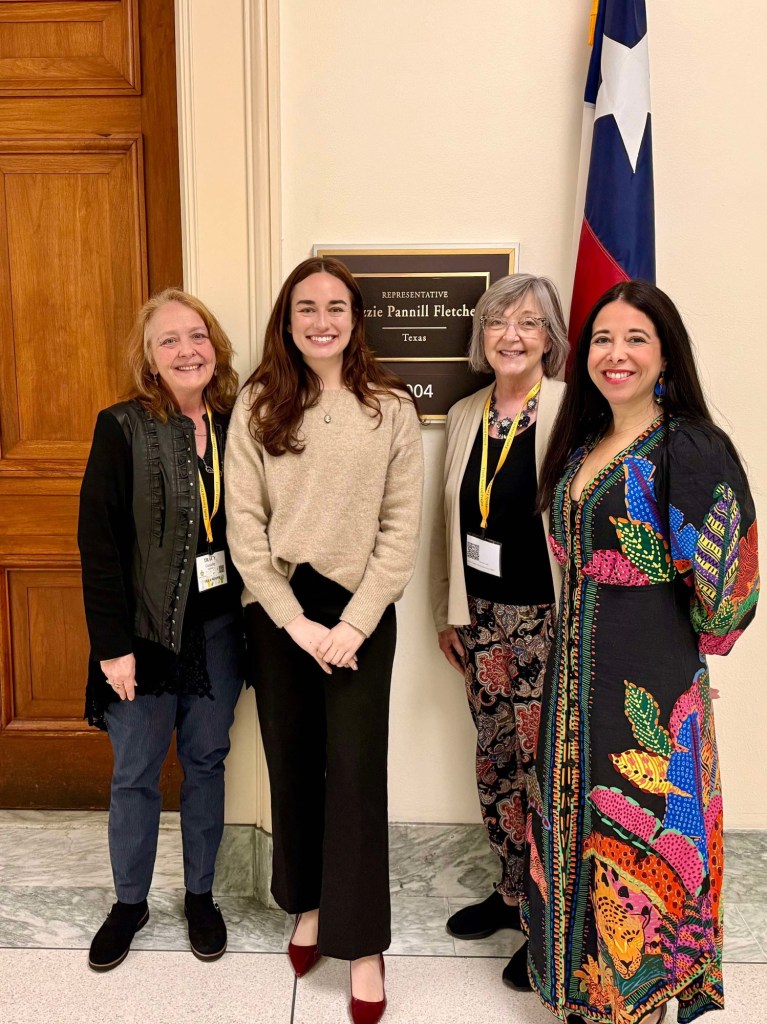
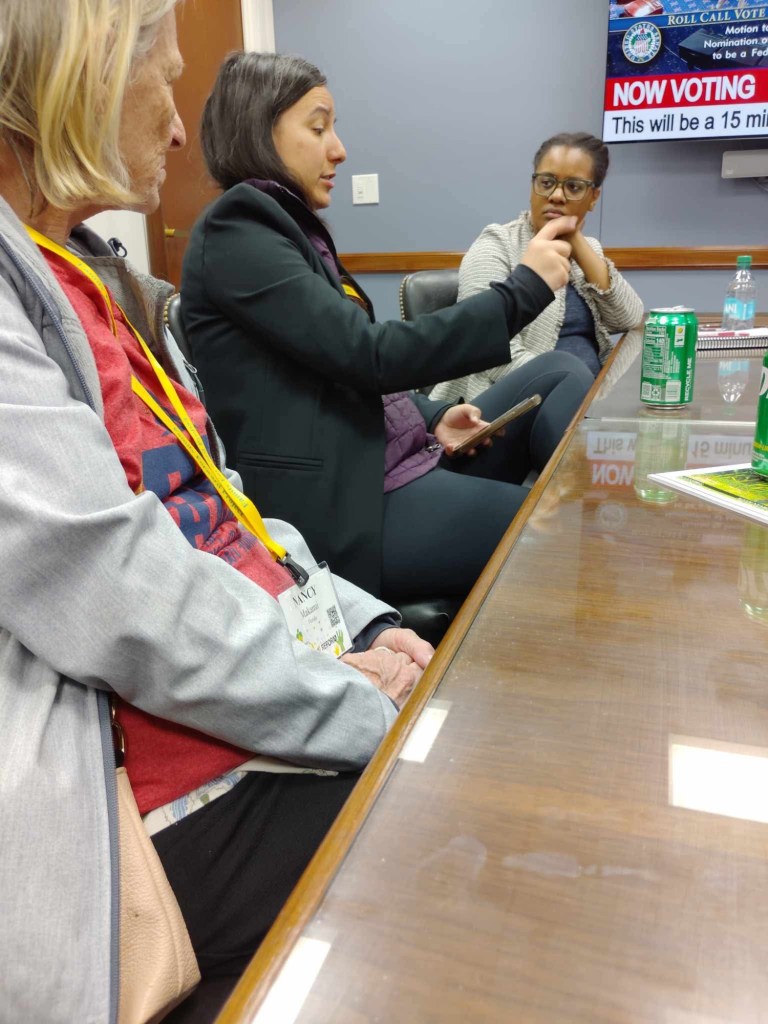
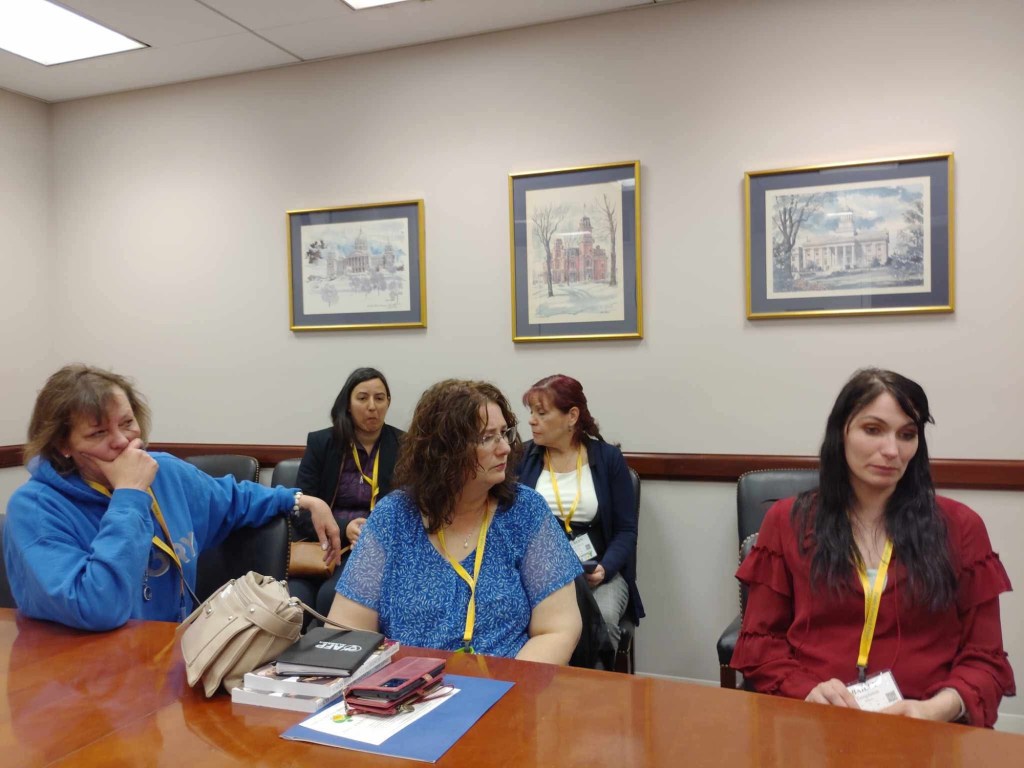
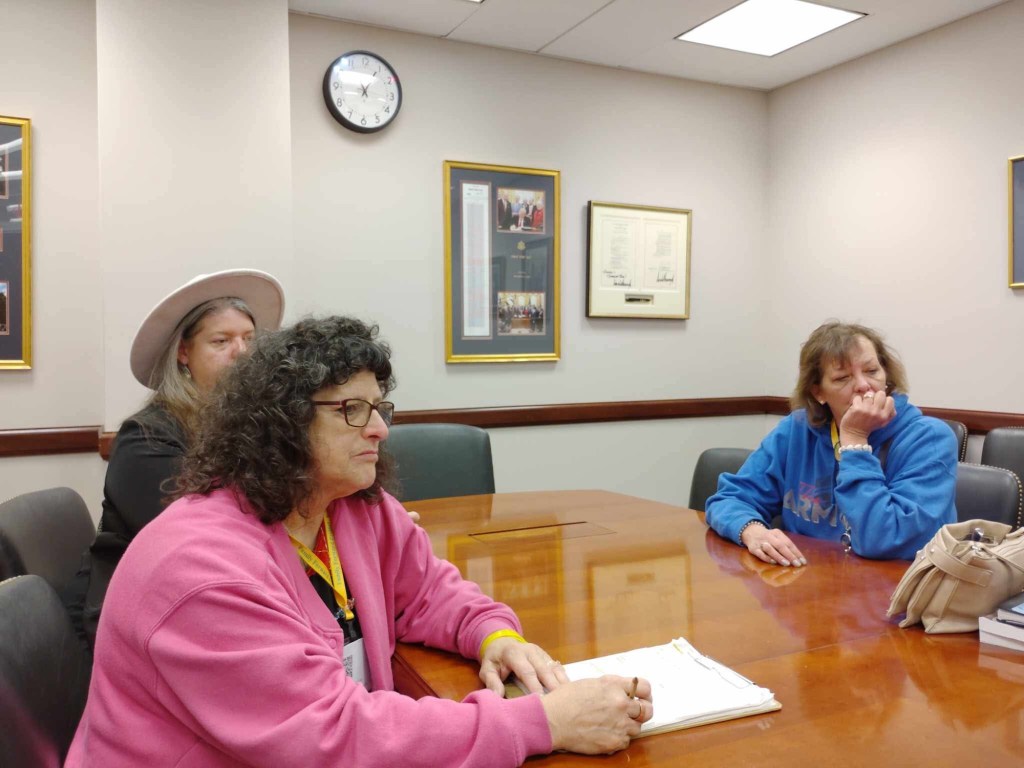
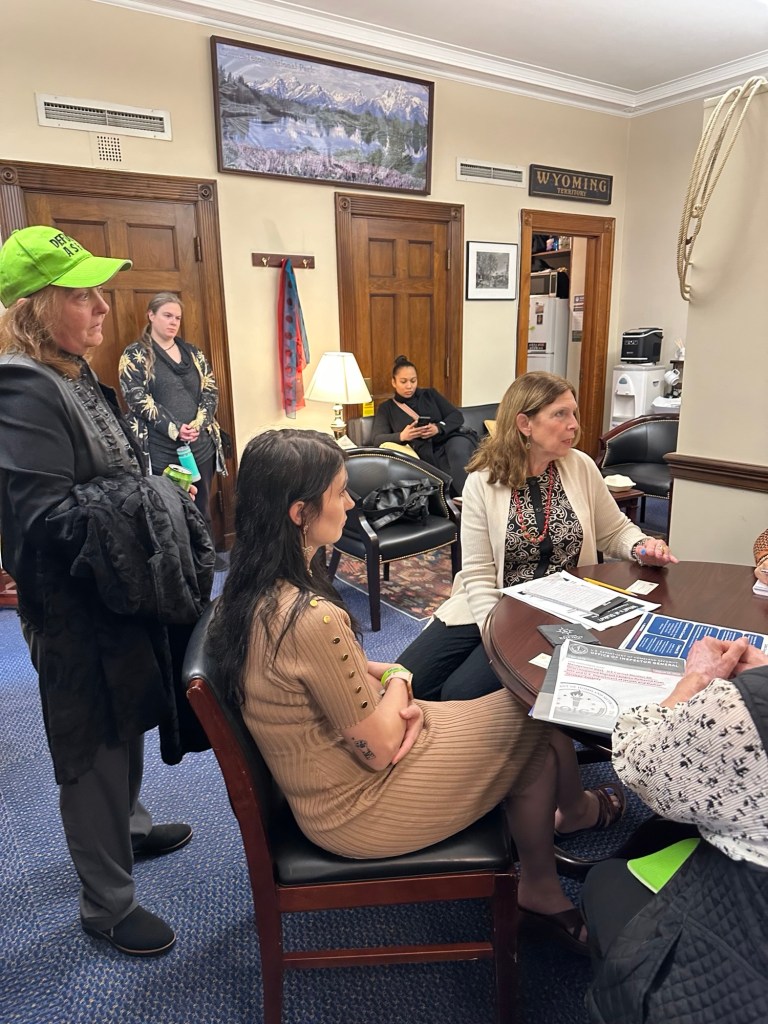
It has been a busy and energetic day. We had eight meetings with both Republicans and Democrats.

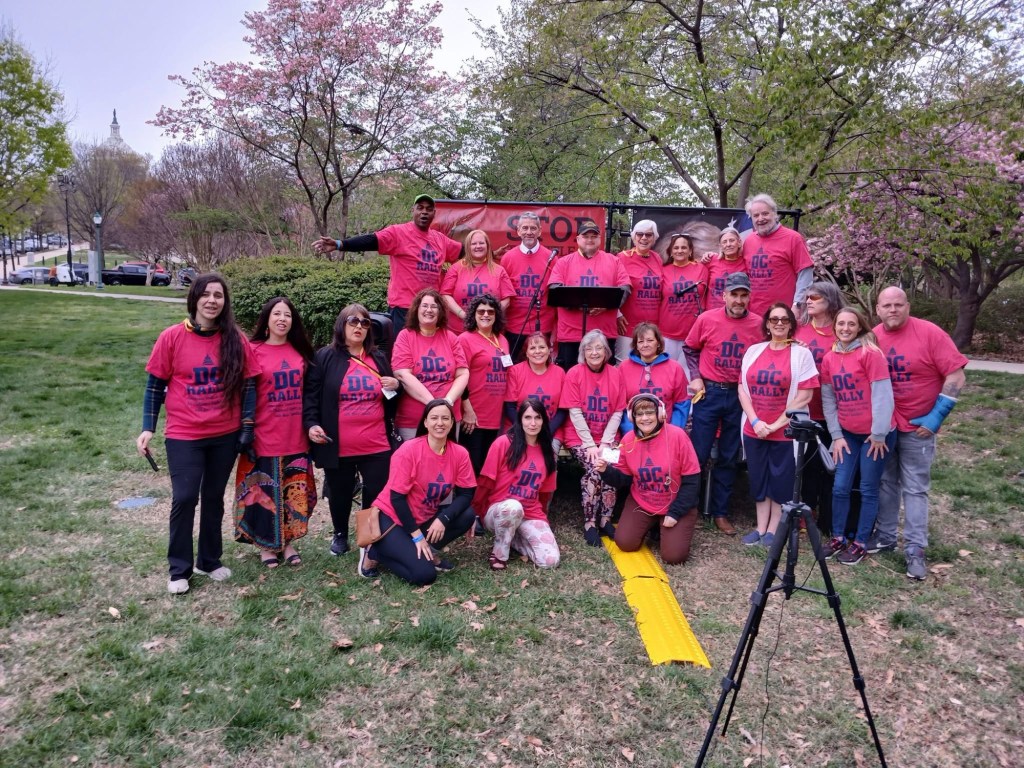
We have families from Family Forward Project from Alabama Illinois Tennessee Alabama Connecticut Florida Washington Texas and Pennsylvania.

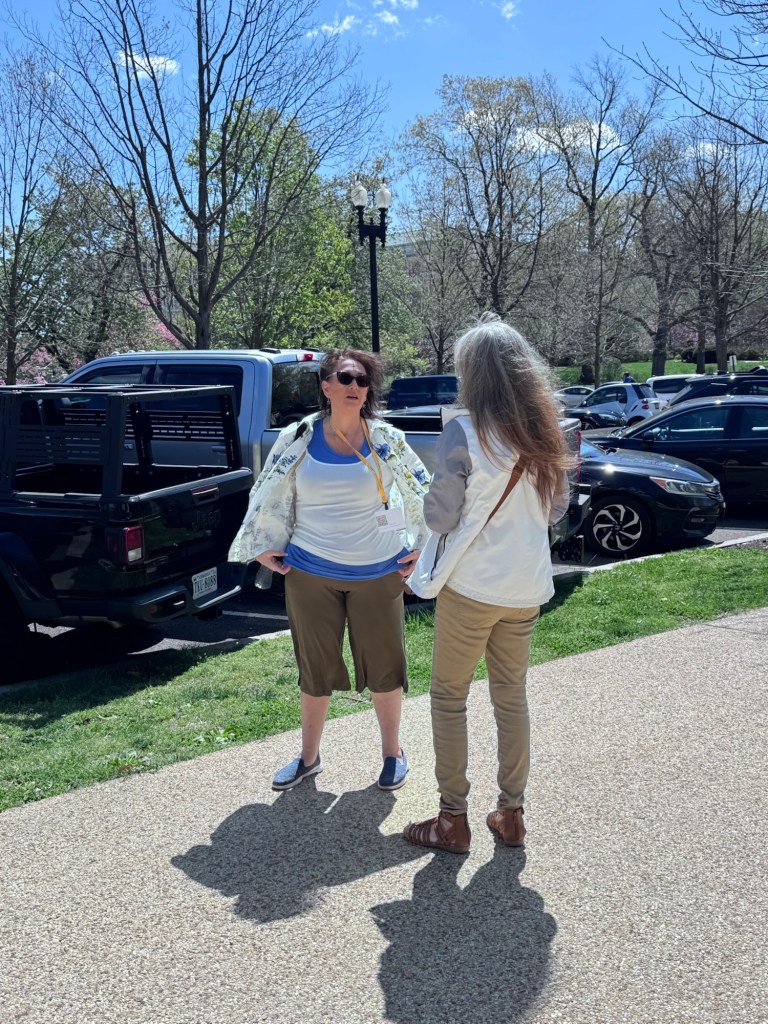
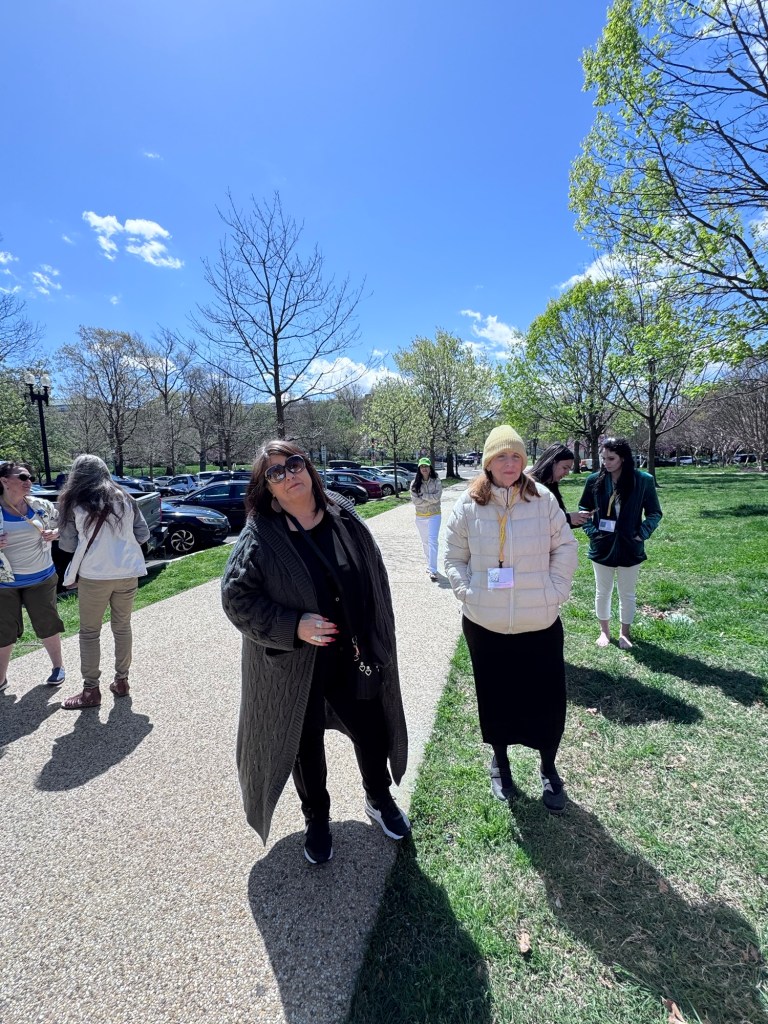
And we need you too. Here are a few of today’s pictures.

We will end the day with dinner and getting by ready for another day.

Tuesday April 9. 2025

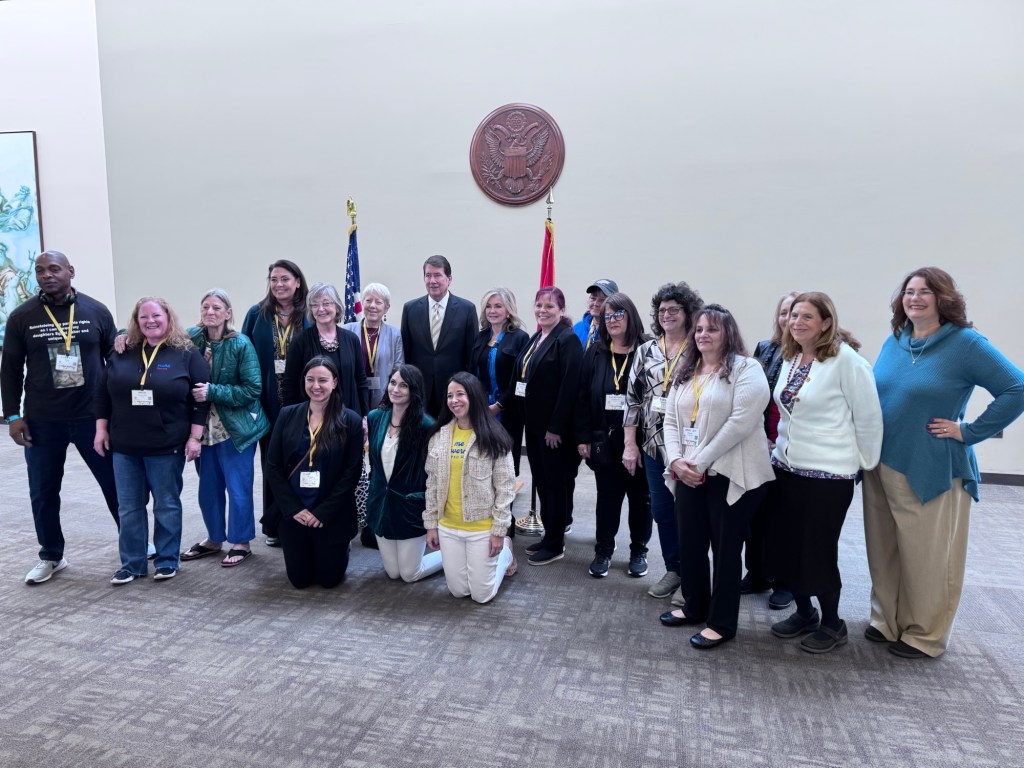
We started at Tennessee Tuesday with Sen Marsha Blackburn and Bill Hagerty with a huge crowd.

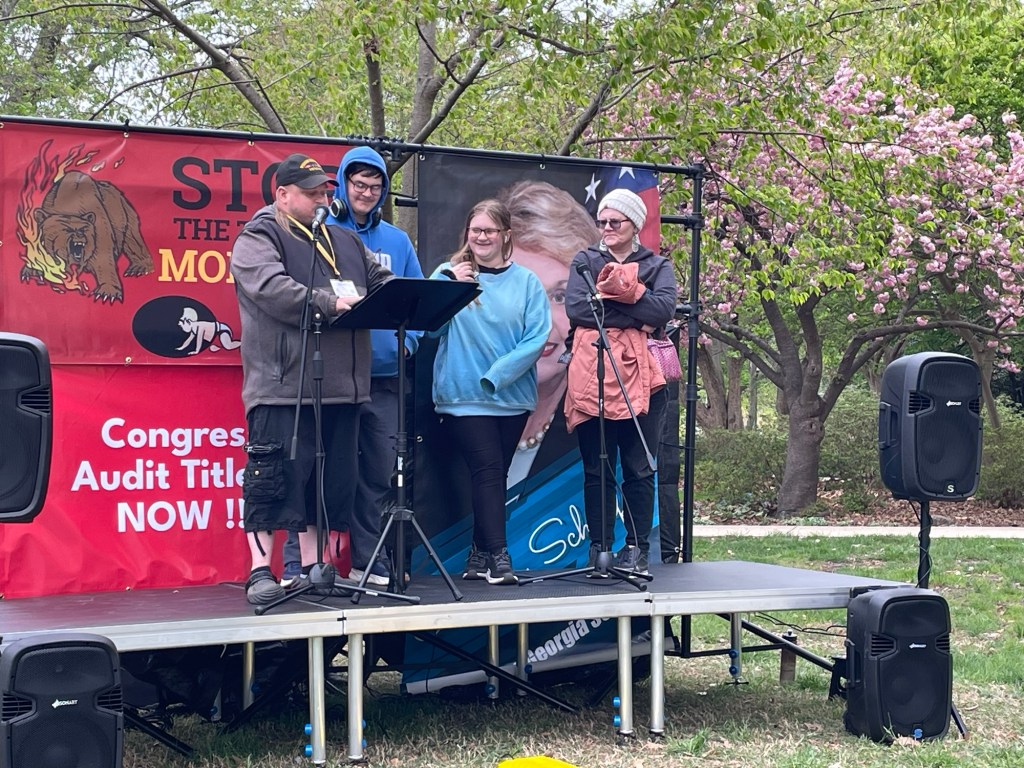
And rallied later in the day.

Evening was fun as well

Wednesday and Thursday April 9 and 10

Time has moved so fast that I forgot to upload the adventure in Wednesday night.

Here are a few examples f the highlights over the last two days

Congressman Mark Messmer – Indiana

Friday April 11 2025

Winding down with a few weeping and casual time at the Anatole Hotel.

And DONE for the week.

CALL TO ACTION FOR TENNESSEE VOTERS

By Connie Reguli, J.D. – April 3, 2025

CALL TO ACTION – TENNESSEE PARENTS

Last year, the Tenn. Gen. Assembly passed the “Parental Rights Bill”.

Connie Reguli, J.D. lobbied against this bill. She argued that parents already had protected parental rights under the 14th Amendment. These rights were confirmed by the United States Supreme Court. Reguli further warned, ‘if you let the state legislators put parental rights in the state code, they can revise them at any time. They can slice away at your rights.’

…AND THEY HAVE. This year Faison (HB 0826) and Haile (SB 0895) filed a new bill changing the parental rights law of 2024.

This bill was filed as a ‘caption bill’ initially. This means the bill was filed with one simple sentence. It asked the courts to report on how many parental rights bills were filed. Then the bill was secretly ‘amended’ to slice away parental rights. The bill added:

1 – A parent can remove a child for religious purposes. If it’s more than 20 days in a school year, the school can force the parent to meet “to discuss the child’s educational future”.

2 – The school no longer needs parental consent to audio record a child. It also doesn’t require consent to video record a child at school or during activities.

3 – A healthcare provider does not need parental consent to examine a child. This is applicable under ‘reasonable suspicion’ of neglect or abuse.

You might not be moved by these new limitations to parental rights. Still, it is just a matter of time. The amendments to this bill will continue to limit the rights of parents. For instance ‘reasonable suspicion’ is not the legal standard under our Fourth Amendment protections, it is exigent circumstances. That means an immediate emergency.

This bill has passed committees and is headed to the floor on April 7th.

Email or call your legislators to vote no.

The bill is here: https://wapp.capitol.tn.gov/apps/BillInfo/Default.aspx…

Find your legislator is here:

https://wapp.capitol.tn.gov/Apps/fml2022/search.aspx

Federal lawsuit over fake felonies will go to trial.

By Connie Reguli

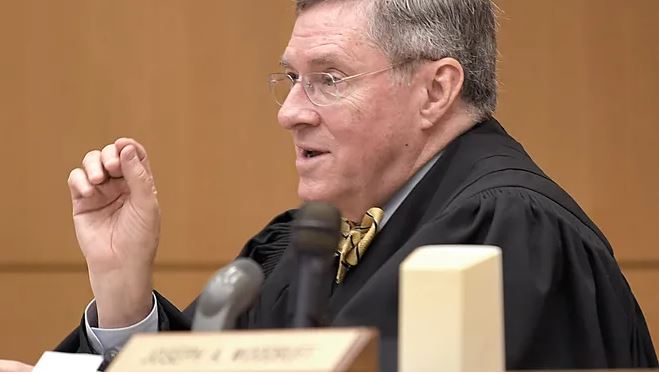
When Connie Reguli turned herself in to the Williamson County Sheriff’s Department in August 2022 on a felony indictment for aggravated perjury, she was already litigation weary. She had already been put through a three day jury trial for accessory to a felony, a sentencing hearing, and a motion for a new trial. The convictions for accessory to a felony were the result of Judge Joseph A. Woodruff manipulating the jury instructions, removing an essential element of the crime, and causing a fake conviction. Although Reguli (and most likely Judge Woodruff) knew that the fake felonies would not stand scrutiny on review, she instantly lost her law license, her entire business model law practice, three employees, dozens of clients, and a juvenile Court judicial election. Nevertheless, she was never required to serve a sentence of incarceration or probation.

Just days after the motion for a new trial in August 2022, Reguli was called by her attorney and told that Williamson County DA Kim Helper had a new indictment on her for aggravated perjury.

The new felony echoed from the chambers of Judge Joseph A. Woodruff as well. While Reguli was in the midst of the first round of fake felonies, Woodruff was shutting Reguli down from obtaining her public records request in another courtroom. After this hearing concluded, Woodruff fined Reguli $5,000 and shut down her request for records. Woodruff would then order that Reguli was prohibited from filing anything pro se without hiring another attorney, and threatened Reguli not to file an appeal. Reguli appealed.

Judge Joseph A. Woodruff, Franklin, TN

What Reguli did not know is that Woodruff initiated his own little private investigation just days after that hearing, sending a private letter to CASA director Emily Layton and Attorney Dana McLendon stating that he was attempting to determine if Reguli made a false statement in the courtroom and asked Layton to respond if Reguli had paid an eight-year-old sanction. Reguli knew none of this, Judge Woodruff’s secret investigation would result in the indictment for aggravated perjury in August 2022.

Reguli represented herself in that case. Although the battleground for justice includes alot more detail and demonstrates a very focused Reguli, the result was that the district attorney dropped the case ten months later.

The case against Reguli had been brought on a false affidavit and withholding exculpatory evidence by CASA director Layton and Attorney McLendon.

EMILY LAYTON – CASA DIRECTOR

Reguli filed a lawsuit against all of the bad actors: Judge Joseph A. Woodruff, DA Kim Helper, DA John Stevens, Atty Dana McLendon, Emily Layton, and CASA. She alleged civil rights violations for malicious prosecution and fabricated evidence and stated claims for abuse of process, intentional infliction of emotional distress, and civil conspiracy.

McLendon’s social media post.

In the typical course of events in federal litigation, all defendants filed motions to dismiss the case. On March 28, 2025, Middle District Judge Traugher entered an order. This order gave Judge Woodruff, DA Helper, and DA Stephens immunity on civil rights claims. The district court permitted the civil rights claims to continue on McLendon and Layton. Afterall, they conspired with state actor Woodruff to conjure up the fake crimes.

In 2024, Reguli’s first round of fake felonies were reversed, and Woodruff’s $5,000 fine against Reguli was also vacated.  

This chart shows the claims that will move ahead in the United States District Court.

We will keep you updated on the progress.

Adopted and DEAD…

Shared from Facebook

By DA Russell Johnson

Brother and Sister Laid to Rest in Graveside Service on Sunday – Brothers, family and friends and others attend with many people to thanks for their role in the service.

On Sunday afternoon, two sweet children – a boy and a girl – were laid to rest in a graveside service attended by their two surviving brothers. These children, the two that are deceased and the two that are surviving, are part of at least five children who were adopted by an evil woman and her husband for the financial benefit they received from the State for adopting them.

The two surviving brothers are now, thankfully, in the care of a wonderful, loving, and caring adoptive mother. The mother’s family members and their friends give the two brothers love that their deceased brother and sister certainly never received.

Early in their lives five children were allowed by the State to be placed ‘in the care’ of a Mr. and Mrs. Gray where the children were forced to endure horrendous circumstances of starvation and torturous confinement.

The two children who were laid to rest Sunday, obviously did not survive these conditions.

Thankfully, during Covid, an alert Roane County Sheriff’s Office deputy was able to recognize a child in need and discovered the house where he and his brother were being confined in makeshift ‘cages’ in the basement. An older sister lived upstairs. As a result of this discovery and further investigation, two bodies were discovered, one buried in the barn behind this house in Roane County and then one in a backyard behind a house in Knox County.

The three surviving children were ‘saved’, and the road to their ‘recovery’ began.

Long story shortened, the biggest hurdle was overcome in May 2024 with the final conviction of both Grays, the ‘adoptive parents’, on life without parole sentences in Roane Couty and additional life sentences in Knox County on top of the Roane County Life Without Parole sentences. The revelations of the shortfalls in the system of adoption, state ‘assistance’ for adopting, and parental responsibility for accountability and reporting, all came into sharp focus as a result of this prosecution and received attention and scrutiny in the state legislation which brought about changes in the law and the system with the Department of Children’s Services.

What is hopefully the final chapter was the closure that was brought about at the graveside on Sunday with the peaceful service that laid to rest two souls that never had peace here on Earth.

This would not have been possible without the generous, volunteer spirit of so many people, so I would like to publicly thank these folks in this manner:

When we concluded the case convicting the two co-defendants, I immediately turned to some friends for help to do something for the remains of the deceased victims. Without hesitation the three ‘angels’ that are to me, The McGill Sisters, came to help. They are Rene’ McGill Shultz, Rebecca McGill Willis and Amy McGill Millsaps, who follow in the community service tradition of their deceased father, Terry McGill. They operate McGill Click Funerals and Cremations in Loudon, and they own Loudon County Memorial Gardens. They are responsible for volunteering their time, their services, and their money to bring to fruition the wonderful service that was held on Sunday. Three of their associates are: Beth Brakebill who sang and led the attendees in singing, as well as Rev. Brian Courtney who participated in the service and Roberto Catota who assisted with the procession and graveside. Loudon Police Department and Loudon County Sheriff’s Office, TN. both provided the escort from McGill-Click Funeral Home to Loudon County Memorial Gardens.

The McGill sisters also donated the plot in a special “Angels” section of their cemetery and partnered with Matthews International, who provided the casket for both sets of cremains. Both the McGill Sisters and Matthews International covered the cost of the memorial plague. Lee-Heights Monument provided the service of opening and closing of the grave. Simerly Vault Company donated the vault. West End Florist in Loudon donated floral arrangements.

So many people contributed to making this day special by attending, including Dr. Darinka Milusenic, Chief Medical Examiner of the Knox County Regional Forensic Center, and her staff, along with anthropologist Dr. Murry Marks. Their work upon the discovery of the bodies of the two children and their expert analysis was instrumental in providing evidence to prosecute the criminal case.

The Kids First Child Advocacy Center of the 9th Judicial District of Tennessee in Lenoir City provided forensic interviews of the surviving children during the initial investigation, and the CAC Director Chris Evans-Longmire and staff were present at the service.

Charme Allen, District Attorney General – Knoxville, TN was present as well, and her office coordinated with our office with both of us prosecuting the two cases in our respective counties.

Members of our office were present at the service including the prosecution team for this case: Assistant District Attorneys Bob Edwards, Jonathan Edwards, Jason Collver and Kristin Curtis, along with Victim/Witness Coordinator Tami Bailey. ADA Jonathan Edwards spoke on behalf of both the Knox County office and our office about the courage of both boys and their victim impact statements at the sentencing hearing last year.

It was a blessed day for closure. Rest in Peace, children.

  • Russell Johnson, 9th District Attorney General (Loudon, Roane, Morgan & Meigs)

EPILOGUE

by Connie Reguli.

This is not the first time “adoption gone wrong story” in Tennessee. Another family in Knox County adopted children that they buried in the back yard.

The story has one thing right for sure that should be an alarm and call for the complete overhaul of child welfare. They did is for money. Yes the adoptive parents took in five kids and would receive a monthly stipend check every month even after the adoption is final. This money comes from the federal funds which is of course still tax payer money.

Gods rest their souls and help me share this tragedy.

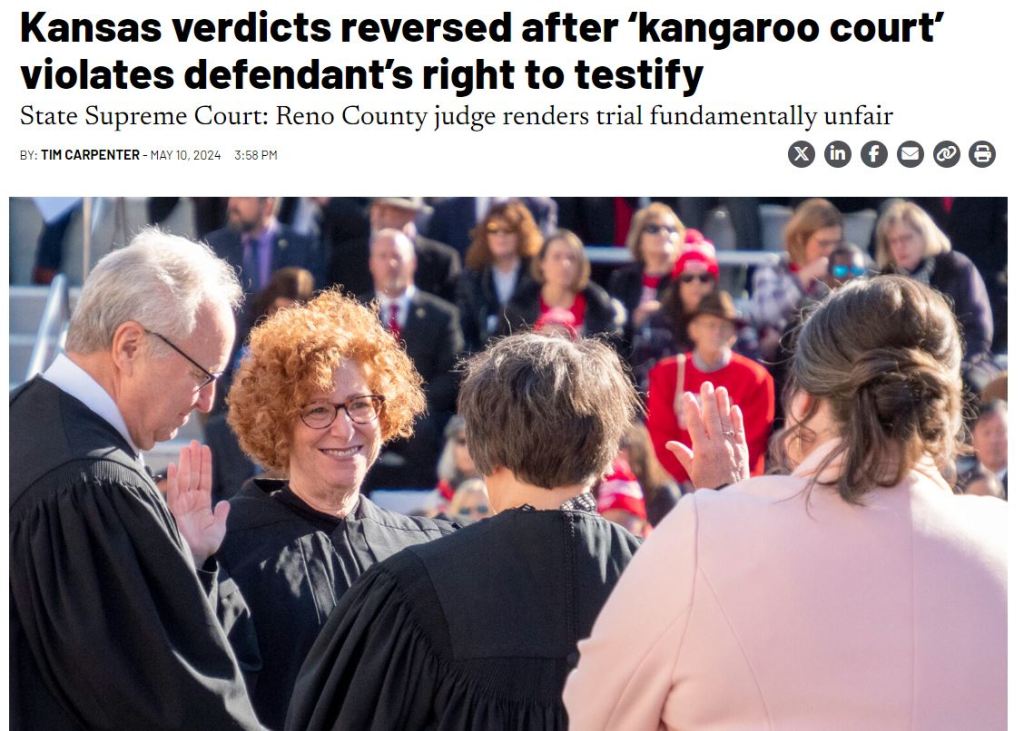
The Right to Defend Oneself in Court. Kansas Sup. Ct. calls out the kangaroo court for what it is. And why is matters.

By Connie Reguli, J.D.

As a family law attorney defending parents against over aggressive state agencies for three decades, I have always worked with parents on how to defend themselves in court. These days, parents contact me from all over the country and say that their court-appointed attorneys are not preparing them for court and are not even allowing them to speak in the courtroom. Parents, sadly, do not have all of the constitutional protections that are provided to criminals, like Miranda rights and the right to confront their accuser, however, the ability to speak and be heard in dependency cases is precious and paramount to winning for parents.

On May 10, 2024, the Kansas Supreme Court released an opinion in the criminal case of State of Kansas v. John R. Cantu which found that the trial court judge had denied the constitutional rights of criminal defendant Cantu by removing him from the witness stand and striking his testimony. Cantu’s convictions were reversed.

This case is worth the read, and begins like this:

Cantu was convicted by the jury and sentenced to 24 months in prison. Thankfully, Cantu and a brave attorney filed on appeal raising the issue that “the court’s decision to strike his entire testimony from the record deprived him of his constitutional right to testify, which was structural error requiring automatic reversal.”

The Cantu opinion explains the right to testify and provides a history of precedential opinions:

The right to testify on one’s own behalf at a criminal trial is a fundamental right grounded in multiple provisions of the United States Constitution. Rock v. Arkansas, 483 U.S. 44, 49-55, 107 S. Ct. 2704, 97 L. Ed. 2d 37 (1987); Ferguson v. Georgia, 365 U.S. 570, 582, 81 S. Ct. 756, 5 L. Ed. 2d 783 (1961). In Rock v. Arkansas, the United States Supreme Court found this right is guaranteed by the Due Process Clause of the Fourteenth Amendment and the Compulsory Process Clause of the Sixth Amendment, and necessarily implied by the Fifth Amendment privilege against self-incrimination. 483 U.S. at 51-53. These constitutional provisions apply to state proceedings through the Fourteenth Amendment. See Washington v. Texas, 388 U.S. 14, 17-19, 87 S. Ct. 1920, 18 L. Ed. 2d 1019 (1967) (incorporating the Sixth Amendment Compulsory Process Clause); Malloy v. Hogan, 378 U.S. 1, 6, 84 S. Ct. 1489, 12 L. Ed. 2d 653 (1964) (incorporating the Fifth Amendment’s protection against compelled self-incrimination).

At its most basic level, the right to testify allows a defendant to respond directly to the State’s charges by “present[ing] his own version of events in his own words.” Rock, 483 U.S. at 52. Thus, the Court has identified the right to testify as one in a bundle of minimum due process rights guaranteed by the Fourteenth Amendment that are essential to a fair trial. Rock, 483 U.S. at 51 (listing a criminal defendant’s basic due process rights at trial as including, at a minimum, the right to confront witnesses, to offer testimony, and to be represented by counsel) (quoting In re Oliver, 333 U.S. 257, 273, 68 S. Ct. 499, 92 L. Ed. 682 [1948]).

The Court has also found the right to testify derives from the Sixth Amendment’s Compulsory Process Clause, which grants a defendant the right to call favorable, material witnesses. Rock, 483 U.S. at 52 (noting “the most important witness for the defense in many criminal cases is the defendant himself”). In this way, the Court recognized the right to testify is part of the broader personal right to present a defense, designating it as even more fundamental than the right of self-representation. 483 U.S. at 52 (citing Faretta v. California, 422 U.S. 806, 819, 95 S. Ct. 2525, 45 L. Ed. 2d 562 [1975]).

Finally, the Court has interpreted the Fifth Amendment’s privilege against self-incrimination as implying an affirmative right to testify. Rock, 483 U.S. at 52-53 (“’Every criminal defendant is privileged to testify in his own defense, or to refuse to do so.’”) (quoting Harris v. New York, 401 U.S. 222, 230, 91 S. Ct. 643, 28 L. Ed. 2d 1 [1971]).

FOR CANTU, THIS WAS NOT A HARMLESS ERROR.

The appellate court held that denying the right to testify was a constitutional error, but it was harmless. The Kansas Supreme Court said that “structural errors” occur where the error at issue compromised the fundamental fairness of the trial mechanism, both from the perspective of the court’s function and the defendant’s right to due process. In this case, the judge’s decision to remove Cantu from the witness stand and strike his entire testimony was a structural and reversible error.

The Court largely relied on the analysis provided by the United States Supreme Court in Illinois v. Allen, 397 U.S. 337, 343 (1970) which permitted the removal of the defendant from the courtroom for disruptive behavior, but cautioned that even “once lost, the right to be present can, of course, be reclaimed as soon as the defendant is willing to conduct himself consistently with the decorum and respect inherent in the concept of courts and judicial proceedings.” The Cantu opinion concluded that courts are to ‘indulge every reasonable presumption against the loss of a defendant’s constitutional rights.” Citing Allen.

WHY IT MATTERS

This case provides a detailed analysis of the constitutional right to testify in order to defend oneself, however, there is an element of the jury trial process that is ignored in this opinion. That is the effect on the jury of the judge’s arrogant and corporal treatment of the defendant in the courtroom. The jury enters into the criminal justice process believing that it will be fair and honest and that the judge is the person in the room with the greatest intelligence, the most deference to the constitutional rights of the defendant, and the most empowered by the people. In many ways this is incorrect and often the judges are NOT the most intelligent in the room, however that is not the point today. When the jury experiences a judge criticizing a witness or defendant in the courtroom, it makes a distinct negative psychological impact on their impression of the person testifying. Judges know this. You can see it in your observations of them. I have seen it myself.

Cantu is important and the ruling here should race across the country to apply to criminal and dependency cases. After all, dependency cases are quasi-criminal and each parent is facing allegations that are also defined in the criminal code. The results are similar. While a criminal court can take away your freedom, a dependency court can separate you from your children forever, remove their lineage, and take away their birth name. Both are devastating.

Connie Reguli, J.D. worked with families for three decades in Tennessee until falsely charged with a fake crime invented by a corrupt judge and district attorney. Those charges were reversed and a civil rights lawsuit has been filed. Reguli et al, v. Hetzel, et al, Case No. 3:24-cv-00541. Follow on Facebook, YouTube, TikTok, LinkedIn, and Instagram for more. Facebook. Connie Reguli and Family Forward Project.

LAWSUIT TURNS THE TABLES ON THE TAX-PAID OFFICIALS WHO MADE UP A CRIME TO SILENCE JUDICIAL CANDIDATE

May 2, 2024

Connie Reguli, J.D.

A lawsuit filed in the Tennessee Middle District Court on May 1, 2024, is an “I told you so” from Williamson County 2022 judicial candidate Connie Reguli.  The Complaint details how the criminal justice system in Williamson County, Tennessee was manipulated to create a fake crime to interfere with the local election.  Reguli’s felony convictions from April 20, 2022 were reversed in the Court of Appeals on March 4, 2024. This civil rights lawsuit exposes the coordinated efforts of judges, district attorneys, police officials, and children’s services to shut down their biggest challenger.

In the spring of 2022, the Williamson County primary elections were gaining public interest when the news exploded with the felony conviction of the juvenile court judicial candidate who was opposing the incumbent, Sharon Guffee.  On April 20, 2022, local attorney Connie Reguli was convicted of accessory after the fact of felony custodial interference when she allegedly interfered with the Department of Children’s Services efforts to take her client’s child in Dekalb County.  Reguli wasn’t a novice at wrangling against the department, for 28 years she had been defending parents against an overaggressive government agency all across the State of Tennessee.  

News ran wild about Reguli’s conviction which just happened to completely coincide with the early voting schedule and was just two weeks before the county primary.  The local Williamson Herald, the Tennessean, and investigative reporter Jeremy Finley with WSMV rushed to publish stories about the conviction and the resulting automatic suspension of Reguli’s law license.  When Reguli was interviewed by Tennessee Conservative News, she told them it was a ‘fake felony’ and that Judge Joseph A. Woodruff and District Attorney Kimberly Helper had manipulated the language in the Tennessee written law to remove an essential element of the crime which was the only way they could create this bogus crime.  She said it was all done to shut her up, interfere with the election, and allow Williamson County to proceed with its two hundred and eighty-one million dollars juvenile ‘kiddie’ jail without being questioned by the public.  

Reguli’s campaign hammered incumbent juvenile court Judge Sharon Guffee in print and emails, including Guffee’s decisions to put children in solitary confinement and suggestions that video evidence from her juvenile detention center was concealed.  Reguli relentlessly outed the new ‘kiddie jail’ which was to be funded, in part, by private equity and include forty-eight mental health beds. Reguli said, “I guarantee you this, if private equity is involved, the county must make a profit on the heads of children.”  Shutting down Reguli’s campaign was a must.

Kimberly Helper and Mary Katherine Evins

This civil rights lawsuit names Connie Reguli and her client, Wendy Hancock, as plaintiffs.  The defendant line-up includes District Attorneys Kimberly Helper and Mary Katherine Evins, Brentwood Police Department’s Lori Russ and David O’Neil, and a state attorney employed in the Department of Children’s Services, Tracy Hetzel.  The complaint alleges that the investigation was initiated in October 2018 by Hetzel who had just managed to get a secret court order to remove the 12-year-old daughter of Reguli’s client, Ms. Hancock.  Hetzel met with Russ, O’Neil, and Evins in October 2018.  Three of the four government employees in that meeting were lawyers.  That was when they cooked up a plan to prosecute Reguli and her client, Hancock, by scratching out an essential element of the crime of custodial interference.  Russ used this fake investigation to obtain a secret search warrant on Reguli’s social media Facebook along with all of her private messages, IP addresses, emails, and deleted content.  

In June 2019, after fighting with DCS for ten months, Ms. Hancock’s daughter was brought home and dropped off at the doorstep.  A month later, Reguli and Hancock were arrested on the secret indictment for custodial interference and accessory to a felony.  Only it was not a crime. It was never a crime.  Nevertheless, Helper, Evins, Russ, O’Neil, and Hetzel all continued to feed into the judicial system a false narrative that Reguli and Hancock were felons.  Two full-blown jury trials took place eating up hours of valuable court time and state-funded services.  The entire Dekalb County Clerk’s staff, District Attorney Kim Helper, Judge Joseph A. Woodruff and his staff, drug task force prosecutor Sean Duddy, and DCS deputy general counsel Sophia Crawford all came to watch the trial.  Thousands of tax dollars were sunk into this pit of a fake felony all to silence Reguli. 

Judge Joseph A. Woodruff

The Complaint describes how Reguli had been an activist as well as a lawyer for years, seeking reform of the Tennessee judicial system and the Department of Children’s Services for years.  Reguli appeared in public forums, lobbied legislators, and engaged others in telling their stories about abuses in the court system.  Her criticism of DCS and the local district attorney’s office may have gotten under their proverbial government-official-thin-skin because when they had the opportunity to arrest and charge Reguli with a crime, albeit a fake crime, they jumped right in.  

The Complaint also describes the tactics used by these government employees as psychological weapons, including triangulation, gaslighting, passive aggressive, scapegoating, projection, lying, sabotage, and isolation, explaining how this perverted attack on Reguli and Hancock was intended to weaken them physically and psychologically.  The Complaint asks for a jury trial and $520 million in damages.   

Connie Reguli is represented by Attorney Larry L. Crain in Brentwood, Tennessee.  Wendy Hancock is represented by Attorney Lorraine Wade in Smyrna, Tennessee.  

Case 3:24-cv-00541 Reguli et al v. Hetzel et al, Middle District Court, Nashville, Tennessee

https://dockets.justia.com/docket/tennessee/tnmdce/3:2024cv00541/99331

ABA publishes resource for parents and family integrity for children

By Connie Reguli

So it’s a mixed topic for today, but we must always be thinking, sharing, educating, and blasting knowledge into cyberspace about the devastating after math of wrongful child removals and the parents’ struggle to survive.

While state legislators are operating under a belief that ‘parents are bad’ and that ‘they would rather see children wrongfully removed from loving parents than miss one abused child’, state laws continue to focus on ‘bad parent’ termination laws, instead of the rights of children to family integrity.

Afterall, termination of parental rights is termination of children’s rights as well. And although children are appointed attorneys to protect the ‘best interest of the child’, these guardian ad litems never, I mean never, protect the substantive due process rights of the children to family integrity which has been recognized by the United States Supreme Court.

One legal scholar (besides me) said this:

Despite this support for the existence of a child’s independent right to family integrity, children rarely assert this right. As a result, children are virtually shut out of legal proceedings that affect their families and stability—usually based on allegations against their parents, not themselves. This may be due in part to the fact that the legal landscape is not clear. But it is also likely due to the confusing role of children’s advocates in civil proceedings and the fact that children in many of these proceedings have no advocate at all. If a parent fails to assert her fundamental right to her children in those proceedings or is unable to do so because of a finding of unfitness, family integrity may never be considered—even though the implications for the child can be devastating. The Supreme Court has noted that “[d]irecting the onus of a parent’s misconduct against his children does not comport with fundamental conceptions of justice.” Yet the Court has not given this observation legal force by overtly recognizing a child’s right to family integrity or clarifying its parameters.

Until children are appointed legal advocates to protect their constitutional rights, we will never have liberty and justice for all.

AMERICAN BAR ASSOCIATION MAKES AN EFFORT TO GIVE PARENTS DIRECTION

In the meantime, I am watching other scholars, organizations, and professionals voice their concern for policing of families and imprisonment of children through fake-foster placement.

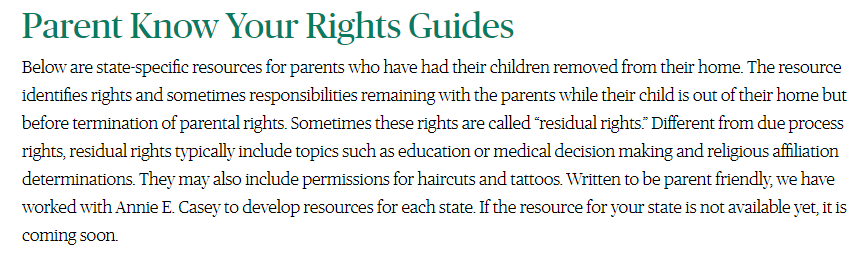
The American Bar Association has finally published state resources for parents in the link found here.

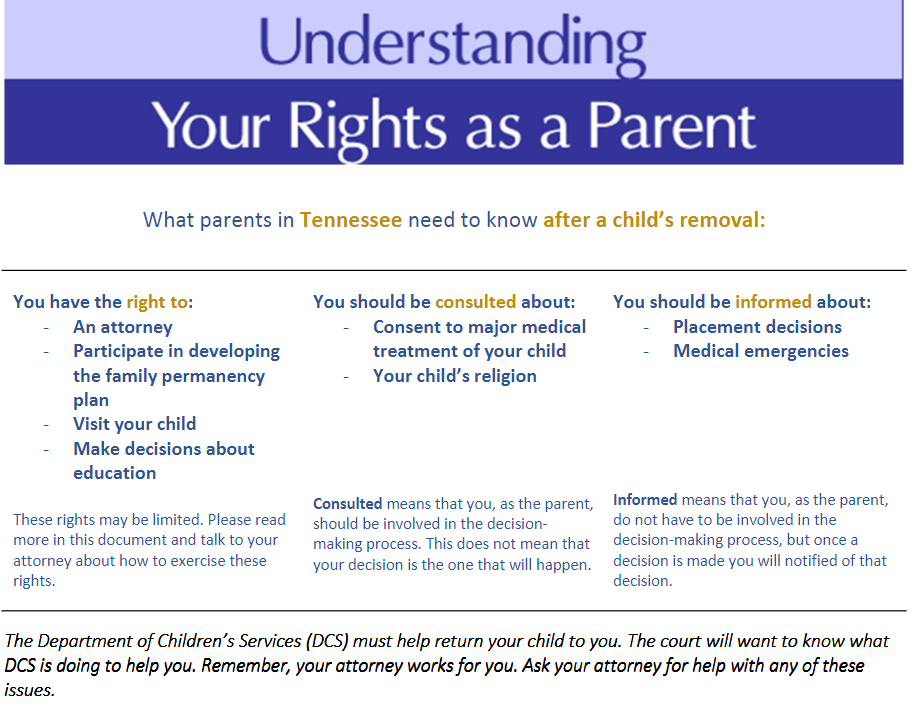
This link will direct you to a list of every state with a link to a summary sheet on the process of child protective services in your state. The ‘one sheet’ analysis is simple and not thorough but will give each parents a chance to be educated in the process before they are caught off guard in court. The Tennessee page looks like this:

This documents will tell you that you have a right to an attorney, to review CPS/DCS records, to attend child and family team meetings, to make medical decision, to make placement recommendations, and to visit your children. HOWEVER, the language at the bottom of this document is clear: A court or judge can limit these rights.

Therein lies the problem. Even though parental ‘unfitness’ requires the high burden of proof of clear and convincing evidence, there is no such elevated burden of proof to remove your rights one by one.

STATE OF ILLINOIS – 2024 LEGISLATION SUGGESTS BETTER PEDIATRIC PRACTICES

In the State of Illinois SB378 is making significant changes which could help redirect child abuse referrals to an ‘assessment’ path instead of an ‘investigative’ path resulting in removal. This could have only happened with the hard efforts of many advocates, including Family Forward Project, who helped to move the Family First Prevention and Services Act of 2018 (now Family First Act) through Congress. This bill allowed for federal funds to assist with services prior to removal, a provision which was ignored under CAPTA (Child abuse prevention and treatment act of 1974) and subsequent legislation which created the perverted funding scheme.

The jury is still out as to how and when this will be fully implemented because Illinois is long suffering in the child welfare department. Over the last three years, its director was held in contempt of court on multiple occasions for failing to account for the incompetence of the department that left children in harm’s way.

I will review this bill closer and follow up. Have a blessed day.


The rights discussed in this document can be limited by the court. This document should not be considered legal advice and is for informational purposes only. For legal
advice talk to your attorney.
© 2018 American Bar Association Center on Children and the Law
Your Responsibilities to the Court and DCS
– Provide all relevant information to DCS.
– Attend all juvenile court hearings and team meetings.
– Cooperate with your DCS case worker. Stay in touch with your worker. Be sure that the worker always
has your current address and telephone number.
– Participate in the services that are offered and work on your child’s permanency plan, including all
activities and services the Court may order you and other family members to complete.
– Provide your DCS case worker with information about your progress towards completing your
responsibilities in your family permanency plan and any changes in your life.
– Visit and communicate with your child as agreed upon.
– Pay child support if ordered by the court.
MoreMoreMoreMore informationinformationinformationinformation ccccan be found:an be found:an be found:an be found:
American Bar Association Center on Children and the Law Parent Representation
http://www.americanbar.org/groups/child_law/what_we_do/projects/parentrepresentation.html
Rise Magazine for Parents http://www.risemagazine.org/
Birth Parent National Network http://bpnn.ctfalliance.org/
1 Tenn. Code Ann. § 37-1-126

https://www.americanbar.org/groups/public_interest/child_law/project-areas/parentrepresentation/parent-know-your-rights-resources

TENNESSEE FAMILY RIGHTS LEGISLATION: IMMEDIATE ACTION NEEDED TO STOP A DANGEROUS AND INCONSISTENT LAW

HB2936 (Amendment #017296) is called the “Families’ Rights and Responsibilities Act” and is being promoted as protecting parental rights, but it fails in many ways and introduces potential harm.

Currently, parents have fundamental rights under the Fourteenth Amendment of the United States Constitution. This bill does NOT codify what already exists, it establishes a platform to continuously trim away parental rights.

Nineteen states have passed legislation that puts the fundamental rights of parents into their state laws. Most of these laws codify parental rights as fundamental (meaning protected by the Fourteenth Amendment).

SEE THE CALL TO ACTION BELOW

HB2936 differs from states providing for fundamental parental rights.

See the FULL BILLTEXT HERE.

Tennessee’s HB 2936 enumerates parental rights and then makes exceptions for other existing statutory law, case law, and court orders, and protects certain government agencies and other entities with carve outs and exemptions. The unintended consequences will do more harm than good.

While the bill looks good on the surface, with this:

“The liberty of a parent to the care, custody, and control of the parent’s child, including the right to direct the upbringing, education, health care, and mental health of the child, is a fundamental right.”

The definition of ‘parent’ should give a first pause as it expands parenthood to include an “individual who has been granted decision-making power over the child”.

THEN language throughout the bill continues to carve away those rights:

Section 1 provides an avenue for future laws to usurp parental rights just by saying so with the language:

“State law enacted after July 1, 2024, is subject to this chapter unless the law explicitly excludes such application by reference to this chapter.”

SECTION 2 creates § 63-1-173(b) and specifically addresses medical care. The section includes:

“Except as otherwise provided by statutory law, case law, or court order.

If existing laws are exempted and all future laws can be exempted from this proposed act, then what exactly does the bill do? Here is our analysis:

  1. Expands the constitutional definition of “parent” by providing that “an individual who has been granted decision-making authority over the child under state law”.
    • This expansion is nowhere in constitutional law. Under United Supreme Court cases, a parent is a legal parent. Period.
    • This puts “parental rights” in the hands of any judge who has taken subject matter jurisdiction over the child, juvenile, divorces, guardianship, truancy, delinquents, and children in state’s custody.
    • Attorneys are appointed to serve as a guardian ad litem for a child in juvenile and some divorce cases. This would allow a judge to give an attorney ‘decision-making’ authority over a child, thus making the attorney the ‘parent’ gaining all ‘parental rights’ listed under § 36-8-103(c), created in SECTION 1 of the bill.
    • This section does not restrict who can grant “decision-making authority”, “under state law”. The vague language would permit a parent to grant decision-making authority, and perhaps a state agency, such as DCS.
  2. Excludes parental rights regarding “Biometric Data” under HIPPA and for all law enforcement purposes, potentially expanding the ability of medical establishments and law enforcement agencies to prohibit access or deny consent to parents. The bill does not require law enforcement or a state agency to make a showing or probable cause of abuse or neglect by the parent. The Fourth Amendment protects persons against unreasonable search and SEIZURE. Obtaining biometric data is a “taking” and constitutionally requires probable cause of a crime.
  3. Fails to detail what process is due when the government claims they are “burdening” a parent’s fundamental rights because of “a compelling governmental interest of the highest order.” United States Supreme Court opinions require a finding that a parent is “unfit” by clear and convincing evidence before burdening or interfering with parental rights.
  4. Fails to include the word “informed” when mentioning “consent.” Especially in medical care, without adequate formation, true consent cannot be granted. Informed consent is a human right. This is the second TN bill this session that is attempting to drop the word “informed” from “informed consent.”
  5. Potentially expands DCS’s authority:
    • To exclude parents from important information regarding their child.
    • To ignore parental fundamental rights during investigations and when children are in their custody, even when the legal parent retains their decision-making rights regarding the child.
  6. Higher Education Exclusion. Parental rights and the legal recourse provisions of this bill do not apply when a parent enrolls their child in higher education before the child is eighteen, such as dual enrollment for high schoolers or when a minor graduates from high school early and starts college at 16 or 17.
    1. This loss of parental rights means a minor child is left navigating an adult environment and the influences of academia alone.
    2. Federal programs such as FERPA and Title X already encroach on parental rights – this bill removes parental rights entirely, leaving the minor functionally emancipated.
  7. Blanket Consent Exclusion.The rights and legal recourse provisions of this bill do not apply when a parent gives blanket consent authorizing a person or entity “to perform an activity listed” in subsection (c), the list of parental rights. Parents commonly sign consent forms for schools, health care facilities, clubs and sport organizations, and more. This legislation would expand and increase the use of contractual blanket consent provisions to avoid lawsuits. Parents will sign these forms without fully understanding the rights they are waiving.
  8. Mature Minor Clarification Act (MMCA) of 2023 Vaccination Consent Concerns
    1. MMCA clarified that federal law mandates and case law upholds that healthcare providers must obtain informed consent from parents prior to vaccination.
    2. The National Childhood Vaccine Injury Act (NCVIA) of 1986 (42 U.S.C. § 300aa-26) removed financial liability from vaccine manufacturers and healthcare providers for injury or death caused by any vaccine recommended by the CDC to children or pregnant women.
    3. Congress mandated that healthcare providers ensure and document that parents receive a current Information Statement (VIS) prior to the administration of every dose of a vaccine to a minor.
    4. There is a conflict of law in this legislation with last year’s Mature Minor Clarification Act (MMCA).  Under the MMCA, a healthcare provider is required to get parental consent prior to administering a vaccine to a minor.  There is no exception.  Under this parental rights legislation, parental rights are forfeited if a child is enrolled in higher education.  Therefore, college medical clinics may vaccinate minors without parental consent.  
  9. “Mistakes” Exclusion. Excludes parental rights and prevents recourse to the civil action portion of the bill when “a government entity or any other person” makes a mistake and accepts the consent of someone “in good faith” who does not actually have the legal the right to consent regarding your child.
  10. Conflicts Within the Bill. The two sections of the bill are in conflict regarding parental medical consent rights.Under the rules of statutory construction, where there is a general law and a more specific law, the more specific law will trump all provisions in the general law, therefore, Section 2 Title 63 regarding a parent’s right to give medical consent will trump Section 1; § 36-8-103(c)(3). There is also a conflict in the relief available in a lawsuit.
    • SECTION 1, § 36-8-103(c)(3) provides that parental rights are preserved for “all physical and mental healthcare decisions for the child and consent to all physical and mental health care on the child’s behalf, as provided in § 63-1-173. This section includes various exceptions, however, it DOES NOT say “Except as otherwise provided by statutory law, case law, or court order”.
    • SECTION 2 Is specifically about the parental right to informed consent regarding medical treatment of their minor child, and it DOES say “Except as otherwise provided by statutory law, case law, or court order.”
    • For children in state’s custody, they will continue to be subjected to laws that allow DCS to make medical decisions, notwithstanding the fact that the parent’s have not lost their parental rights under the language of § 63-1-173 with says, “except as otherwise provided by statutory law, case law, or court order…”
  11. What will litigation look like?
    • Neither section permits a JURY trial, therefore, there is no right to a jury trial since the constitution only provides for jury trial for suits in common law.
    • Neither section specifically permits punitive damages.
    • § 36-1-103(f)(2) in SECTION 1 permits declaratory relief and injunctive relief (restraining order) along with monetary damages. § 63-1-173(f) in SECTION 2 does not provide for declaratory relief or injunctive relief.
    • Damages: Although this section provides for compensatory damages (pain and suffering), it does not provide for punitive damages. There is no standard for what pain and suffering damages should be allowed. These cases will be ruled on by local judges who are unlikely to award substantial damages for pain and suffering.
    • Attorney’s fees: These cases will be lucrative for predatory law firms.
    • Vicarious liability/government: Most assume that the target of this legislation will be the individual who committed the violation against parental rights. The bill is silent as to whether or not the employer (school, county, state, etc) will have vicarious liability for the acts of the individual. There is no vicarious liability in civil rights cases and there are limitations for local governments (county/city) for liability for negligent acts of employees in the Government Tort Liability Act TCA 29-20-101 et seq. Generally INTENTIONAL TORTS do not trigger government entity liability, such as malicious prosecution.
    • Vicarious liability/medical-mental health providers: Generally, the employers are liable for the negligent acts of their employees under the theory of respondeat superior or vicarious liability. However, an entity may not be liable for intentional torts or if there is a determination that the act was not within their scope of duty.
    • Who Pays: Even if compensatory (pain and suffering) damages and attorney’s fees are awarded, who is going to pay?
    • This bill does not directly extend liability to the entity, whether the government tort liability limitation would apply remains a question.
  12. FISCAL NOTE: The fiscal note in this bill says that current state resources are sufficient for implementation of this act.
    • The fiscal note DOES NOT consider the damages and attorney fees that a could be assessed against state and county governments, i.e., the taxpayers.

Until these issues have been fully resolved to the benefit of the citizens of this state, this bill should not become law.

*State law cannot preempt requirements of The National Childhood Vaccine Injury Act of 1986 (42 U.S.C. § 300aa-26)

HB2936 (Amendment #017296) BILLTEXT

SECTION 1. Tennessee Code Annotated, Title 36, is amended by adding the following new chapter:

36-8-101. This chapter is known and may be cited as the “Families’ Rights and Responsibilities Act.”

36-8-102. As used in this chapter:

(1) “Biometric data”:

(A) Means data generated by automatic measurements of an individual’s biological characteristics, such as a fingerprint, voiceprint, eye retina or iris, or other unique biological pattern or characteristic, that is used to identify a specific individual;

(B) Does not include a physical or digital photograph, a video or audio recording, or data generated from the recording, or information collected, used, or stored for healthcare treatment, payment, or operations under the Health Insurance Portability and Accountability Act of 1996 (HIPAA) (42 U.S.C. § 1320d et seq.); and

(C) Does not include data or information collected, used, or stored for law enforcement purposes;

(2) “Child” means an unemancipated, unmarried individual who has not attained eighteen (18) years of age;

(3) “Decision-making authority” means the power granted by the state to a nonparent to make important decisions regarding a child, including decisions regarding the child’s education, religious training, health care, extracurricular activities, and travel;

(4) “Government entity” means any branch, department, agency, commission, or instrumentality of state government, any official or other person acting under color of state law, or any political subdivision of the state; and

(5) “Parent” means a biological, legal, or adoptive parent or an individual who has been granted decision-making authority over the child under state law.

36-8-103.

(a) The liberty of a parent to the care, custody, and control of the parent’s child, including the right to direct the upbringing, education, health care, and mental health of the child, is a fundamental right.

(b) A government entity shall not substantially burden the fundamental rights of a parent as provided under this section unless the government entity demonstrates that the burden, as applied to the parent and the child, is required by a compelling governmental interest of the highest order and is the least restrictive means of furthering that compelling governmental interest.

(c) All parental rights are exclusively reserved to a parent of a child without obstruction by or interference from a government entity, including the following rights and responsibilities:

(1) To direct the upbringing of the child;

(2) To direct the moral or religious training of the child;

(3) To make all physical and mental healthcare decisions for the child and consent to all physical and mental health care on the child’s behalf, as provided in § 63-1-173;

(4) To access and review all health and medical records of the child;

(5) To direct the education of the child, including the right to choose public, private, religious, or home schools, and the right to make reasonable choices within public schools for the education of the child;

(6) To access and review all educational records of the child maintained by the school, including those maintained in accordance with § 49-1-704 of the Data Accessibility, Transparency and Accountability Act and the Family Educational Rights and Privacy Act (20 U.S.C. § 1232g);

(7) To have the child excused from school attendance for religious purposes;

(8) To participate in parent-teacher associations and school organizations that are sanctioned by the board of education of a local education agency;

(9) To be notified promptly if an employee of the state reasonably believes that abuse, neglect, or any criminal offense has been committed against the child by someone other than the parent, unless doing so would interfere with a criminal investigation or department of children’s services investigation, or unless an employee of the state, a political subdivision of the state, a local education agency, a public charter school, or any other governmental entity is required by law to withhold such information;

(10) To consent before the collection, storing, or sharing of any individual biometric data, data relative to analysis of facial expressions, electroencephalogram brain wave patterns, skin conductance, galvanic skin response, heart-rate variability, pulse, blood volume, posture, and eye-tracking, as specified in §§ 49-1-706 and 49-2-211;

(11) To consent before any record of the child’s blood or deoxyribonucleic acid (DNA) is created, stored, or shared, unless authorized by law or pursuant to a court order; and

(12) To consent before any government entity makes a video or voice recording of the child, unless the video or voice recording is made during or as a part of:

(A) A court proceeding;

(B) A law enforcement interaction;

(C) A forensic interview in a criminal or department of children’s services investigation;

(D) The security or surveillance of buildings or grounds;

(E) A photo identification card; or

(F) A public event where the child has no reasonable expectation of privacy.

(d)

(1) This section does not authorize or allow any individual to abuse, neglect, or endanger a child as defined by § 39-15-401.

(2) This section does not prevent the department of children’s services from conducting an investigation or otherwise carrying out its responsibilities under state law.

(3) This section does not apply when:

(A) A parent of the minor has given blanket consent authorizing the person or entity to perform an activity listed in subsection (c);

(B) A government entity or any other person reasonably relies in good faith on an individual’s representations that the individual is the parent of a minor or has otherwise been granted authority to make decisions regarding a minor’s care under state law;

(C) A person, including a law enforcement officer, participates or assists in rendering emergency care pursuant to § 63-6-218;

(D) An employee of a local education agency acts to control bleeding using a bleeding control kit pursuant to § 49-2-137; or

(E) Services are provided to or information is received or maintained about a minor enrolled in an institution of higher education or a minor participating in a program for which the minor’s parent has consented to the child’s participation by an employee of the institution of higher education or other school official.

(e) A public employee, other than law enforcement personnel, shall not encourage or coerce a child to withhold information from the child’s parent. A public employee shall not withhold from a child’s parent information that is relevant to the physical, emotional, or mental health of the child unless required by law to withhold such information.

(f)

(1) A parent whose rights have been burdened by a government entity in violation of this section may assert that violation of this section as a claim or defense in any judicial or administrative proceeding, without regard to whether the proceeding is brought by or in the name of the state, a private person, or another party.

(2) A parent who prevails in a proceeding to enforce this section against a government entity may recover the following from a court of competent jurisdiction:

(A) Declaratory relief;

(B) Injunctive relief; and

(C) Compensatory damages, including reasonable costs and attorney’s fees.

(g) A person or entity that is not a parent shall not have standing to raise in any proceeding in this state the fundamental rights of a parent established in subsection (a).

36-8-104.

This chapter must be construed using the following rules:

(1) The protections of the fundamental right of parents to the care, custody, and control of their child afforded by this chapter are in addition to the protections provided under federal law, state law, and the state and federal constitutions;

(2) This chapter must be construed in favor of a broad protection of the fundamental right of parents to the custody, care, and control of their children, including the right to direct the upbringing, education, health care, and mental health of their child;

(3) This act does not give parents a right to medical treatments for their children that have been prohibited by state law; and

(4) State law enacted after July 1, 2024, is subject to this chapter unless the law explicitly excludes such application by reference to this chapter.

SECTION 2. Tennessee Code Annotated, Title 63, Chapter 1, Part 1, is amended by adding the following new section:

63-1-173.

(a) As used in this section:

(1) “Government entity” means the state, any branch, department, agency, commission, or instrumentality of state government, any official or other person acting under color of state law, or any political subdivision of the state;

(2) “Healthcare provider” means a healthcare professional, healthcare establishment, or healthcare facility licensed, registered, certified, or permitted pursuant to this title, title 33, or title 68 or regulated under the authority of either the department of health or an agency, board, council, or committee attached to the department of health or by the department of mental health and substance abuse services, and that is authorized to provide health or medical care or mental health services in this state;

(3) “Medical decision-making authority” means the power granted by the state to a nonparent to make important decisions regarding a child’s health care;

(4) “Minor”:

(A) Means an individual who has not attained eighteen (18) years of age; and

(B) Does not include an individual who:

(i) Is emancipated pursuant to title 29, chapter 31;

(ii) Needs emergency treatment pursuant to § 63-6-222;

(iii) Is or was previously a member of the armed forces of the United States or a member of a reserve or national guard unit; or

(iv) Is the parent of a minor child and has full custody of that minor child;

(5) “Parent” means a biological, legal, or adoptive parent or an individual who has been granted medical decision-making authority over the child under state law; and

(6) “Person” means an individual, corporation, or any other legal or commercial entity, whether or not a citizen or domiciliary of this state and whether or not organized under the laws of this state.

(b) Except as otherwise provided by statutory law, case law, or court order, a government entity, a healthcare provider, or any other person shall not knowingly take any of the following actions with regard to a minor without first obtaining the consent of a parent of the minor:

(1) Treat, profess to diagnose, operate on, or prescribe for any physical ailment, physical injury, or deformity;

(2) Prescribe, dispense, deliver, or administer any drug or medication;

(3) Render psychological services specified in §§ 63-11-202 and 63-11-203; or

(4) Render counseling services specified in § 63-22-122.

(c) This section does not apply when:

(1) A parent of the minor has given blanket consent authorizing the person or entity to perform an activity listed in subsection (b);

(2) A government entity, healthcare provider, or any other person reasonably relies in good faith on an individual’s representations that the individual is the parent of a minor or has otherwise been granted authority to make decisions regarding a minor’s health care under state law;

(3) A licensed physician performs emergency medical or surgical treatment pursuant to § 63-6-222;

(4) Licensed personnel render appropriate emergency medical care and provide emergency medical services pursuant to § 68-140-309;

(5) A person, including a law enforcement officer, participates or assists in rendering emergency care pursuant to § 63-6-218;

(6) An employee of a local education agency acts to control bleeding using a bleeding control kit pursuant to § 49-2-137; or

(7) Services are provided to a minor enrolled in an institution of higher education by a licensed provider employed by the institution of higher education.

(d) A violation of this practice is an unlawful practice and is grounds for the offending healthcare provider’s licensing authority to suspend, revoke, or refuse to renew the healthcare provider’s license or take other disciplinary action allowed by law.

(e) If the licensing authority of a healthcare provider receives information of a violation or potential violation of this section by the healthcare provider, then the licensing authority shall conduct an immediate investigation and take appropriate disciplinary action.

(f) A parent may bring a civil cause of action to recover compensatory damages, reasonable attorney’s fees, court costs, expenses, and other appropriate relief against an entity or healthcare provider alleged to have violated this section.

(g) If a court in any civil action brought pursuant to this section finds that a healthcare provider knowingly violated this section, then the court shall notify the appropriate regulatory authority and the attorney general and reporter by mailing a certified copy of the court’s order to the regulatory authority and the attorney general and reporter. Notification pursuant to this subsection (g) must be made upon the judgment of the court being made final.

(h)

(1) A civil action commenced against a healthcare provider under this section must be brought within the period required by § 29-26-116.

(2) A civil action commenced against another entity under this section must be brought within one (1) year from the date of discovery of the violation of this section.

(i) This section is declared to be remedial in nature, and this section must be liberally construed to effectuate its purposes.

SECTION 3. This act takes effect July 1, 2024, the public welfare requiring it, and applies to acts committed on or after that date.

Call to Action

OUR MOST IMPORTANT CALL TO ACTION THIS SESSION — WE NEED EVERY SINGLE ONE OF YOU!

THIS ACTION IS EASY because you only have to contact ONE person: Your own Representative.

HB2936 (Amendment #017296) is called the “Families’ Rights and Responsibilities Act” and is being promoted as protecting parental rights, but it massively fails and introduces potential for devastating harm.

Nineteen states have passed legislation that puts the fundamental rights of parents into their state laws. Most of these laws codify parental rights as fundamental (meaning protected by the Fourteenth Amendment). TN’s HB2936 is far different than the laws in those states.

HB2936 differs from those laws in critically important ways that make it dangerous. It must not become law. A full list of problems with the bill is linked HERE.

Contact Tennessee House Members by phone or email. You can find them here. Just click on this link and the list appears. Click on the email to send an email and call the phone number on the list.

PLEASE VOTE NO ON HB2936 – The Family Rights and Responsibilities Act on Thursday, April 11.

  1. Instead of codifying the fundamental rights of parents in TN law, this law creates a platform to trim away those rights. It does this with language throughout the bill that makes exceptions for existing and future statutes, court orders, and case law, as well as carveouts that protect government agencies rather than parents.
  2. The broad definitions of “Parent” and “Person” in the bill would allow governmental and non-governmental agencies and entities to override your rights in many circumstances.
  3. Parents forfeit their parental rights and the right to legal recourse if they enter blanket consent agreements (such as at schools, medical offices, etc.) or for minor children they enroll in higher education.
  4. This new law is likely to put a burden on Tennessee taxpayers when attorneys are awarded massive fees for lawsuits.

The final vote for HB2936 is THURSDAY APRIL 11 during the 9am House Floor Session.

Email, call, and if you can, visit your Representative and tell him or her to VOTE NO!

Tell them the Fundamental Rights of Parents are too important to get wrong. This bill is WRONG. This is not a bill they will be able to boast about.

TENNESSEE’S FAMILY RIGHTS BILL

THE GREAT DECEPTION

By Connie Reguli, J.D.

This year started with three proposed bills for parental rights.  Each carrying its own variety of rights for parents versus rights for the government.  Each sent a wave of anxiety through the grassroots parental rights groups and an air of excitement in large nationally conservative-branded organizations, like Americans for Prosperity, Eagle Forum, and Alliance for Defending Freedom.  And now we know the winner is – Jeremy Faison’s (R-Cosby) HB2936 and Ferrell Haile (R-Gallatin) SB2749 which passed in Civil Justice on Tuesday, April 2, and moves to the house floor with the final version being Senate Amendment SA0860. 

The fiscal note on this bill indicates that there will be an insignificant impact on the taxpayers because any additional duties cast on the Department of Children’s Services, the courts, the Attorney General, and the Department of Health will be accommodated or absorbed using existing resources.

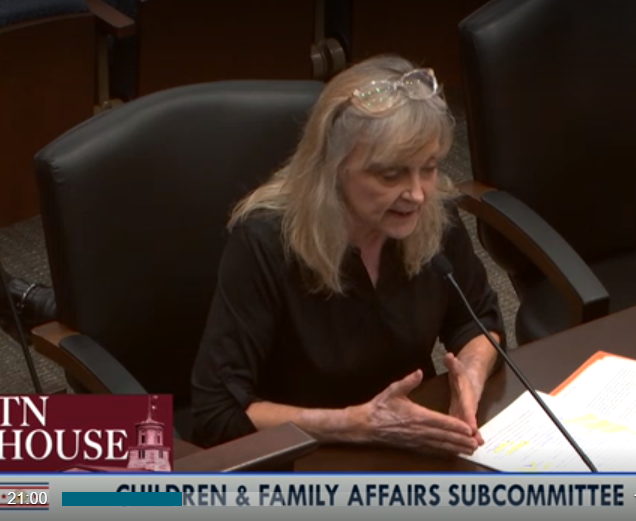
The passage of this legislation has been a battlefield through the Children & Family Affairs Subcommittee and the Civil Justice Committee in the house, and the Senate Judiciary committee.  Citizens have spoken against the bill describing how this legislation actually carves away parental rights that are already guaranteed by the Constitution, while Alliance Defending Freedom (ADF) has spoken in every committee touting this Tennessee legislation as being consistent with parental rights legislation in “seventeen other states.”  ADF felt so strongly about promoting this bill that they brought Michael Farris from Washington DC to convince the House subcommittee to vote for passage.  

NOW HERE IS THE TRUTH.  

First,  ADF was not truthful.  There are not 17 other states that have passed substantially similar legislation.  Nineteen states have some sort of parental rights legislation that proclaim that parenting is a fundamental right protected by the constitution.  West Virginia’s first bill was passed in 1931 shortly after the United States Supreme Court recognized parental rights in 1923.  Meyer v. Nebraska, 262 U. S. 390, 399, 401 (1923).  Several states began to follow suit to codify parental rights, but in a fairly straightforward fashion, stating that parental rights are a fundamental right protected by the United States Constitution. 

Five states have passed parental rights bills since 2021; Florida, Montana, Georgia, North Dakota, Iowa, Alabama, and North Carolina.  In this last tranche of parental rights legislation, the bills have taken a darker more restrictive approach in what is considered positive law.  Little by little exceptions are carved out as to when parental rights do not apply.  These bills are increasingly allowing state’s rights to trump parental rights, strengthening the “parens patrie” doctrine.  

However, here are the significant distinctions in Tennessee. 

In 13 states, a parent is a parent period.  A few suggest that guardians have parental rights (which they don’t). Tennessee will codify that a ‘parent’ can be any individual who has been granted decision-making power.  It does NOT say a person that the parent has voluntarily assigned decision-making power over their child.  

“Granted decision-making power” means one thing.  It means that a court, a judge, an administrative agency, can take parental rights away and give them to someone else.  There is no required burden of proof in this legislation.  So this phrase alone has gutted the constitutional protections of parental rights already ruled on in the United States Supreme Court that requires a finding that a parent is unfit with a high standard of proof before the government can interfere with a parent’s fundamental right to raise their children.  

Second, the Tennessee law provides for ‘BLANKET CONSENT’.  Which means that everything that your child is involved in, education, healthcare, mental health treatment, extracurricular activities, sports, and maybe even birthday parties will include fine print of a blanket consent and waiver of liability.  Guaranteed.  Parents will be unaware because it will be hidden within the context of the agreement to participate in any activity with your child. Only one other state has codified BLANKET CONSENT; i.e. Colorado. 

Third, Tennessee is leaping further than ANY OTHER STATE LAW in giving corporations and commercial entities (include those created in other states or countries) an exemption from liability to providing ‘emergency care’ for children, whatever and whoever decides what arises to ‘emergency’. 

Proponents of this legislation are excited to see a “cause of action” for parents to sue anyone, including government employees and medical personnel, if they violate the enumerated parental rights outlined in this bill.  Parents have been faced with so many challenges in recent years that they feel helpless in getting relief. In a handful of cases, parents have attempted to file lawsuits regarding inappropriate materials in libraries or diversity and inclusion curriculum, and they found out that they “lacked standing” meaning there was no right to sue under the law.  

Now, proponents of this bill, i.e. ADF, are excited to boast that Tennessee has the best parental bill in the country because of a parent’s right to sue and the right to attorney fees in litigation.  

THIS IS THE CATCH.  ADF lobbied for this bill.  ADF is an organization that appears as two different entities:  Alliance Defending Freedom and ADF Foundation.  Both have the legal address of 15100 N. 90th Street in Scottsdale, Arizona.  Alliance Defending Freedom’s 990 tax return for 2021 shows revenues of 104 million with nearly 3 million collected in attorney’s fees.  ADF pays Michael Farris over 625 thousand dollars a year.  ADF Foundation shows 2021 revenue of 1.6 million, and it also pays Michael Farris 625 thousand dollars a year.  That’s right Michael Farris is getting paid more than a million dollars a year to defend freedom.   

So, Tennessee’s “Family Rights and Responsibilities Act of 2024” is not about codifying what the United States Supreme Court has already granted us, it is a ‘product’ for sniffing out achievable attorney fees for ADF.  Period.  

Imagine, if you will, you have a son named Johnny and you find out that a school official has been calling him Julie because your son said he felt like a girl.  Now, you call ADF.  They bring to Tennessee a host of lawyers, let’s say five or six.  They bring a lawsuit against the teacher and the LEA (local education agency) in your county. ADF files the lawsuit in state court in your county, let’s say Grundy County, the poorest in Tennessee.  Let’s say that the judge finds that, yes, the school official did that.  What are the damages?  State court judges in Tennessee are not going to award a parent millions of dollars for this kind of case.  In fact, there is NO WAY to measure damages in this litigation, except for attorney fees.  This bill does not even give you the right to a jury trial so you can plead how emotionally distraught you were to tug at the heartstrings of fellow parents.  Nope.  The state court judge who knows that any damage award could affect the taxpayer dollars available to his constituent’s students is going to minimize the monetary award to a parent.  HOWEVER, the judge MUST award attorney fees to ADF.  And there is no cap on these fees.  The judge MUST award the entire amount of fees which is likely to be thousands and even hundred of thousands of dollars. 

For conservatives who believed that this bill was going to solidify parental rights in the State of Tennessee and protect children from predators who infringe upon the parent’s right to consent to education, medical care, mental health treatments, and more (the bill enumerated one through twelve), you are wrong.  This bill is a PRODUCT for an onslaught of useless litigation that will burden Tennessee taxpayers with legal fees payable to ADF.  School LEA’s will be pinched with the unexpected expense of thousands of dollars in attorney’s fees likely to be paid to ADF or one of its affiliates.  

We have marketed away our precious children in Tennessee one more time.  
This bill moves to the House floor and then to Governor Bill Lee.  Contact your state legislator and ask them to vote no.

Tennessee’s Family Bondage Law 2024

By Connie Reguli, J.D

Sign the petition to reject the Family Rights and Responsibilities Act of 2024 – no matter where you are.

Protect parental rights in Tennessee.  We need your support to STOP the Tennessee General Assembly from slicing and dicing parental rights with HB2936 sponsored by Rep. Jeremy Faison (HB2936) and Sen. Ferrell Haile (SB2749) Find the language here

EVERY PARENT IN TENNESSEE MUST STEP UP TO PROTECT THEIR FAMILY. 

Rep. Faison has in his mind that this bill is necessary to protect parental rights, but the United State Supreme Court has already established that parents have the right to raise their children, obtain medical treatment, and more.  (See below)

What the parental rights bill does is enumerate parental rights and then provides multiple exceptions for the government to block parents from protecting those rights.  The bill includes the word “unless” five times and then provides a slippery slope of exceptions like when a parent provides “blanket consent” or when any person represents themselves has having authority to consent to to waive parental rights (you correct, this is very scary).  

Let’s talk about UNLESS.  The word unless is used five times and gives reasons for parental rights to be subverted by the government.  Like, the government’s right to interrogate to your child without your knowledge or consent.  This bill allows for a complete absence of consent when there is  “law enforcement interaction”…..  So the SRO (school resource officer) can stop your child at school and isolate them to interrogate them? YES.  And of course DCS (Dept. of Children’s Services) can do the same.  The bill DOES NOT require government officials to establish probable cause with credible evidence.  The Fourth Amendment protects persons from search and seizure unless probable cause has been established.  Federal case law is clear on this.  However, children have no protection from Fourth Amendment seizure and interrogation under this bill.  Probable cause is not required.  

Are you seeing the problem? 

Then we get into a very slippery and the barely comprehensible clause when parental rights do not apply like for “a minor participating in a program for which the minor’s parent has consented to the child’s participation by an employee of the institution of higher education OR OTHER SCHOOL OFFICIAL.”   If your reaction is “I totally do not understand when this applies” you are correct that it is confusing and likely has a broader scope of application than it appears on its face.  

So who is giving consent….the parent or the employee or other school official.  And what is the participation……in a program of higher education?…for minors.  I have a feeling that this is more than college attendance.  What if the college has a summer program for high school student on creative writing, coding, or any subject?  Now the enrollment in this program is a waiver of all of your parental rights? YES 

Let’s go back to “blanket consent“.  Now school admission papers, or perhaps any other activity for minors, will include a “blanket consent” clause.  Parents will need to read the FINE print on everything associated with their child.  Years ago, I sued a kids jumping facility because they allowed someone other than the parent to sign the waiver.  I won.  Now those facilities are very careful about waivers. 

Another section of gobble-gook language says that there are no parental rights when “a government entity or any other person reasonably relies in good faith on an individual’s representations that the individual is the parent of a minor child or has otherwise been granted authority to make decisions regarding a minor’s care under state law.”   In layman’s terms this means that a person providing medical or mental health treatment for your child can avoid any liability by saying … OOPS I MADE A MISTAKE.  THAT OTHER PERSON GAVE ME PERMISSION (whomever that other person may be).  This provides for complete exoneration for any who when they rely on someone else’s representation.  

Can you see where this is going? 

Under the medical decision-making section, the law defines a PERSON as “an individual, corporation, or any other legal or commercial entity, whether or not a citizen or domiciliary of this state and whether or not organized under the laws of this state.”  

And a PERSON under this bill can administer EMERGENCY care to your child without your consent.  Please note that it DOES NOT SAY – LIFE SAVING CARE.  So what is an emergency?  Is the governor’s executive order calling for a State of Emergency giving any commercial entity the right to treat your child?  YES IT DOES.  Is your child’s gender dysphoria an emergent situation for your child?  It depends on who is asking.   

Although this bill pretends to give parents a legal right of action to sue anyone who violates their parental rights, the bill is so perverted and packed with exceptions that NO ATTORNEY will touch a case.  And what parent can afford 30, 40, 50 thousand dollars to sue a government or commercial entity who has dozens of attorneys to protect them from liability?  Any school or other other entity will include an ‘indemnity‘ clause, which means, if you allow your child to participate or receive treatment you will NOT sue us.  

An organization called ADF (Americans for Defending Freedom) sent a representative to try to convince the General Assembly to pass this bill on March 5, 2024, claiming that 17 other states have passed “substantially similar” bills.  But this is not true.  After researching the parental rights bills across the country, nineteen states have parental rights bills but only five of the more recent bills have plugged in this type of “exception” list which, by law, gives the government the right to ignore parental rights.  

Many states, like Michigan, Nevada, Virginia, and Montana have set forth a very clear statement that parental rights are fundamental rights and the government must show a compelling interest to interfere.  Any government interference must be narrowly drawn to set the least restrictive environment.  

ParentalRights.org is working on establishing a federal law protecting parental rights that is simple and direct and it is not filled with exceptions and tricky language to exonerate those who continue to try to interfere with these rights.  

That proposed Parental Rights Amendment says this: 

  • Section 1. The liberty of parents to direct the upbringing,
    education, and care of their children is a fundamental right.
  • Section 2. The parental right to direct education includes the right to choose, as an alternative to public education, private, religious, or home schools, and the right to make reasonable choices within public schools for one’s child.
  • Section 3. Neither the United States nor any State shall infringe these rights without demonstrating that its governmental interest as applied to the person is of the highest order and not otherwise served.
  • Section 4. The parental rights guaranteed by this article shall not be denied or abridged on account of disability

One state, ALABAMA, enacted a similar simple parental rights act last year and now seeks to include these rights in their constitution.  

BOTTOM LINE – Tennessee parents, grandparents, and other concerned citizens must stop the Tennessee General Assembly from passing this parental bondage bill.  

Please sign this petition to be presented to the sponsor and committee members. 

HERE ARE THE LINKS TO MEMBERS OF THE GENERAL ASSEMBLY THAT YOU CAN CONTACT DIRECTLY: (Click on the link and there is an “Email Legislator” button or use the email address below. 

Tell them to vote NO on HB2936 – the parental rights bill 

Sponsor:  JEREMY FAISON                            rep.jeremy.faison@capitol.tn.gov 

Committee Chair: MARY LITTLETON            rep.mary.littleton@capitol.tn.gov 

Committee Co-Chair:  ANDREW FARMER    rep.andrew.farmer@capitol.tn.gov

Other members: 

RUSH BRICKEN    rep.rush.bricken@capitol.tn.gov

RON M. GANT   rep.ron.gant@capitol.tn.gov

JOHNNY GARRETT   rep.johnny.garrett@capitol.tn.gov

TORREY HARRIS    rep.torrey.harris@capitol.tn.gov

DARREN JERNIGAN   rep.darren.jernigan@capitol.tn.gov

JASON POWELL   rep.jason.powell@capitol.tn.gov

ROBERT STEVENS     rep.robert.stevens@capitol.tn.gov

This petition is sponsored by Family Forward Project – Building Better Stronger Families. 

Follow Family Forward Project on Facebook. 

Follow Connie on Youtube, TikTok, Instagram, and LinkedIn

Connie Reguli, J.D. Tennessee 

For curious minds….

It is well established by the United States Supreme Court that parents have fundamental interest to parent their children.  The state may not interfere in child rearing decisions when a fit parent is available.  Troxel v. Granville, 530 U.S. 57 (2000), Prince v. Massachusetts, 321 U.S. 158 (1944), Pierce v. Society of Sisters, 268 U.S. 510 (1925), Meyer v. Nebraska, 262 U.S. 390 (1923).   A child also has a constitutionally protected interest in the companionship and society of his or her parents.  Ward v. San Jose, 967 F. 2d 280  (9th Cir. 1992) A state employee who withholds a child from her family may infringe on the family’s liberty of familial association.  Murphy v. Morgan 914 F. 2d 846  (7th Cir. 1990)  The forced separation of parent from child, even for a short time; represent a serious infringement upon the rights of both.  J.B. v. Washington County, 127 F. 3d 919  (10th Cir. 1997)  Absent extraordinary circumstances, a parent has a liberty interest in familial association and privacy that cannot be violated without adequate pre-deprivation procedures. Malik v. Arapahoe Cty. Dept. of Social Services 91 F. 3d 1306  (10th Cir. 1999)  Parent’s interest is of “the highest order,” and the court recognizes “the vital importance of curbing overzealous suspicion and intervention on the part of healthcare professionals and government officials.  Thomason v. Scan Volunteer Services, Inc.  787 F. 2d 403  (8th Cir. 1996) 

Alabama’s embryo decision is contrary to Tennessee law where would-be babies can be destroyed.

By Connie Reguli, J.D. – Family Policy Specialist and Activist

Image from FreePix – 2024

In the wake of the Alabama Supreme Court’s recent opinion that frozen embryos are human life and therefore subject to the wrongful death of a minor laws in the state, there has been a stir of political comments, a suspension of IVF (in vitro fertilization) services, and a general nervousness about the future of this reproductive technology.  

As soon as the Alabama decision circulated in national headlines, Tennessee Senator Jack Johnson made an inquiry to Attorney General Jonathan Skrmetti who opined that the destruction of embryos from IVF would not come under the Tennessee abortion ban law that passed in 2019.  Skrmetti said that disposing of a human embryo that has not been transferred to a woman’s uterus is not punishable as a ‘criminal abortion’. 

Skrmetti’s position is consistent with Tennessee case law.  The case of Davis v. Davis reached the highest court in Tennessee in 1992.  The couple had married and had determined to resolve their inability to conceive a child with in vitro fertilization.  The medical procedure successfully produced eight embryos.  Two embryos were implanted in the womb of Mary Sue Davis, but the transplant was not successful.  Six frozen embryos remained when the parties became embroiled in divorce proceedings.  While many divorcing couples fight over retirement accounts and toasters, the Davis’ were conflicted on what to do with the embryos.  Junior Davis (the husband) wanted the embryos destroyed.  Mary Sue wanted to keep the embryos for future implantation or donation to someone else.  The Courts struggled to find the appropriate resolution.  

The Tennessee trial Court ruled that it was in the best interest of the unborn children that they be awarded to Mary Sue.  Junior appealed arguing that it was unconstitutional to force him to become a father.  The Court of Appeals awarded the couple joint custody of the embryos and said that they could be implanted for full development only if both parents agreed.  Mary Sue appealed to the Supreme Court. 

The Tennessee Supreme Court provided an extensive argument, discussing whether the embryos were property or whether their pre-embryo state made them something less than a person.  In fact, the Court said that pre-embryos “lack legal personhood”.  They concluded that the Davis’ lacked a property interest in the embryos, but since they both contributed genetic material, they retained joint decision making authority over the outcome.  In its June 1992 decision, the court decided that Junior’s burden of enduring unwanted parenthood outweighed Mary Sue’s burden of being unable to donate the pre-embryos to another couple.  If there is a dispute between those who contribute gametes to the creation of the embryos, they will be destroyed unless both parties agree to maintain them or dispose of them by giving them away. 

The Alabama Court concluded in its opinion that: 

This Court has long held that unborn children are “children” for purposes of Alabama’s Wrongful Death of a Minor Act, 6-5-391, Ala. Code 1975, a statute that allows parents of a deceased child to recover punitive damages for their child’s death. The central question presented is whether the Act contains an unwritten exception to that rule for extrauterine children — that is,unborn children who are located outside of a biological uterus at the time they are killed. Under existing black-letter law, the answer to that question is no: the Wrongful Death of a Minor Act applies to all unborn children,regardless of their location.

The conservative outcry is that the Alabama court opinion is detrimental for persons suffering from infertility and who turn to IVF in hopes of completing the cycle of procreation with the assistance of science.  Alabama legislators are scrambling to find a legislative remedy.  The Alabama Attorney General announced that the State had no intention of prosecuting IVF clinics for the destruction of embryos.  And Eagle Forum agreed that this decision should not limit IVF reproduction. 

A bill already filed in Alabama by Democratic legislators says the fertilized human egg or human embryo outside of a human uterus “under any circumstances” would not be considered “an unborn child, a minor child, a natural person, or any other term that connotes a human being for any purpose under state law.”  Rep. Tim Melson said, “We all know that conception is a big argument that it’s life…I won’t argue that point, but it’s not going to form into a life until it’s put into the uterus.”

This battle is a slippery slope whose unintended consequences are vast.  Knee-jerk reactions by state legislators without a policy position are bound to set up a supply of human fetal tissue to the dark side.  

Project Veritas produced an expose on the fetal tissue industry in 2015 showing undercover videos discussing the transactions of aborted body parts.  His production was attacked by liberal media who relied on Planned Parenthood remarks to discredit the report.  

Flashback to April 2016 when the House Select Investigative Panel on Infant Lives held a hearing on “The Pricing of Fetal Tissue”.  Three former U.S. prosecutors on the panel testified that there was sufficient evidence to launch a federal grand jury investigation based on the exhibits provided.

By 2017, the Department of Justice initiated an investigation into the sale and transfer of fetal body parts.  In 2019, the NIH (National Institutes of Health) published an article on the importance of providing fetal tissue to science. The article said that the Trump administration has effectively banned government-funded research on fetal tissue. The article goes on to describe in detail various biomedical experiments that depend on fetal cells.  By 2021, another Congressman called for an investigation.  It remains an unresolved problem.  

Since the reversal of Roe v. Wade in 2022, twenty-one states have bans on abortions.  Liberal media claims that abortion rates continue to rise, but the Center for Disease Control (CDC) statistics stop in 2021.  

IVF is another source of fetal tissue full stop.  If the medical magic of IVF creates eight embryos and only one is permitted to reach “personhood” by full gestation, the lab is left with seven embryos of human tissue.  IVF is rarely a case in which a single embryo is transplanted into the intended mother. After multiple embryos are transferred and begin to grow,  fetal reduction surgery is used to rip growing embryos from the womb, just another variety of abortion. 

If Alabama passes a law that states that the embryo is not human, the participants in IVF and clinics will have free reign to sell tissue or even incubate the embryos in artificial wombs for market distribution as babies for sale or as valuable research tissue.  

So state legislatures are faced with the dilemma of protecting living tissue versus harboring embryos as property which can be bargained to the highest bidder.  They must either police the destruction of tissue that they deem as “non-human” or they must control the production of the living tissue in the first place.  

Conservatives must be preemptive and acknowledge that voluntary participation in reproductive science with the purpose of producing a living organism is procreation.  It is no different from sexual intercourse.  Those who participate in procreation have a duty of care to what they create.  There is no viable option for controlling the disposition of embryos.  If we let this proverbial cat out-of-the-bag it will be decades before we acknowledge the damage.  We should revisit the 1940’s invasion into the body of Henrietta Lacks for scientific research. It is still debated. 

Our Tennessee legislators must take a stand for public policy that promotes conservative values and craft a careful remedy.   

Connie Reguli, J.D. has a law degree and worked the trenches of the legal landmines in Tennessee for three decades traveling for half of Tennessee’s 95 counties.  She has worked over 40 appeals in the state courts; she is responsible for two significant Tenn. Sup. Ct. developments, and she has carved out civil rights for families and children in the Sixth Circuit.  Her area of emphasis is the integrity of the family unit, the perverted federal funding behind programs that affect the family, and abolishing the current child welfare system.  She wears the battle scars from fighting for liberties in the Tennessee courts, but wants to share her knowledge and analysis with other God-fearing conservatives.  She can be found on Facebook, TikTok, Instagram, X, and YouTube.  

More articles 

https://abcnews.go.com/amp/US/wireStory/alabama-ivf-ruling-puts-spotlight-state-plans-tax-107512073

In Indiana, activists where quick to act. They believe access to health care, birth control and abortions play a key role in women’s health. “We know that the people of Indiana want this access,” said Haley Bougher, of Indiana Planned Parenthood. “They’re not giving it a chance.”

Activists in Iowa

Explosive device in Alabama

WHEN THEY TAKE YOUR KID

Republish from PITT / Substack (Parents with Inconvenient Truths about Trans)

Note from Connie Reguli: All of this is so true. I have seen it in real time with hundreds of parents. We are a society on the brink of collapse.

When They Take Your Kid

I was one of the unfortunate early ones. Now, as we’ve seen in the news and read here, it’s happening more frequently. Sorry about the second person, this was too painful to write in the first.

There’s no warning. They don’t come home from school, don’t come back from a visit, or people with name badges holding papers are suddenly at the door with a police officer saying things you are too in shock to understand.

You are in a panicked blur of phone calls, emails, shocked babbling family faces, texts, more phone calls and letters. Official mastheads and signatures frame stone walls of words. The voices and message tones of people who have tremendous power over your family’s well-being are hard, determined, even, empty. 

Your conferences with your lawyer, if you have one, are nightmarish from beginning to end. At first, you’re literally unable to believe what you are hearing.

Your court session feels like an episode of the Twilight Zone.

No contact with your child is allowed. No contact. No contact, no contact. No. Contact. Days, then weeks, then months. Smelling their clothes, seeing their room, hearing their voice on video feels like falling into a pit of spikes.

A twisted, bizarro-world path eventually emerges that you might be able to traverse that could possibly result in seeing your kid. Your lawyer incessantly tamps down your expectations.

Okay! We can do this! you say to yourself. You have to jump through their hoops, do their dance, and cooperate, cooperate, cooperate with every outlandish demand, keep your true feelings hidden, and stay focused on the most important thing, the thing you know will be best for your child: reunification as soon as possible. 

The things you are willing to do and say and endure in order to make that happen fill you with disgust and outrage.

Training videos? Readings? Therapy? No problem! Interviews with purse-lipped Guardian ad Litems with skeptical voices and trap questions? A psychological evaluation with a bored-sounding PhD, bazillion-question multiple-choice tests and hours of in-person sessions? Of course. All paid for by you until your accounts are empty and assets gone? Without a second thought.

You must say that you disavow your gender-critical beliefs, views which you have already expressed to your kid and your ex more than once. This is something you naively thought you would never feel pressure to do. It’s necessary in order to have the best chance at reunification sooner rather than later, your lawyer says. You agree to do so, an act that causes you the most shame of all.

You hope at first that cooperation will earn you accelerated progress and even the benefit of the doubt. But social services and the helping professions are populated mainly with those who have been trained to be woke activists in their work, especially if you are in a blue province/state. Most professionals you encounter interpret your words and actions in the worst possible way.

If you have the misfortune to read any of their reports, you are dumbfounded.

If, as occasionally happens, your co-parent or even your child has followed the coaching of trans activists to hint to the authorities at sexual improprieties by you, a chance at reunification may require you to subject yourself to the most invasive evaluation you can imagine. Sensors are attached to your body and cameras focused on your person while you are shown pictures and made to listen to disgusting and heartbreaking sounds. 

Not all of them are suggestive. Some are just normal pictures and audio of children. Don’t allow the fact that you miss your own child so desperately to trigger you in these moments, because any interest you show by lingering momentarily over those images or voices will be interpreted as sexual in nature. You will fail the sex-abuser test if you like kids too much. 

If the family service agency takes those hints seriously, they have referred them to the Crown/District Attorney, and a criminal investigation has been opened against you. You need a criminal attorney, your civil lawyer tells you. Your child is interviewed by a forensic psychologist and specialist attorney. 

I know these people. They are much better trained and more careful in their jobs than the family services staff, says your criminal lawyer, if you get one. They have a very clever methodology. Chances are good that they’re able to separate the fabrications and fantasies from the reality. Nevertheless, even when the investigation goes nowhere and you never hear from law enforcement, you are technically the subject of an open criminal case for the foreseeable future. They won’t close it until the statute of limitations is reached. 

You are afraid this will hurt your chances of seeing your kid again. It might, might not, your lawyer says. I DIDN’T ABUSE MY KID I’LL DO ANY INTERROGATION THEY WANT TO CLEAR MY NAME, you say. We can’t make a stink about it. That will only increase the chances they’ll charge you with something, your lawyer says. You’ll have to ask the court to allow your psych evaluator to view the video of the interview so they can include it in their report. But even if your kid didn’t disclose abuse and they’re not planning to charge you, the prosecutor will oppose it. 

WHY, you say. IF THEY KNOW I’M INNOCENT WOULDN’T THEY WANT ME TO REUNIFY WITH MY KID. Matter of principle, says your lawyer. Prosecutors prefer to keep all evidence for themselves in case they decide to charge you later.

Now you must head back into the Twilight Zone, and the robed and suited denizens mumbling their legal incantations to each other while you wonder whether you’ll ever see your kid again, and doubt your ability to make it through all of this without breaking down completely.

If you can afford it and/or it’s covered, maybe you could arrange to see a therapist of your own choosing, spill your guts and start to process the shock, the bone-deep grief and intense visceral pain and sadness. 

But if a therapist was the person who betrayed your family to begin with? And all the time you have spent in sessions and interviews observing these MSWs, PhDs and PsyDs has made you realize how clueless, presumptuous and arrogant they can be? So you’d have to keep your gender-critical views to yourself? You might be too wary of them.

Maybe you have found a therapist who thinks all the gender stuff is nonsense. If you live in a liberal area, maybe you can’t. Your insurance/Medicare may or may not cover virtual sessions with far-flung clinicians.

The prescription meds help some, if you get the right ones. The alcohol makes them go down easier and kick in quicker. Not more than a few gulps though, you don’t want to kill yourself while you are numbing yourself.

You sleep, but you don’t dream much. When you do, it’s a horror.

Of course your kid’s picture is your home screen on your phone and computer. You look at it obsessively, helplessly. You write them letters you are not allowed to send. You plan future birthdays, family gatherings, holidays that include them, then miss them.

If the separation drags on long enough, you start to be triggered by seeing other people’s kids yours’ age. You smile at them wistfully through your tears. Not too much though, especially if you’re a guy; people will think you’re creepy.

You’ve lost most of your real-life friends by this point. The ones who stick with you don’t know what to say. They look at you helplessly, as if they were seeing the victim of a car accident still trapped and in pain inside the wreckage waiting for the Jaws of Life.

But when those Jaws of Life finally, after endless struggle and interminable waiting, miraculously, joyfully come? And your chest grows tight and your throat constricts as you brace yourself not to break down bawling as you see them start to round the corner at the visitation center? All of it, every single outrage and humiliation and travesty is worth it, when you see your child’s face and feel their hug again.

JANUARY SIXTH-AVERSARY – INSURRECTION DAY

STATES MUST MAKE PRESIDENTIAL ELECTIONS MORE SECURE

By Connie Reguli 1/6/23

Two portions of the December 29, 2022 Omnibus bill dealt directly with the presidential election, and the transition of presidential administrations.  The Electoral Count Reform Act makes some significant changes to Title 3 of the United States Code, and the Presidential Transitional Improvement Act of 1963 is modified to address any presidential candidate that does not concede the election.  

During the 2020 presidential election, an objection to the State’s electoral votes only required the signature of one Congressman and one Senator to be presented during the vote tally January 6.  The role call on the states is in alphabetical order, and as soon as an objection is received, the two Houses were required to withdraw to their own separate chambers and to consider the following: (1) the votes from the electors have been “regularly given”; and (2) only one certified result was received.  If both conditions were met, the electoral votes must be accepted. Both Houses could reject one or more electoral votes if the vote “has not been so regularly given” by electors even if they have been certified. 

However, if the Vice President received more than one set of votes from a State, a complex inquiry was required. If the returns had been certified by two different State authorities, and there was a challenge to which was the proper State authority, and that conflict had not been satisfied within the State; then, each House had to consider which was the proper State authority “under the laws of the State.”  If the two Houses disagreed, the electors certified by the “executive of the State” would be counted.  This complex inquiry left many questions.  The code did not describe which state official was considered the “executive of the State” or what was meant by “regularly given”.  

Under the Electoral Reform Act passed on December 29, 2022, this complex inquiry is totally removed and the events that occur on January 6, 2021 are unlikely to happen again.  First, the law now requires that objections contain signatures of one-fifth of the members of Congress and one-fifth of the members of the Senate. 

The law does not remove the opportunity for challenges. However, those challenges will need to occur in the States before January 6.  The law clarifies that the “executive of the State” is the governor.  So State certification will not be an act of the Secretary of State.  It must be certified by the governor and that certification will be conclusive in Congress.    Certification issues must be brought prior to January 6 in a State or Federal court.  All legal contests based on the U.S. Constitution or U.S. laws must be brought in a Federal court, assigned to a three judge panel, in the District where the State capitol is located, and heard on an expedited basis.  The panel will include two judges from the circuit court of appeals and one district court judge.  Any appeal taken from this judgment will be reviewed directly by the United States Supreme Court.  All of this must occur before the meeting of electors: the first Tuesday after the second Wednesday in December. So the only set of votes that can be officially transmitted are those signed by the governor.  

There are only two bases for objections.  The first is that the vote was not certified by the Governor.  The second is that the vote of one or more electors has not been “regularly given.”   Although the term “regularly given” was not previously defined and has long been the subject of legal debate, the reformed law describes “regularly given” as an appointment under the governor’s certificate.  

If a State is unable to certify its election results or a State appoints more than one set of electors, that State’s electoral votes shall not count on the January 6. 

In sum, what’s done is done.  The role of the Vice President is now a ministerial function and the burden is on the States to complete all election contests before the December meeting of the electoral college.  

Failure to concede a presidential election no longer carries any significance.  If the loser does not concede five days after the election, the Federal election Administrator can declare an apparent winner pending the final tally of the electoral votes on January 6.  The significance of that time period is that the transition act provides tax dollars prior to the inauguration to the winner. 

A legal question that has not been resolved is a State’s ability to sue another State for election irregularities.  In 2020, Texas filed a lawsuit against Pennsylvania in the United States Supreme Court citing election irregularities that corrupted the election results.  At least seventeen states either joined the lawsuit, filed amicus briefs, or publicly endorsed the case.  The arguments were based on Federalism.  The Presidential election is the only federal election in which the lack of election integrity in one state, such as mail-in ballots, electronic voting, and failure to purge voter rolls, would affect the voters in other states that had more stringent voting laws.  

The United States Supreme Court rejected the lawsuit and said that one state could not control the election process in another state.  We need a federal law which will secure the ability to challenge election integrity across state lines in a presidential election.  Ideally, we would also have federal election integrity laws which would eliminate electronic voting, absentee voting, mail-in ballots, and force state’s to purge voter rolls. 

Bottom line, the only power we have left is to preserve and protect our own conservative values in the State of Tennessee and find a way to support other states, especially the swing states of Pennsylvania, Georgia, Wisconsin, Arizona, and Nevada.  As conservatives, we have to step up our role in State government and help conservatives in our sister states. 

Follow me on Facebook, Instragram, and YouTube – @ConnieReguli

Illinois Foster Fail

By Connie Reguli and Catherine Wang Anderson

Dec 6 2022

ONE BILLION dollars for Illinois cp$’ ANNUAL budget.

These are the “official” numbers released by Illinois’ cp$. We all know how honesty they are. The real numbers have to be much higher.

“More than 2,129 children died under the watch of the Illinois Department of Children and Family Services during the past two decades, including 122 kids in a recent year.”

DCFS failures to protect children could get worse under …

“The 2022 DCFS Office of the Inspector General report examining deaths and serious injuries of children in state care, alongside allegations of impropriety by DCFS employees, covered 27 full investigations between July 1, 2020, and June 30, 2021. It recommended the discharge or discipline of DCFS employees in nine of the 27 investigations. They failed to perform basic duties, compromised investigations, misused department authority and even solicited sex from clients.”

“These systemic department failures, alongside others outlined in a report by Cook County Public Guardian Charles Golbert, have been compounded by DCFS Director Marc Smith being held in contempt of court 12 times during 2022 for failing to get children into appropriate housing. DCFS left children for months locked in psychiatric hospitals and other inappropriate housing.”

Annual report to the governor.

DCFS failures to protect children could get worse under Amendment I

https://www.illinoispolicy.org › dcfs-failures-to-protect-…

Nov 3, 2022 — Now government unions are pushing Amendment 1, which could void 11 child protection laws. More than 2,129 children died under the watch of …

Amendment 1 could undermine 11 DCFS provisions aimed at …
https://www.illinoispolicy.org › amendment-1-could-un…Dec 20, 2021 — Amendment 1 would allow unions to override provisions put in place for the protection of the children Illinois is supposed to be safeguarding.

And in July 2022 CBS Chicago reported on the abuse against children.

Join us on Facebook and view videos on YouTube Connie Reguli

Hawaii CPS exposed and the vast web of child abductions

By Connie Reguli

Thank you Civil Beat in Hawaii for pulling g together a great series on how abusive and corrupt the child welfare system operates. I am sharing snippets and the link to each story. For more stories like this John Hill is the Investigations Editor at Civil Beat. You can reach him by email at jhill@civilbeat.org or follow him on Twitter at @johncornellhill.

Nov 7, 2022. Court appointed attorneys don’t do enough to defend parents. The frustration with family representation by court appointed attorneys is not unique to Hawaii. A Mother Jones article also exposed how the lack of parent representation in western Massachusetts is delaying cases for months.

In Hawaii, a Civil Beat investigation found that the overall system often falls short of the rigorous defense that experts nationally consider the most effective in preserving those rights. In some jurisdictions, those principles form the basis for court-appointed defense in child welfare cases using a much different model than Hawaii’s.

Mother Jones exposed several stories of parents who had lost parental rights due to delays and ineffective court appointed counsel. This problem is not. New one. MJ said: The problem goes back decades: A state-commissioned report in 2003 found a “critical shortage of attorneys available to handle the ever-increasing volume of child welfare cases in the juvenile courts,” and that the issue had reached “crisis proportions” in western Massachusetts. Yet, of all the courts that the authors visited, the Springfield Juvenile Court stood out. “One person we spoke with described the Springfield Juvenile Court system as a fiefdom, with each judge poorly managing his or her own docket,” it reads.

Oct 3 2022 Civil Beat published that State Senator seeks to limit power to remove kids without court order. n. Joy San Buenaventura said the bill would address the findings of a Civil Beat investigation published in September. The story found that in more than 90% of cases of children being taken from their parents after abuse or neglect allegations, police and social workers act on their own without first getting an order from a judge.

Sen Joy San Buenaventura

“I am alarmed that children are being taken away without a court order,” said San Buenaventura, chair of the Senate Human Services Committee.

Her proposal Was to introduce a measure similar to one passed in 2017 by the Arizona Legislature. In that state, child welfare workers had not been getting court orders before removing children. The new law made it clear that court orders should be the norm, and narrowly defined the circumstances that could lead to an emergency removal absent a warrant.

However her belief may have been misguided.

On July 27, 2022 Arizona’s Channel 12 news reported that – According to DCS reports, bed space in licensed foster homes is at a five-year low. The latest data shows only about 6,329 beds are available. While the number of kids in out-of-home care is also at the lowest in at least five years, DCS records show there are still 11,722 kids in out-of-home care. “When we don’t have enough foster caregivers, we utilize congregate care group home settings,” Mesaros said.

And March 2022 azfamily.com reported – There are more than 14,000 children in foster care across Arizona right now. The Arizona Department of Child Safety says there are only 4,500 licensed foster families.

And horror stories like the 2020 house fire that killed a foster-to-adopt ten year old (and her death was never reported) continue to poor out of AZ. After a fire that her adoptive father confessed to setting at the family home in January 2020, a shocking discovery emerged: The child had died in 2017 at age 10. For more than two years, her remains had been concealed in the family’s attic.

10 year old Ana

When police investigating the fire discovered the child’s bones, Rafael Loera told them he and his wife Maribel did not disclose the death to officials for fear that the Department of Child Safety would remove their three other children. And of course it is likely that they continue yes to receive the adoption stipend even after her death. As reported by maryjo.pitzl@arizonarepublic.com and follow her on Twitter @maryjpitzl.

And four-month-old Samora who was left in a hot car by her foster father in 2019 as reported by Azcentral.com. Her family had adopted 15 kids from foster care. The article does not disclose the perverted financial incentive with foster to adopt. The truth is that this family was making about $1,000 per month per child in tax free cash along with free medical care for the kids. And oh yeah don’t forget child tax credit which is “cash back” on your kids from other tax paying citizens.

The infant was in the care of her foster father, Roger Ham, at the time of her death Tuesday, The Arizona Republic has confirmed. Phoenix police officials said they aren’t releasing the identity of the foster father because he hasn’t been arrested.

Police said the foster father, an administrator at a Washington Elementary School District transportation facility, arrived at work at about 7 a.m. after dropping off several children at day care. He left work to pick up the infant girl for an appointment, then returned to work. When he returned to his vehicle again at about 3:30 p.m., he found the child still inside the vehicle.

You are not coming into my house,” she said, according to the police report. “You need a warrant!”

In March 2022 Civil Beat reported on the abusive tactics of taking children without a court order or warrant on anonymous tips which sometimes come from estranged partners.

One mom tried to stop the cps worker and cop from taking her child and as another officer approached the door, Chapman held out her arm to block him. The first officer grabbed her right arm and Chapman went to the ground, the report says. The officers took the baby and handed him over to CWS, which placed him in foster care.

Earlier that day, police — including an officer who a couple of hours later helped remove Chapman’s infant — had responded to her home after she reported that the husband had violated a restraining order. At that time, Chapman told one officer that she was afraid her husband would try to frame her for using drugs, according to Dara Carlin, a domestic violence counselor who was there for both incidents. That officer told Chapman he had no concerns about her sobriety, Carlin said.

When it decided to take Chapman’s baby, CWS failed to take into account that her accuser husband had recently burglarized her home, vandalized her car, stolen her telephone and hacked her email, her lawyer said in a later court filing.

In the nine Western states and two Pacific territories in its jurisdiction, the U.S. Court of Appeals for the 9th Circuit has drawn very narrow criteria for taking children without a court order. The federal appellate court has found that the constitutional rights of parents and children require judicial review unless there’s reasonable cause to believe a child will be seriously injured in the time it would take to go before a judge, often just a matter of hours.

However snatching children without a warrant is nothing new.

ProPublica just published in October 2022 that police need warrants but child protective services rarely gets one.

Each year, child protective services agencies inspect the homes of roughly 3.5 million children, opening refrigerators and closets without a warrant. Only about 5% of these kids are ultimately found to have been physically or sexually abused.

By law, ACS caseworkers are not allowed to enter and search a home without either permission to enter or an entry order, which is the legal equivalent of a search warrant, unless a child is in imminent danger. But many parents don’t know that they have the right to deny these government agents or don’t push back for fear of losing their children, according to parents and their advocates. And caseworkers frequently say things that are coercive and manipulative in order to get inside homes without going to a judge, according to interviews with more than three dozen former ACS workers, New York City Family Court judges, parents, children and attorneys.

Reporter Eli Hagar exposed the abusive government practices of child protective services in New York.

The story in Civil Beat from July 7 2022 discusses qualified immunity granted to social workers when parents sue for civil rights violations.

This summer a mom and her daughter asked the question – can we sue cps for money damages. The 9th U.S. Circuit Court of Appeals answered last week with an unequivocal “yes.”

It was the latest 9th Circuit decision addressing the question of “qualified immunity,” the principle that public officials generally cannot be held liable for official actions. The exception is when they violate clearly established rights that they ought to have known about.

The idea in recent years has come under attack by police reformers who argue that officers should not enjoy special protection when they cross the line, such as using excessive force.

But it often also plays out in child protection cases, when social workers remove children from their parents without a court order. That’s only supposed to happen when children are in so much danger that they could be injured in the short time it would take to get a judge to issue a warrant.

Lawsuits against child protective services rarely make it past the scrutiny. The courts have ways to nuance the facts of the case to shield social workers from liability even in the most egregious cases.

It took Sixth Circuit until 2018 to acknowledge that social workers should get liable for damages if they lid under oath to get a ex parte removal order.

And YouTube is full of videos showing removals in real time where there is no apparent immediate threat of harm.

Indiana. 👇👇👇

Ohio 👇👇👇👇

Tennessee 👇👇👇

And somewhere in America 👇👇👇

Be sure to watch for my follow up.