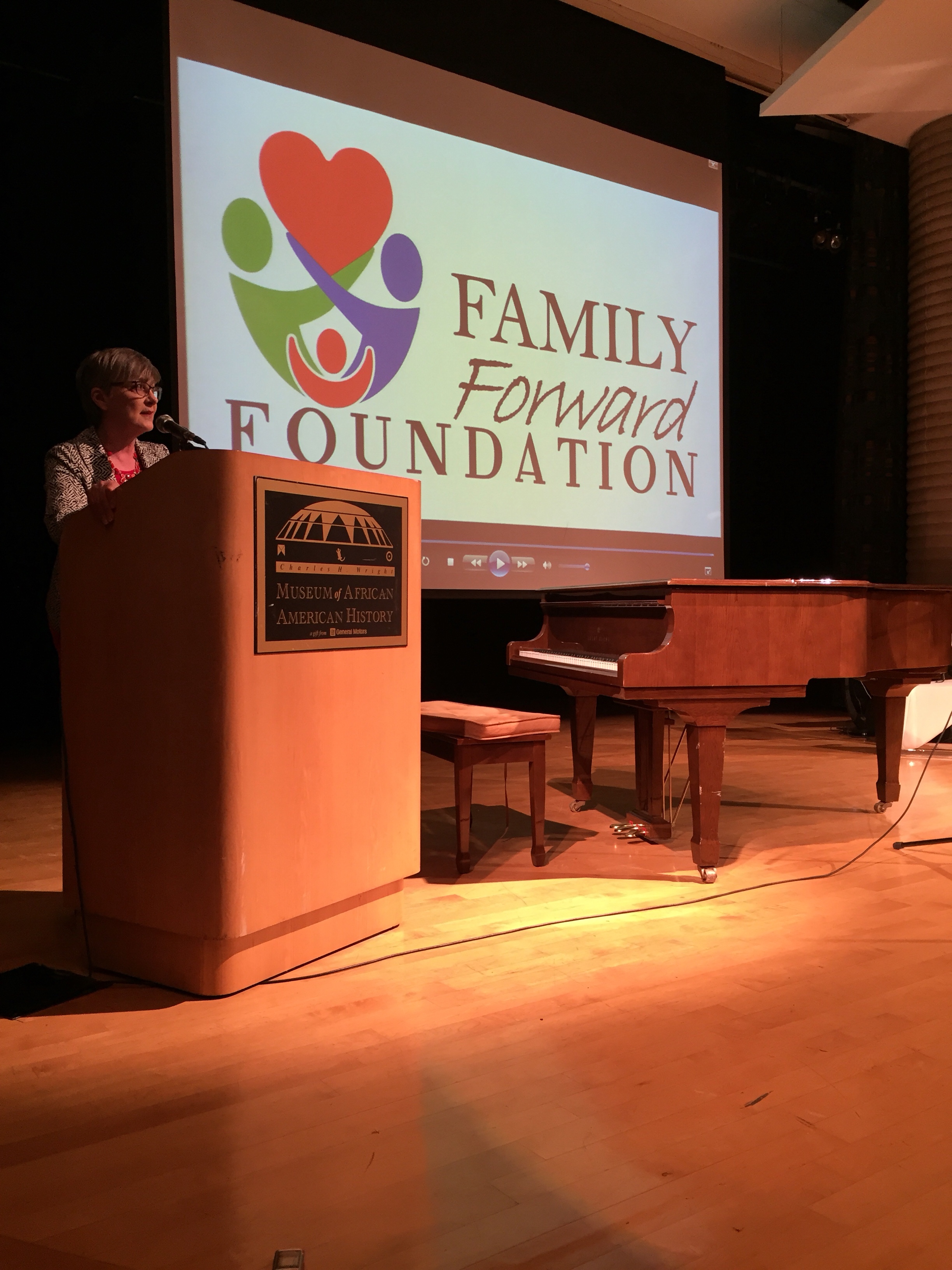
Connie Reguli addresses the Tennessee General Assembly – March 2019 on DCS corruption and abuse of power.

After my 2019 presentation to the Tennessee General Assembly, I received this post from a member of our Family Forward Project on Facebook.   It helps for you to hear the interpretations made by others so we can continue to develop our critical thinking on the problems we are facing in the child welfare reform movement.  
Angie Jones    2 hrs

Connie, I just got a chance to thoroughly listen to you before the Tennessee General Assembly and I must say, the Chairwoman, Representative Michael Curcio, and Representative Iris Rudder’s comments and questions are disturbing.

First, the chairwoman said “I have teacher friends who say that a child with behavioral issues believe it’s the fault of the parents”. Then she goes straight into “drug use”.

Let me address Mrs. Chairwoman (sorry didn’t catch her name)..so what you’re saying is that removing a child from his or her parents is often necessary because a child has bad behavior??? Are you even serious Mrs. Chairwoman ?? Should your children have been removed from YOU because a teacher “thinks” that YOU are the cause of behavior that’s not suitable to a teacher’s classroom?? Mrs. CHAIRWOMAN….I’m APPALLED that you even asked such a question as a member of the legislative body of Tennessee. Let me ask you…What is the line in the sand where a parent is FIT to UNFIT based on the behavioral issues of ANY American child?? Please tell me the line of demarcation.

To Representative Michael Curcio: When you addressed Mrs. Reguli, you asked if she was a medical expert in a condescending way to discredit her; this gives me great pause about you and your ability to govern. Mrs. Reguli is an “expert” in dealing with the juvenile and family court issues which include the broken Foster system and Child Protective Services. To insinuate one has to be a “medical expert” to properly quantify a problem teeters on ridiculous, closer to absurd. The truth of the matter is…these medical “experts” are part of the problem which Mrs. Reguli did not have time to expound on, but if she did, I’m certain her “expertise” in these issues would confirm this. One not need be an expert in any field to determine the broken, kids for cash system. Speaking of medical experts…why don’t you call the Cabinet and ask how much TRAINING a social worker gets in the MEDICAL FIELD??? Because when a social worker comes into the home of a citizen, they count and handle prescription medicines WITHOUT SANITARY GLOVES…and 4 out of 4 social workers I’ve dealt with could not do SIMPLE MATH to count the prescription meds. Also, this borders on a NATIONAL HEALTH CRISIS because of all people, the DEPARTMENT OF HEALTH just happens to NOT WEAR GLOVES to count these meds. Think of how much hand to disease contact these workers deal with out in the field each day. THIS IS UNACCEPTABLE. So Mr. CURCIO, when you asked Mrs. REGULI if she was a “medical expert”…..you should have asked if SOCIAL WORKERS are being trained properly to handle playing the role of God, doctor, psychiatrist, and so on. Perhaps you should learn the FACTS.

To Representative Iris Rudder: Boy, you just had me FLOORED with your comments. Did I hear you correctly say that a child “never deserves to be reunited with a parent if they use drugs”??? Is that what I heard you say?? And right here is where CPS is getting the majority of children. …👉prove the parent a drug user and the public will agree that the child doesn’t deserve to be with his or her family. And this is what happens. Well let me tell you Mrs. RUDDER…I’ve known many people who “used” drugs whom you would NEVER know they’re using. Should we take those kids too?? So a parent who smokes marijuana is UNFIT to parent?? If you believe that Mrs. RUDDER, I question your own mental fortitude. The question should be…why is the state TAKING CHILDREN because a parent uses drugs??? There’s plenty of fully functional drug users and abusers, I dare say they may be sitting right next to you in the legislative body. The “DRUG USE” excuse to separate parents from children is getting old, and the scheme is being told to the masses. That’s why only 3% of child removals are for actual ABUSE Mrs. RUDDER…that’s because NEGLECT needs NO PROOF. I’m APPALLED at your comments.

I’m sorry Connie, I think these representatives HAD to be addressed and I hope each and every one reads it.

My letter is on the way to you. I hope it makes it in time and thank you very much for advocating for the rights of children…AND parents across this nation.

Predictive Neglect vs Parental Rights

By Connie Reguli

In the State of Connecticut, the legislature and the courts have decided that parental rights may be interrupted by the government when the state can establish predictive neglect.

This is frightening in the world of parental rights defenders. I truly wish that some brave attorney in Connecticut would make a constitutional challenge on this standard.

In reviewing the doctrine of predictive neglect, the Connecticut Supreme Court explained that DCF need not wait until a child is actually harmed before intervening to protect that child.  As the Supreme Court stated, “Our statutes clearly and explicitly recognize the state’s authority to act before harm occurs to protect children whose health and welfare may be adversely affected and not just children whose welfare has been affected.”  The Court explained, “The doctrine of predictive neglect is grounded in the state’s responsibility to avoid harm to the well-being of a child, not to repair it after a tragedy has occurred… Thus, [a] finding of neglect is not necessarily predicated on actual harm, but can exist when there is a potential risk of neglect…”

Under the standard set forth in In re Kamari C-L, DCF could establish its case merely by proving by a preponderance of the evidence the existence of a “potential risk” of neglect. However, as the Supreme Court noted, under this standard, DCF could theoretically prevail even if there was only a 10% chance of future harm to a child.  According to the Supreme Court, the “potential risk” standard gives insufficient weight to the “combined family integrity interests of parent and child.”

In formulating a more burdensome standard, the Court held that in predictive neglect cases, the trial court must find with respect to each parent that, if the child were to remain in that parent’s independent care, the child would be denied proper care and attention, physically, educationally, emotionally or morally, or would be permitted to live under conditions, circumstances or associations injurious to the well-being of the child or youth.  Where parents will be caring for the child together, the trial court may treat the parents as a single unit in determining whether DCF has met its burden of proving predictive neglect.

This narrative was first published by Attorney Michael D. DeMeola, Esq. directly.  He can be reached in the firm’s Westport office at (203) 221-3100, or by e-mail at mdemeola@mayalaw.com.

DCS Case recordings as evidence – Application of the Business Records exception.

By Connie Reguli

Are DCS records admissible as business records in a court hearing?

I have located five cases in Tennessee directly addressing this question.  

Hearsay is a statement, other than one made by the declarant while testifying at the trial or hearing, offered in evidence to prove the truth of the matter asserted.  TRE 801(c). Such a statement is inadmissible unless it is shown to be admissible as provided by the rules of evidence or otherwise by law. TRE 802. TRE 803(6) covers the hearsay exception for records of regularly conducted activity.  The party proffering the records under TRE 803(6) has the burden to establish (and must lay a foundation) that the records are admissible meeting the five elements of admissibility identified below.  

The following cases in Tennessee discuss the admissibility of DCS case recordings.  

State v. B.F., E2004-00338-COA-R3-PT, (Tenn. App. 12/2/2004) – In this termination of parental rights (TPR) case the case worker was allowed to testify regarding facts in the child’s case file about which she had no personal knowledge but which were documented (or she said were documented) on the case file which was not made an exhibit.  The trial court (Sevier County Judge Stokes) allowed the case worker to testify under the business records exception of Tenn. R. Evid (TRE) 803(6). The appellate Court reversed the trial court stating the TRE 803(6) specifically refers to “records” and indicates that a “record” consists of a memorandum, report, record or data compilation, in any form.  It is clear from this language that this exception pertains solely to the admission of information in the form of tangible documentation. The rule provides for the admission of “records.” It does not provide for the admission of testimony of a witness as to his or her memory of what the record stated. The ground for this exception to the hearsay rule is the fact that regularly kept records typically have a high degree of accuracy.  It is not reasonable to assume that a witness testifying from memory exhibits the high degree of accuracy attributed to regularly kept record. This case does not specifically address any other objections as to the source of information in the records. However, the Court relied on Perlberg v. Brencor Asset Management, Inc. 63 S.W. 3d 390 (Tenn. App. 2001) in which the Court found that a letter in the employment record that referred to a letter from a doctor (but did not contain the doctor’s letter) was inadmissible and not a business record.  Therefore, two questions are considered in this case (1) it is clear that testimony alone from a person who claims to have reviewed the business record is NOT admissible under TRE 803(6); (2) it is also clear that a business record that refers to or incorporates outside information is ALSO NOT a admissible under TRE 803(6) as a business record.  

State Dep’t of Children’s Services v. Stinson, W2006-00749-COA-R3-PT, (Tenn. App. 2006) (McNairy County – Judge Danny Smith) – In this termination of parental rights case Mother objected to the admissibility of the DCS case recordings asserting that the records contained hearsay, however, she did not object to any specific content within the records.  Therefore, the Court ruled that they were admissible under the business records exception to hearsay TRE 803(6). Since the MOther had not objected to any specific entry in the records, the Court did not make an independent assessment of whether the records contained in admissible hearsay. In this case, there was overwhelming evidence of substance abuse and criminal conduct by the parents and the Court stated that even if the records were inadmissible that there was ample evidence to meet the clear and convincing standard for the TPR.  

State Dep’t of Children’s Servs v. C.M.B., E2006-00841-COA-R3-PT, (Tenn. App. 12/13/2006) (Knox County Judge Timothy Irwin) – In this TPR case, the DCS caseworker read into evidence the records created by a previous DCS case management agent.  Mother’s attorney made a faint-hearted objection, saying we would like to have the direct testimony of the witness rather than referring to something I can’t cross-examine. (This is hardly an appropriate objection.)  The Court overruled the objection saying it fell under the hearsay exception. The Judge allowed the reading of the records and asked several questions about where the people were that made those entries. In particular, Mother argued that the trial Court’s conclusion that “cocaine was found within the reach of the children” came ONLY from the hearsay in the DCS records.  On appeal, Mother’s attorney argued that DCS had to demonstrate that the records were made at or near the time of the incidents reported in the records, and that the records were created by someone with the business duty to record or transmit the records during the court of a regularly conducted business activity. The Court found that the records were hearsay and that DCS failed to lay a proper foundation for the admission of these records.  The Court, however, found that it was harmless error (TRAP 36(b)) considering the record as a whole because even striking the complained of evidence, it did not affect the correctness of the judgement. (Note: The problem is that the “fact” recorded in the judgment becomes the law of the case and may be used against the parents in the future.)  

In re Demitrus M.T., E2009-02349-COA–R3-CV (Tenn. App. 3/14/2011) (Claims Commission) – In this wrongful death case, the case recordings were the subject of a motion in limine to exclude inadmissible hearsay by the plaintiff.  The commissioner admitted the case recordings with limited redaction of content that was hearsay within hearsay. The case recordings include an “event date” and “completed date” which is the date that the entry in the record was made.  In this case there was a lapse of time between the event date and the completed date. The DCS employee that was present to testify (not the one that made the record entries) stated that she did not know why there was a delay in the entry of the record and that there is no requirement for the case recording to be made within a certain time. (which is not true)  She testified that sometimes case workers make handwritten notes and then put them in the system later. The case recordings were treated as admissible under TRE 803(6). The commissioner found that the reports were typical of reports regularly prepared by DCS case workers in the fulfillment of their job responsibilities. And that preparing such reports clearly appear to be a proper exercise and implementation of the powers granted DCS under TCA 37-5-106(1) to attain the purpose for which it was created under TCA 37-5-102.  There was no hearsay exception for hearsay within hearsay that was redacted from the records. The Court examined the elements necessary for a record to be admissible under TRE 803(6): (1) The document must be made at or near the time of the event recorded: (2) The person providing the information in the documents must have first hand knowledge of the recorded events or facts; (3) The person providing the information in the document must be under a business duty to record or transmit the information; (4) The business involved must have a regular practice of making such documents; and (5) The manner in which the information was provided or the document was prepared must not indicate that the document lacks trustworthiness.  Arias v. Duro Standard Prods., 3030 S.W. 3d 256 (Tenn. 2010). The COA examined whether element (1) and (5) had been satisfied. As to element (1) the Court said that the key element is whether the lapse of time between the event and the record of the event interferes with the likely accuracy of the business record. The Court found that the lapse of a few days was acceptable, but the lapse of five weeks was not. The absence of proof that the case worker has some phenomenal memory, or interim notes that captured the events and allowed him to record them later, or some explanation of why the records were accurate despite the lapse of over a month, the State failed to make the required showing that they were made at or near the time of the occurrence.  In this case, the Court also analyzed whether or not the records could be admissible under the public records exception, TRE 803(8) which states, “Unless the source of information or the method or circumstances of preparation indicate lack of trustworthiness, records, reports, statements, or data compilations in any form of public offices of agencies setting forth the activities of the office or agency or matters observed pursuant to a duty imposed by law as to which matters there was a duty to report, excluding however, matters observed by police officers and other law enforcement personnel.” The Court said that the same time lapse in the entry of the record would make the records untrustworthy under the public records exception. The Court, however, made an interesting note stating that the fact that the records were not “open to the public” and had been “produced under a protective order” did not disqualify the case recordings from the public records exception.  

In re Melanie T., 352 S.W.3d 687 (Tenn. App. 2011) (Coffee County Judge Vanessa Jackson) – In this dependent and neglect action, the State offered the case recordings made by a case worker who died before the trial into evidence.  The records were admitted into evidence under the hearsay exception of TRE 803(6) – business records. The COA went through the same analysis of the elements and found that the significant delay between the event date and the completed dated rendered the record inadmissible and they lacked trustworthiness.  DCS argued that the court only relied on the records for a timeline and not for the truth of the matter. The COA found that the substantive and material evidence in the records was testified to by other witnesses. Therefore, although is was an error to admit the records, it was harmless error. 

There is no case on point in DCS case recordings to address the hearsay within hearsay, such as statements DCS workers take from third parties, additions to the case recordings made by third-party contractors who are outside of the agency, references in the records to other outside materials (such as medical, dental, or other reports), opinions of the case worker without supporting facts (such as statements that a parent is uncooperative), or conclusions/concerns that are not supported by facts.  

The business records exception clearly requires the recorder to have first hand knowledge of the information contained in the record.  

Additional case law, i.e., other business records opinions may add to this context. 

Please Join Us on Family Forward Project on Facebook. Find Connie Reguli on YouTube. Follow us on Twitter and Instagram


Additional case law in Business Records exception to Hearsay.

Business records

Courts have consistently viewed hearsay evidence with suspicion because of concerns about its trustworthiness. Accordingly, hearsay is not admissible in judicial proceedings unless it fits within one of the recognized exceptions to the hearsay rule. This common-law rule is now embodied in Tenn. R. Evid. 802, which states that hearsay is not admissible except as provided by these rules or otherwise by law.

While the Tennessee Rules of Evidence govern proceedings in the state trial courts, they do not necessarily apply with the same force to other nonjudicial proceedings. Tenn. Code Ann. § 4-5-313(1) (1991) provides: The agency shall admit and give probative effect to evidence admissible in a court, and when necessary to ascertain facts not reasonably susceptible to proof under the rules of court, evidence not admissible thereunder may be admitted if it is of a type commonly relied upon by reasonably prudent men in the conduct of their affairs.This provision applies only to facts not reasonably susceptible to proof under the rules of court and does not permit substituting hearsay for the testimony of otherwise available witnesses.

Tenn. R. Evid. 803(6) embodies the hearsay exception commonly known as the “business records” exception. It replaces the Uniform Business Records as Evidence Act, Tenn. Code Ann. § 24-7-111 (repealed 1991).

Records regularly kept in the regular course of business are viewed as trustworthy and reliable. Thus, the purpose of Tenn. R. Evid. 803(6), like its predecessor, is to enable litigants to introduce and use business records without the expense and inconvenience of calling the numerous witnesses involved in preparation and maintenance of the records.

Tenn. R. Evid. 803(6) does not render all business records admissible. The trial court, or in the case of an administrative hearing the administrative law judge or hearing officer, has the discretion to determine whether a particular record is sufficiently trustworthy to be admissible. In the final analysis, the trustworthiness of a business record depends upon the source of the information contained in the record as well as the time and manner in which the record was prepared.

Documents must satisfy five prerequisites in order to qualify as a record of a regularly conducted activity under Tenn. R. Evid. 803(6). First, the person providing the facts recorded in the document must be acting under a business duty. Second, the person providing the information must have firsthand knowledge of the facts or events. Third, the document must be made at or near the time of the event recorded. Fourth, the document must be one that is regularly made or kept in the normal course of business. Fifth, the document must be introduced through its custodian or some other qualified witness who has knowledge of the manner in which the record was made or prepared.

Business records often contain information provided by others and, accordingly, present multiple hearsay problems. Because Tenn. R. Evid. 803(6) was not intended to shield the contents of business records from the rules of evidence, hearsay statements contained in a business record do not become admissible simply because they have found their way into a business‘s files.

The courts resolve the multiple hearsay problems presented by business records using a two-tier approach. First, they determine whether the primary statement – the record itself – qualifies as a business record or fits within some other exception to the hearsay rule. Second, they determine whether the secondary statement – the one contained in the record – fits within a hearsay exception in its own right. Hearsay statements in business records are admissible only if both the record and the statement contained in the record fit within an exception to the hearsay rule.

Among the due process rights under Tenn. Const. art. I, § 8 and the due process clause of the Fourteenth Amendment to the United States Constitution is the right to be afforded an effective opportunity to defend by confronting any adverse witness.

Rayder v. Grunow, 1993 Tenn. App. LEXIS 261, (Tenn. Ct. App. Apr. 2, 1993)

See Tenn. R. Evid. 803(6) (2011).

Under Tenn. R. Evid. 902(11) (2011), a business record may be authenticated through an accompanying affidavit, with the following requirements: The original or a duplicate of a domestic record of regularly conducted activity that would be admissible under Tenn. R. Evid. 803(6) (2011) if accompanied by an affidavit of its custodian or other qualified person certifying that the record: (A) was made at or near the time of the occurrence of the matters set forth by, or from information transmitted by, a person with knowledge of and a business duty to record or transmit those matters; (B) was kept in the course of the regularly conducted activity; and (C) was made by the regularly conducted activity as a regular practice. A party intending to offer a record into evidence under this paragraph must provide written notice of that intention to all adverse parties, and must make the record and declaration available for inspection sufficiently in advance of their offer into evidence to provide an adverse party with a fair opportunity to challenge them.

The rationale underlying the business records exception is that records regularly kept in the normal course of business are inherently trustworthy and reliable.

The business records exception is intended to facilitate the use of business records by eliminating the expense and inconvenience of calling numerous witnesses involved in the preparation and maintenance of the records and unduly disrupting the business‘s activities.

An extraordinary report prepared for an irregular purpose, particularly when prepared with litigation in mind, may not be made in the regular course of business and may be inadmissible as a business record under Tenn. R. Evid. 803(6) (2011).

Documents prepared specifically for the subject litigation are properly excluded because of motivational concerns arising from the fact that they were generated for litigation purposes, as opposed to records generated for business purposes.

The routine of modern affairs, mercantile, financial, and industrial, is conducted with so extreme a division of labor that the transactions cannot be proved at first hand without the concurrence of persons, each of whom can contribute no more than a slight part, and that part not dependent on his memory of the event. Records, and records alone, are their adequate repository, and are in practice accepted as accurate upon the faith of the routine itself.

A compilation of business records, compiled for specific litigation, may be admissible as a summary of voluminous writings under Tenn. R. Evid. 1006, so long as the data included in a compilation otherwise satisfies the business records exception.

Tennessee courts have broadly defined the term “qualified witness” as a witness with personal knowledge of a business‘s record-keeping methods and can explain same to the court, and is not required to have personal knowledge of the facts recorded, nor to have been personally involved in preparing the documents or even know who did.

This appeal concerns the collection of credit card debt. The plaintiff, a subsequent purchaser of the debt, filed this collection action against the appellant debtor. On appeal, the appellant debtor argues, inter alia, that the trial court erred in admitting into evidence various documents from a previous owner of the debt, pursuant to the hearsay exception for business records under Tenn. R. Evid. Rule 803(6). We hold that two of the exhibits were not appropriately admitted into evidence under the business records exception. Without those exhibits, we find that the evidence preponderates against the trial court’s judgment in favorof the creditor, and reverse.LVNV Funding, LLC v. Mastaw, 2012 Tenn. App. LEXIS 282, (Tenn. Ct. App. Apr. 30, 2012)

Better Outcomes for Kids – at Home

By Connie Reguli

This 2018 study from Finland should be required reading for EVERY judge with the power to remove children from their homes.

If the judicial branch will not educate themselves on this then we must.

Children in adverse home situations have better outcomes when raised in their homes than when separated from their families. End of story.

Except where their is substantial risk of harm the government should not interfere with our Fourteenth Amendment right to family integrity.

Read this study and you will see that the research has been done.

America is shameless in not conducting its own research because the child welfare money is too alluring.

#banasfa #childwelfareform

Articles

Out-of-home placement in early childhood and psychiatric diagnoses and criminal convictions in young adulthood:

a population-based propensity score-matched study

Sylvana M Côté, Massimiliano Orri, Mikko Marttila, Tiina Ristikari

Summary

Background To ensure their protection and healthy development, children exposed to adverse family circumstances might be placed in foster homes, institutions, or kinship care (out-of-home placement). We aimed to compare the rates of psychiatric diagnoses and criminal convictions in young adulthood (ages 18–25 years) among children who were first placed at ages 2–6 years with those of children who were not placed and who had similar sociodemographic and family characteristics.

Method We did a population-wide cohort study using the 1987 Finnish Birth Cohort, which collects longitudinal data linking nationwide child welfare, medical, and criminal registers for all 59476 livebirths in Finland in 1987. The exposure was the first out-of-home placement at ages 2–6 years. Outcomes were rates of psychiatric diagnoses, criminal convictions, and prescriptions for psychotropic medication filled at ages 18–25 years. We matched cases to non-placed controls using propensity score matching on parental characteristics (eg, age, psychiatric diagnoses, education, family structure) and child characteristics (eg, neurodevelopmental problems, prematurity). Differences in adult outcomes between children placed and matched controls were assessed by use of logistic regression on the matched cohort.

Findings Of 54 814 individuals with complete data, 388 (1%) were first placed at ages 2–6 years; matched controls were identified for 386 of these children. At ages 18–25 years, those who had been placed as children had greater odds than never-placed controls of substance-related disorders (odds ratio 2·10, 95% CI 1·27–3·48), psychotic or bipolar disorders (3·98, 1·80–8·80), depression or anxiety (2·15, 1·46–3·18), neurodevelopmental disorders (3·59, 1·17–11·02), or other disorders (2·06, 1·25–3·39). Participants who were placed had more psychotropic medication prescriptions (1·96, 1·38–2·80) and higher rates of criminal convictions (violent offences, 2·43, 1·61–3·68; property offences, 1·86, 1·17–2·97).

Interpretation Preschool children who are placed out-of-home are at risk of adverse outcomes as adults, even accounting for their initial circumstances. It is important to explore which conditions lead to more or less favourable outcomes in child protection.

Lancet Child Adolesc Health

2018; 2: 647–53

Published Online

July 26, 2018 http://dx.doi.org/10.1016/ S2352-4642(18)30207-4

See Comment page 623

Department of Social and Preventive Medicine, University of Montreal, Montreal, QC, Canada

(S M Côté PhD); Research Centre, Sainte-Justine Hospital, Montreal, QC, Canada

(S M Côté); Bordeaux Population Health Research Centre, INSERM U1219, University of Bordeaux, Bordeaux, France (S M Côté,

M Orri PhD); McGill Group for Suicide Studies, Douglas Mental Health University Institute, Department of Psychiatry, McGill University, Montreal, QC, Canada (M Orri); and Welfare Department, National Institute for Health and Welfare, Helsinki, Finland (M Marttila MSc,

T Ristikari DsocSc)

Correspondence to:

Dr Sylvana M Côté, Research Centre, Sainte-Justine Hospital, Montreal, QC H3T 1C5, Canada sylvana.cote.1@umontreal.ca

Funding Academy of Finland.

Copyright © 2018 Elsevier Ltd. All rights reserved.

Introduction

In an attempt to help children in unfavourable circumstances when their parents are deemed unsuitable to their wellbeing, child protection agencies can remove children from their parents and place them in foster homes, institutions, or kinship care.1 In Europe, more than a million children live in foster care or in residential care institutions.2 In Finland, rates of placement doubled in one decade from 3·1% of children born in 1987 to 6% of children born in 1999. Although reasons for placement might vary across countries, the Finnish child protection system has a family support orientation, and placement is used as a last-resort measure. The most common reasons for placement are parents’ inability to care for the child because of their physical or mental illness or because of the child’s need for special care and education. Parental abuse and maltreatment are less common motives for placement.3,4 By age 18 years, most placed children have experienced

several different placements,5 and decisions for such changes are made by social workers who take into account the best interests of the child. Therefore, in early childhood, more children are placed in family care than in institutions, a type of placement that is more common in adolescence. Additionally, Finnish child protection law encourages a return to the biological family as soon as possible, and adoption is almost never used as a child protection measure.6

Studies have shown that children placed out-of- home have poorer long-term outcomes in terms of education and income, substance use, criminal convictions, and mental health, as compared with non-placed children in the general population.7–15 Children placed out-of-home usually come from low-income families, with few resources or social support,7,8 high rates of physical violence, psychological and social problems,8,9 and abuse or neglect.16,17 As these same characteristics are also risk factors for poor mental health and criminal behaviour, it is difficult

http://www.thelancet.com/child-adolescent Vol 2 September 2018

647

Articles

Research in context

Evidence before this study

We systematically searched Medline and PubMed without data and language limitations up to March 2, 2018, using the keywords “foster”, “foster care”, “placement”, “out of home placement”, “psychiatric”, “mental health”, “psych*”, “anxiety”, “anx*”, “depress*”, “substance”, “bipolar”, “criminal*”, “medication”, “psychotropic”, “population”, “population based”, “longitudinal”, “cohort”, and “register”. We selected only studies with population-based samples assessing mental health, criminal behaviour, or psychotropic medication use. We found 15 relevant studies, including a systematic review. Studies generally investigated placement across the whole of childhood and early adulthood and considered the criminal convictions, behavioural problems, and substance use as outcomes. The results of these studies suggested that placed children had worse outcomes compared with children from the general population. However, two studies that accounted for selection bias using a propensity score matching (matched for background and family variables [child age, race, income, marital status], child vocabulary, and childhood behaviours) found little evidence of an increased risk of behavioural problems among placed children after propensity

scores were applied. This finding suggests that pre-existing risk factors might account for the worse outcomes in placed children.

Added value of this study

To our knowledge, this is the first study to assess the association between placement and psychiatric diagnoses using propensity score matching to limit selection bias, and specifically assess placement in early childhood, thus limiting the heterogeneity of children exposed to placement. We showed that individuals who had out-of-home placement in early childhood (ages 2–6 years) had greater odds of psychiatric diagnoses and criminal convictions than never-placed controls, even after accounting for family and child characteristics before placement.

Implications of all the available evidence

Evidence, including psychiatric diagnoses from official records, suggests that children placed out of home are at risk of adverse outcomes as adults. The effects on psychiatric diagnoses, criminal convictions, and psychotropic medication use that we identified persisted after accounting for preplacement risk factors. It is important to explore which conditions lead to more or less favourable outcomes in child protection.

648

http://www.thelancet.com/child-adolescent Vol 2 September 2018

See Online for appendix

to establish which observed negative outcomes for placed children are attributable to placement or to those back- ground characteristics.18–20 Propensity score matching is a robust methodological design enabling comparison between placed children and children who are not placed but have similar family and sociodemographic character- istics.21 To our knowledge, no study has used this method to test the association between out-of-home placement before school entry (age 7 years in Finland) and the risk of adult psychiatric diagnoses. Children’s dependence and attach- ment to the family is fundamental in early childhood, and disrupting attachment via out-of-home placement could have a negative effect on future outcomes. Alternatively, reducing exposure to a potentially pathogenic family environment via placement might have a positive impact.

We aimed to quantify the risk of psychiatric disorders, use of psychotropic medications, and criminal convictions in adulthood (ages 18–25 years) among people placed out- of-home in early childhood (ages 2–6 years) compared with, first, people from the general population, and second, propensity score-matched individuals with similar background risks to the placed individuals. Because reasons for placement vary with age,9 and because we wanted to investigate the role of early childhood placement, we focused on placement during the preschool period.

Methods

Participants and data collection

We did a population-wide cohort study using the 1987 Finnish Birth Cohort (FBC-87), which collects longi- tudinal data linking nationwide registers for all children born in Finland in 1987 (see appendix for a full list of data

sources).22 Data were available up to the age of 25 years (ie, 2012). Data on out-of-home placement in early childhood were extracted from the Child Welfare Register of the Finnish National Institute for Health and Welfare. Children were classified as being placed if they were placed outside the home at least once, with the first time being at ages 2–6 years. In the context of this study, out-of-home placement includes voluntary care agree- ments and placements in residential, foster, and community or kinship care.

Use of the FBC-87 data was approved by the ethics committee of the Finnish National Institute for Health and Welfare (Ethical committee 28/2009) and all people with access to the data obtained the necessary permissions from each administrative registry. Data were handled in accordance with Finnish data privacy laws.

Outcomes

Psychiatric data were obtained from the Finnish Health Information System, which includes all information on inpatient and outpatient visits at public hospitals, as submitted to the Finnish Hospital Discharge Register. Coverage of registered diagnoses in hospitals can be considered to be near-complete.22 Psychiatric diagnoses were made during inpatient or outpatient visits to specialised hospital units, in accordance with the International Statistical Classification of Diseases and Related Health Problems (ICD), 10th Revision (ICD-10) codes F00–F99 and ICD 9th revision (ICD-9) codes 290–319. The categories of disorders studied (table 1) were substance-related disorders, psychotic and bipolar disorders, depression and anxiety disorders,

neurodevelopmental disorders, and other disorders. We also included a variable reflecting the number of diagnoses from each distinct class (ie, comorbidity). Prescriptions were assessed using the Anatomical Therapeutic Chemical classification codes N05–N06. Filled prescriptions were obtained from purchases as per the Social Insurance Institution of Finland’s register on reimbursed prescribed medicine. Information on criminal convictions (violent offences, property offences, and any offence) was extracted from the registry of the Finnish Legal Register Centre.

Confounders

Potential confounders that could be used for propensity score matching based on individual and family char- acteristics from before the child was aged 2 years were obtained from registers.22,23 Family variables were parental age at the birth of the index child (mother or father younger than 20 years), education (either parent did not complete high school), family structure (divorced or not divorced), death of a parent, use of social assistance (either parent received social assistance benefits at any time), and psychiatric and neurodevelopmental disorders of either parent. Child variables were child’s order of birth (ie, first-born or later), preterm birth (gestational age <37 weeks), nicotine exposure during pregnancy, and diagnosed intellectual disability or neurodevelopmental disorder at age 2 years or younger.

Statistical analysis

Propensity score variables were entered into a multiple logistic regression model estimating the likelihood of exposure to out-of-home placement (propensity score).

We then matched each case (child placed out-of-home) to a control (child not placed out-of-home) using the propensity score as a matching criterion. Propensity score matching was done using the R package matchit. We did nearest neighbour matching, without replacement, with a calliper of 0·1 times the SD of the logit-transformed propensity scores, and exact matching on sex. The chosen calliper represents the maximum permitted difference between matched subjects. Matching variables included parental use of social assistance benefits and education, young parental age, diagnosis of parental mental health problems, maternal smoking during pregnancy, divorce, and preterm birth. If no suitable matched control could be found, the case was discarded from further analysis. Covariate balance was assessed with the standardised bias before and after matching.

Differences in adult outcomes between individuals placed as children and matched controls were assessed with logistic regression on the matched cohort. Results were reported as the odds ratio (OR) and 95% CI. Complementary analyses were done using logistic regression on the entire cohort, adjusting for baseline differences between placed and not-placed individuals. The adjustment variables in regression analyses were the same as those used in propensity score matching.

The main unmeasured confounding variable in our study was child maltreatment or neglect. To test the sensitivity of the results to this unmeasured confounder, we did a sensitivity analysis based on the approach suggested by Rosenbaum.24 We relaxed the assumption of equal probab- ility of treatment assignment within the matched pairs, instead allowing the treated and control individuals to vary

Articles

Child characteristics

Parent and family characteristics

Before matching

Not placed (n=54 426)

Placed Standardised (n=388) bias

After matching

Not placed Placed Standardised (n=386) (n=386) bias

Sex

Male

27 829 (51%)

197 (51%)

–0·007

197 (51%)

197 (51%)

0·000

Female

26 597 (49%)

191 (49%)

0·007

189 (49%)

189 (49%)

0·000

First-born

32 800 (60%)

240 (62%)

0·033

249 (65%)

238 (62%)

–0·059

Preterm birth

2611 (5%)

33 (9%)

0·133

42 (11%)

32 (8%)

–0·093

Nicotine exposure during gestation

8093 (15%)

224 (58%)

0·867

208 (54%)

222 (58%)

0·073

Intellectual disability before age 2 years*

5 (0%)

0

··

0

0

··

Neurodevelopmental disorder†

74 (0%)

2 (1%)

0·053

3 (1%)

2 (1%)

–0·036

One or both parents did not finish high school

5176 (10%)

165 (43%)

0·667

172 (45%)

165 (43%)

0·022

Received social assistance benefits at any time

7114 (13%)

314 (81%)

1·725

310 (80%)

312 (81%)

0·013

Parent aged <20 years at birth of index child

1809 (3%)

56 (14%)

0·316

49 (13%)

56 (15%)

0·052

Psychiatric or neurodevelopmental disorder‡

735 (1%)

56 (14%)

0·372

51 (13%)

54 (14%)

0·030

Parent (or parents) died

135 (0%)

4 (1%)

0·077

6 (2%)

3 (1%)

–0·077

Parents divorced

546 (1%)

18 (5%)

0·173

16 (4%)

18 (5%)

0·025

All characteristics are presented as n (%). ICD-10= International Statistical Classification of Diseases and Related Health Problems, 10th Revision.*Defined as ICD-10 codes F70–F79 and ICD-9 codes 317–319. †Defined as ICD-10 codes F00–F69 and F80–F99 and ICD-9 codes 290–319. ‡Defined as ICD-10 codes F10–F99.

Table 1: Baseline characteristics

http://www.thelancet.com/child-adolescent Vol 2 September 2018

649

Articles

in their odds of treatment up to a factor of Γ. For a given value of Γ, we could then determine the possible range of observed p values obtained via a McNemar’s test, given the presence of a confounder associated strongly with both the treatment assignment and outcome.

Analyses were performed with R, version 3.4.0 (R Foundation for Statistical Computing).

Role of the funding source

The funder of the study had no role in study design, data collection, data analysis, data interpretation, or writing of the report. MM had access to all the raw data and the corresponding author had final responsibility for the decision to submit for publication.

Results

Data were available for 59476 individuals up to age 25 years, of which we analysed the 54814 who had complete data for the study variables. Of these individuals, 388 (1%) were placed in out-of-home care for the first time between the ages of 2 years and 6 years (figure 1).

Before matching, individuals who were placed as children were more likely than non-placed controls to have come from families that used social assistance benefits, and have parents who were very young, less educated, smoked during pregnancy, divorced, or diagnosed with a mental health issue (table 1). Placed individuals were more likely to have been born preterm, but otherwise were not significantly different from the non-placed group in terms of sex ratio, birth order, intellectual disability, or neuro- developmental disorders before the age of 2 years.

With propensity score matching, we identified 386 pairs of placed individuals and matched control, excluding two people for whom no suitable control could be found. Of these 386 individuals, 249 (65%) were placed in foster care, while the remaining 137 (35%) were sent to institutions or some other form of placement. The length of placement varied between a few days to 16 years (mean 7·3 years, SD 5·8). After matching, differences between placed and not placed individuals were substantially reduced in all selected covariates; the standardised bias before and after matching suggested that the procedure was successful in

59 476 children born in Finland in 1987

321 excluded

199 died before age 2 years 122 placed out of home

before age 2 years

59 155 alive and never placed out-of-home at age 2 years

430 placed out-of-home at age 2–6 years

58 725 not placed out-of-home at age 2–6 years

42 had missing data

4299 had missing data

388 placed as children

54 426 not placed as children

Propensity score matching

386 placed as children

386 matched controls

Figure 1: Study population

Before placement

After placement

Any mental disorder†

Substance-related disorders‡

Psychotic and bipolar disorders§

Depression and anxiety disorders¶

Neurodevelopmental disorders||

Other disorders** Psychotropic medication use Any criminal conviction

Conviction for property offences Conviction for violent offences

Not placed (n=54 426)

6168 (11%) 1457 (3%) 1115 (2%) 4134 (8%)

434 (1%) 2713 (5%) 5713 (10%)

5700 (10%) 1701 (3%) 1673 (3%)

Placed (n=388)

129 (33%) 50 (13%) 30 (8%) 88 (23%)

14 (4%)

50 (13%) 104 (27%) 139 (36%)

81 (21%) 54 (14%)

Unadjusted OR (95% CI)

3·90 (3·15–4·82) 5·38 (3·98–7·27) 4·01 (2·75–5·84) 3·57 (2·81–4·54)

4·66 (2·71–8·01) 2·82 (2·09–3·80) 3·12 (2·49–3·92) 4·77 (3·87–5·88) 5·10 (3·81–6·82) 8·18 (6·37–10·50)

Adjusted OR* (95% CI)

2·24 (1·79–2·79) 2·19 (1·60–3·01) 2·47 (1·66–3·67) 2·09 (1·63–2·68)

3·02 (1·70–5·36) 1·74 (1·28–2·38) 1·84 (1·45–2·32) 2·05 (1·64–2·56) 1·78 (1·31–2·42) 2·58 (1·97–3·37)

Not placed (n=386)

67 (17%) 25 (6%) 8 (2%)

46 (12%)

4 (1%) 26 (7%) 61 (16%) 82 (21%) 38 (10%) 31 (8%)

Placed (n=386)

128 (33%) 49 (13%) 30 (8%) 87 (23%)

14 (4%)

50 (13%) 104 (27%) 139 (36%)

81 (21%) 54 (14%)

Matched OR (95% CI)

2·36 (1·68–3·31) 2·10 (1·27–3·48) 3·98 (1·80–8·80) 2·15 (1·46–3·18)

3·59 (1·17–11·02) 2·06 (1·25–3·39) 1·96 (1·38–2·80) 2·09 (1·51–3·87) 1·86 (1·17–2·97) 2·43 (1·61–3·68)

Data are n (%) unless specified otherwise. Odds ratios for placed vs not placed individuals were estimated with logistic regression for unmatched samples and conditional logistic regression for matched samples. OR=odds ratio. ICD-10= International Statistical Classification of Diseases and Related Health Problems, 10th Revision. *Adjusted for parental use of social assistance benefits, young parental age, low parental education, maternal smoking during pregnancy, divorce, parental diagnosis of mental health problems, and preterm birth. †Defined as ICD-10 codes F10–F99. ‡Defined as ICD-10 codes F10 and F11–19. §Defined as ICD-10 codes F20, F25, F21–F24, F28, F29, F30,

and F31. ¶Defined as ICD-10 codes F32–F34, F38, F39, F42, F40, F41 (excluding F41.2), F93, and F94; ||Defined as ICD-10 codes F70–F79, F84, F80–F83, F90, and F95. **Defined as ICD-10 codes F90.1, F91, F92, F50, F41.2, F43–F45, F48, F51 (excluding F51.3, F51.4), F52–F55, F59, F60, F62, F63, F65, F66, F68, F69, and F9.

Table 2: Associations between placement at ages 2–6 years and mental health outcomes at ages 18–25 years

650

http://www.thelancet.com/child-adolescent Vol 2 September 2018

Articles

creating a comparable control group (table 1; appendix).

Of the 386 individuals placed as children, 128 (33%) were treated in specialised inpatient or outpatient hospital units for psychiatric or neurodevelopmental disorders, com- pared with 67 (17%) of the 386 matched controls (OR 2·36, 95% CI 1·68–3·31; table 2). The risk for placed individuals was higher than for non-placed matched controls in all diagnostic categories: neurodevelopmental disorders (3·59, 1·17–11·02), psychotic and bipolar disorders (3·98, 1·80–8·80), depression and anxiety (2·15, 1·46–3·18), and substance-related disorders (2·10, 1·27–3·48). In terms of comorbidities, 61 (16%) placed individuals had one psychiatric diagnosis compared with 39 (10%) matched controls (1·93, 1·25–2·98); 38 (10%) placed individuals had two comorbid diagnoses compared with 15 (4%) matched controls (3·13, 1·69–5·82); and 29 (8%) placed individuals had three or more comorbid diagnoses compared with 13 (3%) matched controls (2·79, 1·40–5·41; figure 2). Prescriptions for psychotropic medications were filled by 104 (27%) placed individuals and 61 (16%) matched

controls (1·96, 1·38–2·80; table 2).

Among individuals placed as children, 139 (36%) of

386 had a criminal conviction between ages 18–25 years, compared with 82 (21%) of 386 matched controls (2·09, 1·51–3·87; table 2).

For most outcomes, analyses with multivariate logistic regression yielded similar results to the matched analyses (table 2). For psychotic and bipolar disorders, however, the difference between the two estimates was substantial (OR 2·47, 95% CI 1·66–3·67 for regression analyses vs 3·98, 1·80–8·80, for propensity score matching), although the CIs overlapped.

Our sensitivity analysis indicated that an unmeasured confounder that is strongly associated with psychiatric disorders (eg, maltreatment) would have to increase the odds of being placed by about 80% (ie, would unbalance the groups by a factor Γ=1·814) for the association between placement and any psychiatric disorder to be non- significant (ie, p>0·05). Additional sensitivity analyses investigating patterns of associations between length of placement and adult outcomes suggested a U-shaped association, with higher rates of problems among individuals placed for shorter durations (ie, <2 years) and those placed for longer durations (ie, between 11 years and 16 years; appendix). These descriptive statistics must be interpreted with caution because of the small or absent data points.

Discussion

In this population-wide birth cohort study using data from linked administrative databases, we found that children removed from their parents and placed in institutions or foster care at ages 2–6 years had odds of having a psychiatric diagnosis, filling prescriptions for psychotropic medications, or having a criminal record in young adulthood (18–25 years) that were twice as high compared with their non-placed counterparts. We

matched placed and non-placed individuals on the basis of propensity scores relating to family and individual characteristics before the age of 2 years, and our findings suggest that placed children have an excess risk of poor outcomes in young adulthood compared with non-placed children, over and above what might be explained by measured risk factors reflecting sociodemographic characteristics and family background.

A third of individuals placed as young children were diagnosed with a mental health disorder in adulthood, compared with about one-tenth in the entire cohort. The odds of having two or three comorbid diagnoses was three times higher in placed individuals than in matched controls. By the age of 25 years, a fifth of those who had been placed were convicted of a property offence.

Sensitivity analyses indicated that possible unmeasured confounding (such as maltreatment) would have to increase the odds of being placed by about 80% to sufficiently unbalance the groups and render the results not significant. Although it is difficult to determine whether child abuse or maltreatment could increase the odds of being placed by 80% in our cohort, this analysis suggests at least a moderate level of robustness to our

100

75

50

25

0

Not placed

No diagnosis One diagnosis

Placed

n=319

n=258

n=61

n=39

n=38

n=15

n=13

n=29

Placement

Two diagnoses

Three or more diagnoses

http://www.thelancet.com/child-adolescent Vol 2 September 2018

651

Figure 2: Number of psychiatric diagnoses at 18–25 years in placed individuals versus matched controls

Cumulative percentage of individuals with zero, one, two, or three or more psychiatric diagnoses in adulthood in placed individuals (n=386) and the matched controls (n=386).

Study population (%)

652

http://www.thelancet.com/child-adolescent Vol 2 September 2018

Articles

results. It is also important to consider that, in the Finnish context, the main reason for placement is not abuse, but some level of neglect or inability to care for the child as a result of parental poor mental health, financial difficulties, and the accumulation of problems.25 Psychiatric and financial problems were used as matching variables.

Notably, the increased risk of psychiatric diagnoses varied by disorder. The odds ratios were small to moderate (OR 2–3) for depressive, anxiety, and substance use disorders and moderate to large (OR 3–5) for neuro- developmental and psychotic and bipolar disorders. The odds ratios for criminal convictions were also small to moderate, with a greater odds ratio for violent offences than for common property offences.

Our findings are consistent with those of previous studies showing a 2–3 fold increased risk of mental health symptoms,8,10,12 substance use,9,10 criminal convic- tions,7,9 and all medication use, including use of psycho- tropic medication26 in individuals placed in out-of-home care as children, but they add to the literature in several ways. To our knowledge, this is the first study to use data from medical records for psychiatric problems and legal records for criminal offences. Given that self-reported mental health assessments are subject to bias, especially for severe psychiatric illnesses such as psychotic or bipolar disorder, this point constitutes a meaningful contribution to the field of child and adolescent health, and to mental health in particular.

We have provided estimates of the risks of placement in early childhood, as compared with previous studies that covered the entirety of childhood. Reasons for placement vary widely by age. Children placed during adolescence are more likely to have shown behavioural and mental health problems and criminal convictions before placement.10 Exploring the very young age range, together with the notion of first placement, makes it easier to disentangle the association with pre-existing risk factors from that of placement itself and also provides additional information on very young children, with which to inform decision making in child protection.

No previous study has, to our knowledge, used propensity score matching to address the effect of placement in early childhood on adult psychiatric diagnoses and criminal conviction outcomes. We have shown that almost half of the associations between placement and adult mental health could be explained by family and child characteristics before placement (41% for psychotropic medications use, 57% for criminal convictions, and 40% for any psychiatric disorders). Estimation of the putative role of placement requires an informative control group. Two studies found that the negative effect of placement on non-psychiatric outcomes disappeared when propensity matching was used.27,28 This difference from our findings might be attributable to factors such as the relatively high statistical power of our study compared with most previous studies, our reliance on conservative information from official records as outcomes (as opposed to self-reports),

differences between countries, and differences in the ability of studies to control for confounding.

Our study design did not allow us to test why placement led to unfavourable outcomes. Placement could lead to psychiatric illnesses because of the hazards of foster or institutional care, including poor quality and disrupted care (ie, change in the mode of care).29 The timing of placement—ie, during early childhood—might have disrupted attachment with parents during a sensitive developmental period. We could not test the hypothesis that disruption or timing was related to better or worse outcomes because of the small number of placed children in the different categories. However, the matching procedure and sensitivity analyses suggest that the home life characteristics that led to out-of-home placement cannot explain the pattern of results. An underlying genetic susceptibility to mental health problems could have partly explained the results. However, parental mental health diagnosis was a matching variable, which reduces the possibility that common genetic predisposition to mental health problems explains the results. Finally, the length of placement might have affected outcomes, but the small number of participants in the different placement duration categories did not allow us to conduct multivariate analyses. Bivariate descriptive analyses suggest a U-shaped association, with higher rates of problems among individuals placed for shorter durations and for longer durations.

The strengths of this study include the use of a total population-based cohort followed from birth to 25 years of age, the linkage of administrative databases of mental health diagnostic information and criminal records, and a study design that uses propensity score matching. In terms of generalisability, Finland’s child protection services, like those in most high-income countries (including the USA and Canada) rely on placement when first-line responses including family treatment and home-based service programmes are considered infeasible.13 The psychiatric diagnostic information was obtained from administrative databases and, as such, reflects service use among patients with mental health problems severe enough to warrant a diagnosis. Thus, the associations might be considered conservative because the rates of diagnosed mental health problems are lower than the true rates. Indeed, according to nationally representative Finnish surveys, the rates of mental health problems among young adults are 20–25%,30 whereas the rate of diagnoses in the present cohort is 11%. Furthermore, although propensity score matching allows us to quantify the effect of an exposure by creating comparable case and control groups, the possibility that unmeasured con- founders might explain part of the results cannot be excluded. Importantly, placed children might have had greater exposure to family situations such as abuse or neglect (which were unmeasured in this study) than their matched counterparts. As shown in sensitivity analyses, accounting for abuse or neglect is unlikely to entirely

explain the associations observed. Data on parental criminal convictions were not available in this study and could potentially explain part of the association between placement and criminal conviction outcomes. Finally, the data were gathered from administrative databases, where missingness caused by incomplete registration of events is not distinguishable from missingness due to an absence of events so it is therefore not possible to estimate the effect of missingness on the results.

In conclusion, young children exposed to out-of-home placement between the ages of 2 years and 6 years were more likely to have a psychiatric diagnosis or a criminal conviction in young adulthood than were non-placed controls with similar family and individual characteristics before placement. Given that placement is done to protect children from adverse family environments, it is important to identify conditions leading to more or less favourable outcomes. Future population-based studies could aim to distinguish between types of placement (eg, institutional care vs kinship care vs foster care), reasons for placement (behavioural problems vs family adversity),9,10,13 and durations of placement, while using robust methods. However, very large samples are needed and we were unable, using this total birth cohort, to examine variations in placement because of small sample sizes in the different categories.

Contributors

MM prepared and coded the data, and conducted the primary statistical analysis. MO contributed to the primary analysis and conducted the sensitivity analyses. All authors contributed to the study design,

data interpretation, and writing of the manuscript.

Declaration of interests

We declare no competing interests.

Acknowledgments

Data were obtained from official Finnish government records.

The Academy of Finland (grant number 308556 PSYCOHORTS and 288960 Time Trends in Child and Youth Mental Health, Service Use and Wellbeing Cohorts) provided support for the salary of MM and TR and had no role in the study. We are grateful to Danielle Buch (medical writer and editor) for critical revision and substantive editing of the manuscript.

References

1 Fernandez E, Barth RP. How Does Foster Care Work? International Evidence on Outcomes. London: Jessica Kingsley Publishers, 2010.

2 Eurochild. Children in alternative care: National surveys— 2nd edition. Brussels: Eurochild, 2010.

3 Gilbert N. Combatting child abuse: international perspectives and trends. Oxford: Oxford University Press, 1997.

4 Rauhala U. Huostaanotto [Taking into custody]. Helsinki: Suomen virallinen tilasto, Sosiaalisia erikoistutkimksia, 1978.

5 Children’s Bureau. Children’s Bureau: an office of the administration for children and families. https://www.acf.hhs.gov/cb (accessed March 31, 2018).

6 Laine S, Pösö T, Ujula T. Adoptio lastensuojelussa–lukumääristä ja ominaispiirteistä [Adoption within child protection—numbers and characteristics]. Yhteiskuntapolitiikka 2018; 83: 199–207.

7 Lindquist MJ, Santavirta T. Does placing children in foster care increase their adult criminality? Labour Econ 2014; 31: 72–83.

8 Zlotnick C, Tam TW, Soman LA. Life course outcomes on mental and physical health: the impact of foster care on adulthood.

Am J Public Health 2012; 102: 534–40.

9 von Borczyskowski A, Vinnerljung B, Hjern A. Alcohol and drug abuse among young adults who grew up in substitute care— findings from a Swedish national cohort study.

Child Youth Serv Rev 2013; 35: 1954–61.

10 Pecora PJ, White CR, Jackson LJ, Wiggins T. Mental health of current and former recipients of foster care: a review of recent studies in the USA. Child Fam Soc Work 2009; 14: 132–46.

11 Vinnerljung B, Hjern A, Lindblad F. Suicide attempts and severe psychiatric morbidity among former child welfare clients—

a national cohort study. J Child Psychol Psychiatry 2006;

47: 723–33.

12 Gypen L, Vanderfaeillie J, De Maeyer S, Belenger L, Van Holen F. Outcomes of children who grew up in foster care: systematic-review. Child Youth Serv Rev 2017; 76: 74–83.

13 Kessler RC, Pecora PJ, Williams J, et al. Effects of enhanced foster care on the long-term physical and mental health of foster care alumni. Arch Gen Psychiatry 2008; 65: 625–33.

14 Randsalu LS, Laurell L. Children in out-of-home care are at high risk of somatic, dental and mental ill health. Acta Paediatr 2018; 107: 301–06.

15 Stewart CJ, Kum HC, Barth RP, Duncan DF. Former foster youth: employment outcomes up to age 30. Child Youth Serv Rev 2014; 36: 220–29.

16 Gilbert R, Widom CS, Browne K, Fergusson D, Webb E, Janson S. Burden and consequences of child maltreatment in high-income countries. Lancet 2009; 373: 68–81.

17 Turney K, Wildeman C. Mental and physical health of children in foster care. Pediatrics 2016; 138: e20161118.

18 Lund C, Silva MD, Plagerson S, et al. Poverty and mental disorders: breaking the cycle in low-income and middle-income countries. Lancet 2011; 378: 1502–14.

19 Sareen J, Afifi TO, McMillan KA, Asmundson GJG. Relationship between household income and mental disorders: findings from a population-based longitudinal study. Arch Gen Psychiatry 2011;

68: 419–27.

20 Whittle S, Vijayakumar N, Simmons JG, et al. Role of positive parenting in the association between neighborhood social disadvantage and brain development across adolescence. JAMA Psychiatry 2017; 74: 824–32.

21 Austin PC. An introduction to propensity score methods for reducing the effects of confounding in observational studies. Multivar Behav Res 2011; 46: 399–424.

22 Paananen R, Gissler M. Cohort Profile: The 1987 Finnish Birth Cohort. Int J Epidemiol 2012; 41: 941–5.

23 Gissler J, Haukka J. Finnish health and social welfare registers in epidemiological research. Nor Epidemiol 2009; 14: 113–20.

24 Rosenbaum PR. Observational Studies, 2nd edn. New York: Springer-Verlag, 2002.

25 Heino T, Hyry S, Ikäheimo S, Kuronen M, Rajala R. The reasons for child placement, background, services and costs. Main findings from HuosTa-project. Report: 3/2016. Helsinki: National Institute for Health and Welfare—THL, 2016.

26 Gardner H, Corsi S, Nelson M, Schaneman J, Pendleton P, Simison B. Polypharmacy and pregnancy among foster children. Child Welfare 2016; 95: 101–16.

27 Berger LM, Bruch SK, Johnson EI, James S, Rubin D. Estimating the ‘impact’ of out-of-home placement on child well-being: approaching the problem of selection bias. Child Dev 2009; 80: 1856–76.

28 Berzin SC. Difficulties in the transition to adulthood:

using propensity scoring to understand what makes foster youth vulnerable. Soc Serv Rev 2008; 82: 171–96.

29 Humphreys KL, Gleason MM, Drury SS, et al. Effects of institutional rearing and foster care on psychopathology at age

12 years in Romania: follow-up of an open, randomised controlled trial. Lancet Psychiatry 2015; 2: 625–34.

30 Marttunen M, Kaltiala-Heino R. Nuorisopsykiatria. In: Lönnqvist, J, Henriksson, M, Marttunen, M, et al, eds. Psykiatria [Psychiatry], 9th edn. Helsinki: Kustannus Oy Duodecim, 2011.

http://www.thelancet.com/child-adolescent Vol 2 September 2018

653

Articles

When Parents Speak Out

By Connie Reguli

In many child welfare and child custody cases, the Parents want to reach out on social media. Sometimes for comfort and encouragement; sometimes to rant about the injustice; and sometimes to point out irregularities in the judicial process and express a legitimate concern.

Too often parents are “gagged” by the Courts who cite many reasons, most of which are nonsense. In my experience, most of the means to silence a parent are intended to prohibit them from making valid complaints about the process.

I have been an attorney for 25 years. The judicial process is flawed and the players are human. The fact that a judge gets mad at a parent or an attorney is unprepared happens. However, to the litigant/parent these things interfere with THEIR CASE. They have a right to be frustrated.

Judicial GAG orders are mostly unconstitutional.

Here is why:

THE PROHIBITION AGAINST PRIOR RESTRAINTS

            The United States Supreme Court established a broad prohibition against prior restraints of speech in Neb. Press Ass’n v. Stuart, 427 U.S. 539 (1976).  The First Amendment thus accords greater protection against prior restraints than it does against subsequent punishment for a particular speech.  A system or prior restraint is in many ways more inhibiting than a system of subsequent punishment.  It is likened to being under government scrutiny a far wider range of expression; it shuts off communication before it takes place; suppression by a stroke of the pen is more likely to be applied than suppression through a criminal process; the procedures do not require attention to the safeguards of the criminal process; the system allows less opportunity for public appraisal and criticism; the dynamics of the system drive toward excesses, as the history of all censorship shows.  It has been generally, if not universally, considered that it is the chief purpose of the First Amendment’s guaranty to prevent prior restraints upon publication. 

            The Nebraska Press case dealt with the Court’s attempts to suppress publication of events that happened in the courtroom and attempted to expand that limited exception to this prohibition.  The Supreme Court rejected this attempt to shut down reports of judicial proceedings, determining that the Courtroom was already in the public domain.

            In 2002, the Middle District Court of Tennessee considered the government’s role in prior restraint on speech in the context of controlling a non-profit’s ability to raise charitable donations.  A prior restraint exists when the exercise of a First Amendment right depends on the prior approval of public officials.  The term prior restraint describes administrative and judicial orders that block expressive activity before it can occur.  Under a system of prior restraint, the lawfulness of speech turns on the advance approval of government officials.  Although prior restraints are not unconstitutional per se, they come to court bearing a heavy presumption against their validity.  Feed the Children, Inc. v. Metro. Gov’t of Nashville,  330 F. Supp. 2d 935, (M.D. Tenn. Mar. 21, 2002)  SEE ATTACHED. 

            The Tennessee Court of Appeals recognized the federal guidelines on prior restraint of speech in In re Conservatorship of Turner, M2013-01665-COA-R3-CV, (Tenn. Ct. App. May 9, 2014).  It acknowledged that an impermissible prior restraint exists when the exercise of First Amendment rights depends upon prior approval  of public officials.  A system of prior restraints bears a heavy presumption against its constitutional validity.  The Court did recognize the exception stated by the Sixth Circuit in which a person could be prohibited from repeating the same libelous and defamatory statements which have been judicially determined in proceedings to be false and libelous

THANK YOU FOR PROVIDING A REVIEW.

THE PROHIBITION AGAINST CRIMINAL SEDITION

            In 1984, the United States Supreme Court entered an opinion in Garrison v. La., 379 U.S. 64, (1964) in which discussed a dispute between the district attorney and a judge.  The attorney held a press conference where he issued a statement disparaging judicial conduct.  The district attorney was arrested under the criminal sedition laws of New York.  The court stated that where the criticism is of public officials and their conduct of public business, the interest in private reputation is overborne by the larger public interest secured by the constitution, in the dissemination of truth.  Even where the utterance is false, the great principles of the Unites States Constitution which secure freedom of expression in this area preclude attaching adverse consequences to any except the knowing or reckless falsehood. Debate on public issues will not be uninhibited if the speaker must run the risk that it will be proved in court that he spoke out of hatred; even if he did speak out of hatred, utterances honestly believed contribute to the free interchange of ideas and the ascertainment of truth.  Since an erroneous statement is inevitable in free debate, it must be protected if the freedoms of expression are to have the breathing space that they need to survive, only those false statements made with the high degree of awareness of their probable falsity may be the subject of either civil or criminal sanctions.  For speech concerning public affairs is more than self-expression, it is the essence of self-government.  The First and Fourteenth Amendments embody a profound national commitment to the principle that debate on public issues should be uninhibited, robust, and wide-open, and that it may well include vehement, caustic, and sometimes unpleasantly sharp attacks on government and public officials. 

IS CPS OVERREACH GONE TOO FAR?

Is CPS overreach a racial issue? I think not. The stats show that about the same percentage of children in care are “white” as are “black”.
However it is a great op-ed on the government’s intrusion into family life.
Connie Reguli

Posted by Connie Reguli

Death of Justice Loss of Justice Stephens

On July 17, 2019 – the ABA blasted this message:

Yesterday, Justice John Paul Stevens passed away at the age of 99. Thirty-eight years ago, Justice Stevens wrote a dissent in Lassiter v. Department of Social Services<https://www.law.cornell.edu/supremecourt/text/452/18#ZD1-452_US_18ast> (1981) that continues to resonate in our child welfare legal community today.

The Supreme Court majority held in that case that parents have no constitutional right to counsel in termination proceedings. Justice Stevens disagreed and asserted that the reasons supporting rights to counsel in criminal proceedings under the Due Process Clause of the Fourteenth Amendment “apply with equal force” to termination of parental rights proceedings. He compared the deprivation of liberty in a criminal proceeding to the deprivation of parental rights in a child welfare case and concluded that although “both deprivations are serious, often the deprivation of parental rights will be the more grievous of the two.” As he explained, deprivations of liberty are often for a fixed term while the termination of parental rights involves the permanent deprivation of a parent’s freedom to associate with her child and a judicial decision through which “the natural relationship may be destroyed.”

With respect to his colleagues’ assessment that financial constraints should limit parents’ rights to counsel in termination cases, Justice Stevens responded that The issue is one of fundamental fairness, not of weighing the pecuniary costs against the societal benefits. Accordingly, even if the costs to the State were not relatively insignificant, but rather were just as great as the costs of providing prosecutors, judges, and defense counsel to ensure the fairness of criminal proceedings, I would reach the same result in this category of cases. For the value of protecting our liberty from deprivation by the State without due process of law is priceless.” (emphasis added) The intellectual rigor with which Justice Stevens approached this field was priceless as well. We are thankful for his work on the Court and for the legacy he leaves behind for the child welfare legal community.

Thank you for caring about Family Rights.

Connie Reguli, Attorney at Law, LawCare Family Law Center, Brentwood, TN

Speaking C P S – How to talk like a government social worker.

For 25 years I have practiced law in the area of family law. There is no doubt that the most challenging is dependency law especially when families are confronted with government social workers.

In my opinion, the majority of the social workers are incompetent. They lie. They are secretive. And they are NOT there to help. I salute the half dozen or so that have truly helped families. They are a rarity.

Learning to speak social-eze is an important part of the process. Each state agency has their own set of ABC an acronyms.

For instance Tennessee they have a CFTM which stands for child and family team meeting. I have stated out loud there is no “team” about it. They might as well call it the Agency Demand Meeting.

Anyway parents must learn the lingo. Here are a few links and I will add more as families share them with me.

Tennessee

https://www.tn.gov/dcs/program-areas/qi/dcs-acronyms.html

Connecticut

https://portal.ct.gov/DCF/1-DCF/DCF-Acronyms

Florida

http://floridafapa.org/how-to-speak-child-welfare-aka-acronyms-gone-wild/

Tennessee’s Gestapo Legislation

On April 30, 2019, the Tennessee House unanimously passed legislation that criminalizes parents who change their child’s school enrollment “with the intent” of hindering a child protective services investigation (CPS). (HB 917/SB 1359) This otherwise legal, and constitutionally protected activity, becomes a Class A misdemeanor carrying up to a year in jail, and if the parent moves to another state it is a Class E felony, carrying a sentence of one to three years in prison.  The fiscal note attached to this bill stated that the assumption was that one person every ten years would face this penalty and a mere $3,400 (over ten years) was attached to the bill. This will be codified in Title 37; Title 39 and Title 49. Watch the video here.

Why should this frighten every free citizen of this State.  This is police-state legislation.  A CPS investigation can be started by an anonymous report with NO facts and on the mere allegations of a disgruntled neighbor, boyfriend, relative, or SCHOOL TEACHER.  If a parent becomes upset with a child’s treatment at school, either academic, discipline, or social involvement, this legislation sets up the school personnel as the arbiters of the investigation, i.e., being the source of the referral as well as in control of the access to the child.

Currently, the Tennessee Department of Children’s Services can, and does, go directly to the school and has the authority to have a child pulled out of class for a private interview with the state-employed social worker without notice to the parent.  These interviews are not recorded nor are they witnessed by a neutral third party (such as a school counselor).  Even though in-school interviews were considered by the federal court in California under Greene v. Camreta (9th Cir. 2009) and found to be a Fourth Amendment violation, by the time the case made its way to the United State Supreme Court, the child had reached the age of majority and the issue was found “moot” by the court.

As a family law attorney for 25 years, I have always been troubled by the agency’s secret access to children through the public-school system.  Children, unaware of the process, are interrogated by strangers over inane details of their family’s daily life. And I have seen children threatened with removal for their failure to fully cooperate with the investigator.

Just a few years ago, retired Rep. Sheila Butt had proposed legislation that all interviews conducted of children at school would be recorded and/or in the presence of a neutral third party.  After heavy lobbying against the passage of this bill by the Department of Children’s Services, it failed.

Those who have never seen the brutality of DCS will say, but this is intended to protect children who are the subject of a child abuse investigation.  To those I say, remember, an “investigation” is only that.  If the agency has evidence of brutality, such as physical abuse, they have the authority to immediately protect a child.  Now a complaint of “the child goes to school dirty” or something equally asinine, will trigger a private closed-door interrogation of your child.

At the end of the day, DCS operates a for-profit foster care industry.  Of Tennessee’s 8,500 children in foster care, 62% of them are there under the vague and undefined category of “neglect”; about 30% are there because of drug use in the home; and less than 10% are there due to physical or sexual abuse.

Once DCS has a child in “custody” they are on a 15-month clock for which they receive federal funds “no questions asked” under Title IVE.  These private foster care companies profit HUGE.  Omni Vision, the prodigy of previous DCS commissioner Jim Henry, contracts for over $50 million per year for foster care and services.  This is just ONE of the dozens of private contractors.

This new law is not only financially outrageous, it is constitutionally corrupt.

Parents have a constitutional right to parent their children as determined by our United States Supreme Court in Stanley v. Illinois (1972); Troxel v. Granville (2000), Pierce v. Society of Sisters (1925), and many more.

In 2011, the American Bar Association published an article which documented the ‘’legal” actions taken by the Nazi Germany judiciary to imprison innocent people.  The summation of the article was this, “everything they did was legal” and the lawyers who stood against this autocracy were impugned and ostracized.

All it takes for tyranny to rule is for good people to do nothing……….

Tennessee Administrative Hearings on Child Abuse substantiation – Motion to Dismiss

img_2857

By Connie Reguli

Update May 2020: Since I first wrote this Motion to Dismiss in 2016, DCS has updated the Regs found in Chapter 0250-07-.09 and changed the definition of “neglect”. It is now found as item (10) under definitions and reads: “Neglect” means the actions or omissions of a parent, relative, guardian, or caregiver which subject a child victim to actual or threatened harm, including, but not limited to conduct which leads to a child suffering from any of the conditions listed in the definition of “dependent and neglected child set out at TCA 37-1-102(b)(13).

This changes the nature of the objections, but the appellant should required the State agency to “elect” how they intend to proceed. That is, are they proceeding under “abuse” (definition 1) or “neglect (definition 10). And if they elect neglect, they must elect a subsection of TCA 37-1-102(b)(13).

The category that the state sees as their “shoe in” is Neglect and psychological harm, but they claim that anything a parent does the harms the self esteem of the child is psychological harm notwithstanding any real harm or evidence of harm.

2016 THE MOTION TO DISMISS READ AS FOLLOWS:

DEFENDANT’S MOTION TO DISMISS ON CONSTITUTIONAL GROUNDS

Now comes the Defendant, ______, by and through Counsel, and files this Motion to Dismiss on constitutional grounds.  Movant would show:

ABUSE AND NEGLECT

The definitions of abuse and neglect set forth in Chapter 0250-07-09.01 are unconstitutionally vague as written and as applied.

  • Abuse exhibits when a person under the age of eighteen is suffering from, has sustained, or may be in immediate danger of suffering from or sustaining a wound, injury, disability or physical or mental condition caused by brutality, neglect or other actions or inactions of a parents, relative, guardian or caretaker.

(6) Neglect means a child: (G) who is suffering from abuse or neglect.

These rules are unconstitutionally vague and do not define for a parent what conduct it prohibits or the culpable mental state.  Can a parent spank a child for misbehavior?  Can a parent put their hands on a child who is acting out?  In spite of the DCS policies stating that reasonable discipline is not child abuse, the parents are left without guidelines for appropriate conduct.

STANDARD OF PROOF

The definition of the standard of proof, preponderance of the evidence, is also unconstitutional as it fails to consider the totality of the evidence.  See.  0250-07-09-.05 which states that “Proof of one or more of the following factors, link to the abusive act to the alleged perpetrator, may constitute a preponderance of the evidence, (a) medical and/or psychological information from a licensed physician, medical center, or other treatment professional, that substantiates the physical abuse, sexual abuse, or severe physical abuse occurred; (b) an admission of the perpetrator, (c) statement of a credible witness that the abuse occurred, (e) physiological indicators or signs of abuse or neglect, including, but not limited to, cuts, bruises, burns, broken bones or medically diagnosed physical conditions; and (f) physical evidence that could impact the classification decision.”  This standard fails to consider the totality of the evidence and a tribunal’s obligation to weigh the evidence.

FUNDAMENTAL RIGHT TO PARENT

The administrative review uses an unconstitutional standard of review.  The indication of abuse upon a parent substantially impacts their constitutional right to parent and therefore, nothing less than clear and convincing evidence is appropriate.

It is well established that “parents have a fundamental right to the care, custody, and control of their children.” In re Drinnon, 776 S.W.2d 96, 97 (Tenn. Ct. App. 1988) (citing Stanley v. Illinois, 405 U.S. 645, 92 S. Ct. 1208, 31 L. Ed. 2d 551 (1972)).

CHILD ABUSE REGISTRY

The use of a child abuse registry which prohibits ones constitutional right to work without a showing of ongoing harm is unconstitutional.  0250-07-09-.02 (Scope of Rules)  T.C.A. § 37-1-401 et seq; 37-1-601 et seq; 49-1-1101 et seq; 71-3-501 et seq; and 68-11-1002(b)(2).

CONSTITUTIONAL REVIEW

The Fourteenth Amendment to the United States Constitution prohibits states from depriving any person of life, liberty, or property, without due process of law. Tenn. Const. art. I, § 8 provides an identical protection. The “law of the land” proviso of the Tennessee Constitution is synonymous with the “due process of law” provisions of the federal constitution. Due process of law requires, among other things, notice of what the law prohibits. Laws must give the person of ordinary intelligence a reasonable opportunity to know what is prohibited, so that he may act accordingly. Criminal statutes must define the criminal offense with sufficient definiteness that ordinary people can understand what conduct is prohibited. A statute is unconstitutionally vague, therefore, if it does not serve sufficient notice of what is prohibited, forcing men of common intelligence to necessarily guess at its meaning. City of Knoxville v. Entertainment Resources, LLC, 116 S.W.3d 650, (Tenn. 2005)

A two tier system applies for evaluating classifications by state legislatures. If the classifications do not interfere with the exercise of a fundamental right or operate to the peculiar disadvantage of suspect classes there must simply be a rational basis for the legislation. However, if it would infringe on a fundamental right or class then the classification must withstand strict scrutiny. The question of bona fide residential requirements for governmental personnel falls within the rational basis category. City of Memphis et al v. International Brotherhood of Electrical Workers Union, 545 SW 2d 98 (Tenn. 1976)

CONCLUSION

Due process, the right to parent, and the right to work are all fundamental constitutional liberties which should not be impinged by the government without strict scrutiny in passing constitutional muster.

Damages for Mental Anguish in Contract

img_2860Connie Reguli

Subject to some exceptions, there can be no recovery for mental anguish suffered by a plaintiff in connection with an injury to his or her property. Where, however, the act occasioning the injury to the property is inspired by fraud, malice, or like motives, mental suffering is a proper element of damage.  Whaley v. Perkins, 197 S.W.3d 665 (Tenn. 2006)

However, contract damages in Tennessee are NOT limited to the monies paid to engage services under contract.  Tennessee has long recognized consequential damages in contract.  The courts have held that in addition to damages for diminution in value and cost of repairs for contractual breaches, the courts may also award all damages that are normal and foreseeable.  Holladay v. Speed, 208 S.W.3d 408, 415 (Tenn. Ct. App. 2005) (citing Morrow v. Jones, 165 S.W.3d 254 (Tenn. Ct. App. 2004)) These types of damages include incidental and consequential damages. Id.  The long-established standard to determine damages in a breach of contract action in Tennessee is whether the damages are naturally arising or if the damages were within the contemplation of the parties at the time of contracting. Chisholm & Moore Manufacturing Co. v. United States Canopy Co., 111 Tenn. 202, 77 S.W. 1062 (Tenn. 1903) (citing Hadley v. Baxendale, 9 Exch. 341, 156 Eng. Rep. 145 (1854)) The court in Hadley went further in saying “if special circumstances were communicated by the plaintiff to the defendant, and thus known by both parties, the damages resulting from the breach of such a contract which they would reasonably contemplate would be the amount of injury which would ordinarily follow from a breach of contract under these special circumstances so known and communicated.” Id.

The Court must ascertain whether or not the damage itself was so remote, imaginary or speculative as to be unascertainable or whether it is only the amount of damages that is at issue.  “Uncertain and speculative damages are prohibited only when the existence of the damage is uncertain and not when the amount of damage is uncertain.” Cummins v. Broadie, 667 S.W.2d 759,765 (Tenn. Ct. App. 1983) A Court will allow damages for breach of contract “even where it is impossible to prove the exact amount of damages so long as there is proof with a reasonable degree of certainty.”  Moore Construction Co. Inc. v. Clarksville Dept of Electricity, 707 SW2d 1 (Tenn. App. 1985)

An illustration is found in Johnson v. Woman’s Hospital, 527 SW2d 133 (Tenn. App. 1975) where a mother lost her unborn child and after the fetus was removed she contracted for the disposition of the body.  She later found out that the child had been placed in a jar of formaldehyde.  When presented with this garish image, she suffered nightmares, insomnia, and depression for which she was awarded emotional damages.

            Also see Southeastern Greyhound Lines, Inc. v. Freels, 176 Tenn. 502, 144 S.W.2d 743 (Tenn. 1940) In Southeastern the court allowed a passenger to recover for punitive damages from the harm by the carrier in failing to provide him with the passage after he had purchased the ticket.  The Court stated that Tennessee is in line with the rule that “the tendency of modern authority is to allow damages for mental anguish where it is clearly within the terms of the contract or transaction and was negligently or wantonly caused by the defendant.” Id. at 507 The Court continued to affirm that the question is for the jury as to whether or not the conduct of the defendant was extreme enough to aggravate the damages and justify additional recovery beyond the actual damages.  Id. at 508 The Court quoted “punitory damages cannot be claimed as a matter of right; but it is always a question for the jury, within its discretion, no matter what the facts are.” Id. (citing Railroad Co. v. Satterwhite, 112 Tenn. 185, 79 S.W. 106, 112 (Tenn. 1903))

Punitive damages are available where a defendant has acted either intentionally, fraudulently, maliciously or recklessly. A person acts intentionally when it is the person’s conscious objective or desire to engage in the conduct or cause the result. A person acts fraudulently when (1) the person intentionally misrepresents an existing, material fact or produces a false impression, in order to mislead another or to obtain an undue advantage, and (2) another is injured because of reasonable reliance upon that representation. A person acts maliciously when ill will, hatred, or personal spite motivates the person. A person acts recklessly when the person is aware of, but consciously disregards, a substantial and unjustifiable risk of such a nature that its disregard constitutes a gross deviation from the standard of care that an ordinary person would exercise under all the circumstances. Metcalf v. Waters, 970 S.W.2d 448, (Tenn. 1998)

The courts in two states have permitted adoptive parents to assert negligent misrepresentation claims against adoption agencies for failing to supply them with information in the agency’s possession regarding the biological parents’ genetic information and medical background. Roe v. Catholic Charities of the Diocese of Springfield, 225 Ill. App. 3d 519, 588 N.E.2d 354, 361, 167 Ill. Dec. 713 (Ill. App. Ct. 1992); M.H. v. Caritas Family Servs., 488 N.W.2d 282, 287-88 (Minn. 1992).  Hodge v. Craig, 382 S.W.3d 325, 345  (Tenn. Oct. 1, 2012)

In Hodge v. Craig, the Court also stated, We recognize that “[t]he inexhaustible and ever-changing complications in human affairs are constantly presenting new questions and new conditions which the law must provide for,” Box v. Lanier, 112 Tenn. at 408, 79 S.W. at 1045(quoting Woodman v. Pitman, 79 Me. 456, 10 A. 321, 322 (Me. 1887)), and that, as a common-law court, we are obligated to revise, or even abolish, court-made rules in light of these changed conditions. Broadwell ex rel. Broadwell v. Holmes, 871 S.W.2d 471, 473 (Tenn. 1994); Dupuis v. Hand, 814 S.W.2d at 345-46.  Hodge v. Craig, 382 S.W.3d 325, 346,  (Tenn. Oct. 1, 2012)

Plaintiffs’ rights to compensation for mental anguish is often overlooked or ignored in cases where the relationship appears to be one of contract.  However, Plaintiffs should be willing to assert these rights when available.

A question has been posed whether a Plaintiff who is suing their attorney for malpractice can keep mental anguish damages.  When there is such a confidential, trusting and special relationship, the Court’s should look to the lose and damages occurring due to the negligence of counsel.  This question remains outstanding.

May 2018


Tennessee Court of Appeals Listening Tour

img_3202

AS AN ATTORNEY who has participated in over forty appeals in the State of Tennessee, I am saddened at the state of law in protecting families and their constitutional right to family integrity.  – CONNIE REGULI

Here are some oral arguments in the Court of Appeals for you to ponder.

COURT RECORDINGS AND VIDEOS CONTROLLED BY THE JUVENILE COURT JUDGE.

IN 2014, Connie Reguli challenged the Williamson County Juvenile Court Local Rule which allowed Juvenile Court Judge Sharon Guffee to veto any request for courtroom videos.  This went to the Court of Appeals who upheld the Judge’s ability to deprive parents and their attorneys of the videos.  Here is the Argument before the Court of Appeals.  You can see how circular it is.  Question:  Why NOT give the parents and their attorneys the videos?

TERMINATING PARENTING RIGHTS OVER POVERTY

IN 2015, Connie Reguli argued before the Tennessee Court of Appeals on a termination of parental rights case in which the Father had NEVER harmed his child.  The Department of Children’s Services terminated his parental rights because he did not pay child support, in spite of many limitations that prevented him from working.  The result,  his rights were terminated anyway.  This system is a disaster and parents are being stripped of their rights.   As an attorney I have stood up for many parents arguing that poverty is NOT a reason to terminate parental rights.

WHEN FAMILY STEALS YOUR CHILDREN

When a family gets caught up in juvenile court, it seems that they can never get out of court.  I argued at the Court of Appeals for this family that when parents are expending thousands of dollars to get their kids back and enforce orders for reunification, they should not be required to pay child support.  Guess what?  NOPE……even when strapped with attorney’s fees and your kidnappers refuse to obey court order….even when they go behind your back and get ex parte orders to cut you off from visiting your kids….YA STILL GOTTA PAY THEM CHILD SUPPORT.  

WHEN YOUR ATTORNEY THROWS YOU UNDER THE JAIL AND WALKS AWAY, HERE IS WHAT YOU GET. 

I represent a Mother who went through a divorce in 2006.  Her attorney had her file a sworn answer to a criminal contempt petition (WRONG) and failed to deliver the Mother’s discovery to opposing counsel which was required by a Court order.  In one pendente lite hearing, the Mother went to jail, was kicked out of her house, and lost her children.  The attorney was dishonest with the Court about the discovery and Mother’s pleadings were stricken.  The attorney THEN failed to follow through with the appeal.  She finally had to settled just to see her kids.  We sued her attorney in 2007 and the case is still pending.   The trial Court dismissed her case saying oh well, you settled your divorce case so you have no damages.  The appeal is pending.

May 6, 2018


Termination of Parental Rights – Changing times on the Court of Appeals

img_2836SUBJECT: TERMINATION OF PARENTAL RIGHTS

TOPIC: Times have changed the attitudes and decisions in the reviewing Courts in the State of Tennessee.

Court of Appeals vacates an order terminating parental rights on the ground of persistent conditions – 2003.


By Connie Reguli, Attorney at Law

I have stated many times that in my over twenty years of practicing law, I have witnessed a dramatic shift in the judiciary’s attitude about parent rehabilitation and government interference into family affairs in Tennessee.

In the first half of my legal career, I watched cases roll out of the Court of Appeals, time after time in which rulings that terminated parental rights were overturned.

Beginning in about 2007-08, the tide began to shift.  This was ten years after the Adoption and Safe Families Act was signed by President Bill Clinton.  The federal legislation, known as ASFA, put a bonus check on the head of every child in foster care. Since 2007, I have seen the legal standard of “clear and convincing” evidence against parents deteriorate.  The Court’s rule on judicial clichés such as “best interest of the child”, “contrary to the welfare of the child”, and “reasonable efforts” without articulating the detailed history of the case.  I have seen them ignore facts that in favor of parents and exaggerate facts that support the State’s position.   These clichés  are words articulated in 42 USC 671.  42 USC 671 and 42 USC 673 are the federal directives that every state should have a “state plan” incorporating  Court findings consistent with these clichés.  Now the emphasis on “cliché” finding have consumed any discussion on the constitutional right of family integrity.  The attorney’s defending parents and children and the judges who ultimately make the law with their published decisions on a case by case basis have successful redirected the conversation in family law.  To be fair, every TPR decision commits a paragraph or two about Santosky v. Kramer or Stanley v. Illinois, but the emphasis has now turned to upholding the trial Court’s termination of parental right instead of scrutinizing the State’s interference with family rights.

Let me take you back a few years and show you how the state courts in Tennessee would defend parents against government interference.  Now, this would be a rare occurrence.

In 2003, the Tennessee Court of Appeals reversed the trial Courts termination of the parental rights of a father we will call “Rip, Sr.”  His baby, Rip, Jr., was a mere four months old when a report came into the DCS that Rip, Jr. was suffering from chronic asthma.  Their apartment was without electricity, it was cold and dark.  Rip, Jr.’s mother was missing.  The DCS worker said the baby felt “warm” and was wheezing and insisted on taking the baby to the doctor.  Shortly thereafter DCS filed a petition against Rip, Sr. and the baby was placed in foster care.  About a year and a half later, DCS filed a petition to terminate Rip, Sr.’s parental rights.

DCS filed their petition alleging three grounds for termination (1) abandonment; (2) substantial noncompliance; and (3) persistent conditions.  The trial court dismissed the first two grounds but found persistent conditions and terminated the father’s parental rights.

In today’s appellate courts this would have been the end of any real due process, since today the appellate process is almost perfunctory and meaningless.  I have received opinions that it is apparent that the court did not review the record, and I have even doubted that they read my briefing in defense of parents.  But in the case of Rip, Sr., it was 2003 and something different occurred.

Court of Appeals Judge Houston M. Goddard wrote the opinion and it was joined by Judges Charles Susano and Hershel P. Franks.  Of these three, Judge Susano continues to sit on the Court of Appeals bench in East Tennessee.

Judge Goodard provided an in-depth scrutiny of the grounds of persistent conditions providing what seems today as shocking leniency to the parents, but by his words the state’s proof did NOT rise to clear and convincing evidence that the “the conditions which led to child’s removal or other conditions which in all reasonable probability would cause the child to be subjected to further abuse and neglect and which, therefore, prevents the child’s safe return to the care of the parents..” TCA 36-1-113(g).

The trial Court found that the child had been removed because the Father could not care for the child; he did not have adequate money and could not provide a suitable home.  There was “some concern” about the father’s ability to provide proper medical attention, to provide food and shelter, the basic necessities of life.  The trial Court then found that the (1) Father’s employment had been checkered and he had apparently voluntarily left two jobs because he did not have transportation.  Neither parents had a high school education; the child was special needs for speech and hearing therapy; visitation had been inconsistent; the parents continued to be separated; and both parents driver’s licenses were suspended. The trial Court said the separation of the parents, the failure to have steady employment, and the failure to have an adequate stable home were the conditions that persisted for two years.

The Court of Appeals (COA) stated that the record showed that the reasons for removal were that the home did not have power and the father lacked transportation to take the child to the doctor.  The COA disagreed that that the child was removed for lack of adequate food, noting that the father had a note on the refrigerator door that posted the times the baby was fed.  The COA stated, “The problem is that [Rip, Sr.] at that particular time didn’t seem ot have skills to take care of a baby and keep that baby safe and healthy.  It wasn’t that he did not care about the child.”

The COA summarized the reasons for removal as the father’s ignorance of parenting skills, the financial inability of the father to provide certain basic necessities for his child and the absence of the mother as a result of the parents’ separate and the resultant instability in the home.

Then the COA detailed the parents history over the past two years in a manner that has been lost in the appellate process in Tennessee.

First, the COA said that the father had had five residences since the removal and the mother had had seven residences since the removal.  The COA said, “we do not agree that the mere fact that the parents were living in multiple locations during the eighteen-month period preceding trial denotes the existence of a condition that in all reasonable probability would cause [the child] to be subject to abuse of neglect.  There is no proof than any of the residences in which either [parent] lived during this period of time presented any environment risk or that either was unsafe or unhealthy for their child.”

Second, the COA found that both parents had had trouble with their driver’s license being suspended, but found that Mother’s license had been resinstated by the date of the trial and father had paid the ticket which caused the suspension.  The failure to have a valid driver’s license had interfered with their employment, an issue which was now on the mend.   The COA agreed with the trial Court that the record confirmed the fact that the parents had a sporadic work history, but stated “we do not agree that the Department has presented clar and convincing evidence that the sporadic employment of the parents would in all reasonable probability cause [the child] to be subject o abuse or neglect.”   

Next the COA examined the effect of the parent’s inconsistent visitation.  The COA found that the Department had worked on expanding visitation with the parents, even providing overnight visitation (which they NEVER do today) and even a three-day weekend.  A few months after providing extended visitation, the Department informed that parents that they were going to proceed to termination of their parental rights and the parents became very distressed.  The parents visits ceased for several months and then commenced against shortly before the trial began.  The COA agreed that the parents’ visitation had been sporadic but stated, “we do not agree that their failure in this regard was so extreme under the circumstances as to constitute clear and convincing evidence of a condition which would in all reasonable probability cause [the child] to be subject to abuse and neglect.”

Finally, the examined the relationship of the mother and father, and how the instability of this relationship could effect their future parental relationship with their child.  The COA agreed that the record did support a finding that there was instability in the relationship of the parents and stated, “we do not agree that this instability constitutes a condition which in all reasonable probability would cause [the child] to be subject to abuse or neglect.”  The Department had admitted that the Father had a bonded relationship with the child and had appeared to be the primary care giver.

At the conclusion of the opinion, the COA noted that the Department claimed that there had been instances of domestic violence in the home between the parents.  The father had admitted to pushing the mother and to hitting her on one occasion.  However, the father testified at trial that now he tries to avoid any fights with the mother.  The COA stated, “while we condemn any violence which may have occurred between these parents, we do not find that the Department has presented clear and convincing evidence that domestic violence is a persisting condition in the home that in all reasonable probability will subject [the child] to abuse or neglect.

The COA vacated the judgment of the trial Court restoring the parental rights of the Father.

State of Tennessee, Department of Children’s Services v. T.L.C. et al., M2003-00509-COA-R3-JV, (Tenn. Ct. App. Dec. 2003)  Arising out of Coffee County Judge Timothy R. Brock.

CONCLUSION

I encourage all parents involved with DCS in Tennessee to pull this case out and give it to their attorneys and get it in their court file.  The times have changed.  Parents are now under a higher scrutiny than they were 15 years ago.

I encourage all attorneys and guardian ad litems working in termination of parental rights cases or dependency cases to use this case to defend the integrity of the family.

Date:  December 24, 2017


TENN. SUP. CT. TPR REVERSAL – not in the best interests of the child

By Connie Reguli

2017 – September 29

In Re Gabriella D.  E2016-000139-SC-R11-PT, Filed 9/27/17

Tennessee Supreme Court reversed the termination of a mother’s parental rights finding that Mother had been “able to make the necessary adjustments.”  This opinion written by Justice Cornelia Clark provides new light for parents suffering in the child welfare system.

In Gabriella, the family epitomized nearly every destructive behavior one could imagine.  Mother has a child born with methodone in its system and another one suffered withdrawal after birth; her narcotic pill counts was off; she repeatedly returned to a relationship that was destructive; her resident boyfriend smoked marijuana; her child suffered thrush from dirty bottles; law enforcement found drug paraphernalia in her home; one child suffered from malnutrition; and was child was six months old and was so developmentally delayed that he appeared to be a newborn.  In addition, the Mother had her parental rights terminated on two other children.

In March 2012, three children were removed from Mother and placed in foster care.   The Mother was cooperative with the agency and gained unsupervised visitation in September 2012.  The foster Mother complained that Gabriella did not want to visit with her Mother and further complained that the child’s behaviors regressed after visits.

The Mother obtained appropriate housing when her Mother (Maternal Grandmother) and Mother’s brother (Maternal Uncle) moved to Tennessee to assist Mother.  The uncle moved in with the Mother to help with the children.  A trial home visit was to begin on July 31, 2013.

The foster parents went to Circuit Court and filed a petition to terminate the parental rights of the Mother on the same day the children were to be placed back with Mother on this trial placement (July 31, 2013).  In addition, the Mother was arrested for felony child abuse on September 4, 2013 on her way to juvenile court for a hearing, due to the severe malnutrition of her child in March 2012.  Therefore, DCS did not place the children back with the Mother.

In October 2013, the Juvenile Court judge found that the foster parents had voided their contract with DCS by filing a petition for termination of parental rights and DCS left the child in an inappropriate placement (the fosters) for too long.  The judge found that the children should have been placed with the Mother July 31, 2013 as planned.

The Mother plead guilty to child neglect (a misdemeanor) and was sentenced to a year of probation which included included drug screens.  Mother had a positive drug screen for hydrocodone while on probation.

The foster parents had been dissatisfied with the goal of reunification from the beginning.  They made repeated complaints about the Mother and claimed that the children had thrived in their care.  They claimed that the mutual affection between the fosters and the children had developed and deepened.

Before the TPR trial started Mother broke a bone in her foot and had dental surgery.  On both occasions, she was prescribed narcotic pain medication and failed in inform the treating professionals that she had a history of narcotic drug abuse.

At the trial, Mother offered the testimony of two expert witnesses.  Dr. Alice Greaves who did a parenting assessment on the Mother and Dr. Irene Ozbek, who performed a bonding study on the Mother by making direct observations of her interactions with her children.   Dr. Gleaves testified that Mother’s improvements were commendable.  Dr. Ozbek testified that the Mother handled the children well and used appropriate discipline.

The Supreme Court opinion goes through a detailed analysis of the factors to be considered in the best interest of the child.  Tenn. Code Ann. 36-1-113(i)(1).

In summary, the Sup Ct found that “almost all of the statutory factor weigh heavily against finding that terminating Mother’s parental rights is in the best interests of the children.  “THE COURT OF APPEALS ERRONEOUSLY PLACED OUTCOME-DETERMINATIVE WEIGHT ON STATUTORY FACTOR SIX, AND MORE SPECIFICALLY, ON THE PROOF REGARDING MOTHER’S SEVERE NEGLECT OF THE CHILDREN IN THE PAST.”

The Sup Ct acknowledged that the Mother may relapse in the future, “yet, the risk that Mother may relapse is a possibility only and does not amount to clear and convincing evidence that termination is in the best interests of these children.”    The Sup Ct said, “Our decision instead results from an objective and comprehensive review of the record to determine whether the facts presented satisfy the constitutionally mandated heightened standard of proof. This heightened standard is designed specifically to reduce the risk of erroneous decisions depriving parents of their precious and fundamental rights to the care and custody of children.”

Is this a new day for parents?  Perhaps.

By Connie Reguli

SHARING THE BLISS OF FAMILY LAW IN TENNESSEE

JULY 26, 2017 – Connie Reguli

I had lunch today with one of my favorite members of the Davidson County Bar who also suffers through juvenile court on a regular basis like I do. We both like to challenge the perspectives of the Juvenile Court judges, we both stand up for clients in difficult situations, and we both have watched judges in the Courtrooms do some strange things.

We always share what has been going on in our cases from the legal perspective. How we challenge the government is one our favorite topics.

Topics of discussion today:

Evidence – Rule 803(25) – the hearsay exception on allowing children's statements though other persons. The rule specifically allows this in dependency, termination, and custody proceedings. Therefore, if you are in a administrative hearing contesting an child abuse indication, this hearsay exception does not APPLY.

Termination of parental rights and Adoption – We discussed how the Court of Appeals decided this year that foster parents have the right to file for termination of parental rights and adoption. EVEN though 37-1-129 give DCS total control over placement once the child is in DCS custody and 37-1-130 gives DCS the authority to return a child to the parents. It begs the question that if foster parents file for termination why DCS doesn't go get the child and move him/her. A termination and adoption proceeding is NOT a custody proceeding. Therefore, the tpr/adoption court does NOT have jurisdiction to award custody.
In 2015, the Court of Appeals ruled that "former foster parents" have NO standing to seek termination of parental rights and adoption against a parent. But in 2016, the Court ruled that current foster parents DO have standing to file a contest termination and adoption petition against DCS.
Put this back to back with the rule that grandparents have NO standing (right) to intervene in a termination proceeding filed by DCS when children are in foster care. The Court of Appeals in Tennessee has ruled that the only relief that can be granted in a TPR is termination of parental rights and guardianship, therefore, grandparents can not intervene. Of course they do not discuss that the grandparents could be awarded guardianship in that same proceeding.
Okay, so one more twist to this. I represented a Mother who lived in Texas and the children lived in Tennessee with their Father. Father dropped dead suddenly. Stepmother rushed to Juvenile Court and got an ex parte custody order saying the Mother abandoned the children. Then, she ran over the Chancery Court and filed to termination and adoption, so she could get the survivor benefits of Social Security. Mom came to Tennessee to fight for her children. Under the abandonment statute, the stepmother was going to show that Mom did not pay child support so therefore, there were grounds for termination. I wrote three briefs that the stepmother lacked standing at the request of the Sumner County Chancery Court. The judge made us come back three times just to argue the legal standard. Finally, he agreed with me and dismissed stepmother's petition. Even after he FULLY dismissed her petition, he refused to give the kids back immediately. He said the kids needed time to say goodbye and gave the stepmother two more weeks to turn the kids over. I asked him put the exact date and time in the order. Sure enough, stepmother did not show up. At least the Mother had a court order and she was able to get law enforcement to help get them back.

ICPC – Interstate Compact for the Placement of Children. First of all, this document created by a third party is total HEARSAY. Several years ago, guardian ad litems used to file reports with the court. In Toms v. Toms, the Tennessee Supreme Court finally said that these are HEARSAY and cannot be admitted in the court file. HOWEVER, DCS and CASA continue to file ex parte hearsay reports with the juvenile court ALL THE TIME. And the ICPC report it total hearsay. Well it doesn't matter much if your client PASSES the ICPC. But if your client FAILS the ICPC, you are flat out of luck. I had a client/Mother who moved to Kentucky and her case was in Tennessee. DCS told her she had to get an ICPC passed before she could get her kids back. Okay, we say, bring it on. A Kentucky social worker shows up at her home. I told Mother to record everything. So she recorded the entire 20 minute visit by the social worker. As she walked out the door, the social worker was asked, Is everything Okay? "Y'all have nothing to worry about." She said. Then the client failed the ICPC in the report because she did not have central air conditioning and they said her boyfriend was "too controlling." I filed a petition for custody and the Juvenile Court judge in Sumner County would not even let us be heard. DCS said that the Mother did not even have the right to a hearing if she did not pass the ICPC. In 2016, the Court of Appeals told my client, a father who never harmed or abused his child, that since he failed the ICPC (because he lived with his mother) that he was not entitled to seek custody. They also said that since he was not married to the Mother, he NEVER had any custodial rights. In 2015, the Court of Appeals said the relatives who failed the ICPC were NOT entitled to seek custody even after the judge held an evidentiary hearing and found that it was in the best interest of the child to go with the relatives. Recently, the Court of Appeals has ruled that a parent does not have to comply with ICPC, but only if there are no allegations against that parent.

CHILD AS A PARTY / CHILD AS A WITNESS – Is the child a party to a dependency and neglect action in Juvenile Court under 37-1-103? Children, especially, those over 12 years old, are often the reporters of abuse and neglect against their parents. They may or may not be legitimate claims. If the child is going to testify in a hearing, the parents' attorneys should have access to the child for deposition testimony. Now how does that occur. Most Courts will allow the testimony of the child in chambers or outside of the presence of the parents. However, the attorneys and the court reporter are allowed to participate. There is no direct authority on whether or not the parents should be allowed to participate in the child's deposition. I have had the parents across the table from child for purposes of deposition without objection. I understand that Williamson County Juvenile Judge Guffee denied counsel the right to depose the minor accuser/witness.

VANDERBILT CHILDREN'S HOSPITAL AND DR. DEBORAH LOWEN – For those who don't know, Dr. Lowen is the child abuse expert at Vanderbilt – the go-to hospital for child abuse referrals. We both agreed that this doctor is the ultimate profession henchman for DCS. Everything she sees "could have only happened from abuse." I have dealt with her inflexible and unwavering opinions regarding her "medical diagnosis" of "child abuse." We also discussed the legal standard for a "reasonable degree of medical certainty." Attorney John Day recently reported that the Third Restatement on Torts has rejected the "reasonable degree of medical certainty" standard because "the reasonable-certainty standard provides no assurance of the quality of the expert’s qualifications, expertise, investigation, methodology, or reasoning."
Added to the complexity of this cliche legal standard is the contrast between the preponderance of the evidence standard and the clear and convincing standard required in a dependency proceedings.
In all cases, parents' attorneys should be requiring "child abuse experts" to provide the medial research, literature, case studies, and review articles that support their opinion. Remember that most medical opinions are formed from "medical literature" and NOT medical RESEARCH. Know the difference. Literature is just an opinion. Medical literature changes over time and so do medical opinions. It takes substantial preparation on the part of the defense attorney to understand how to defeat these medical experts.

MANY MANY PARENTS find themselves in the abyss of the family court system. And often they wonder why we can not give them black and white answers on questions related to parental rights.

The system needs a major overhaul.