ABA publishes resource for parents and family integrity for children

By Connie Reguli

So it’s a mixed topic for today, but we must always be thinking, sharing, educating, and blasting knowledge into cyberspace about the devastating after math of wrongful child removals and the parents’ struggle to survive.

While state legislators are operating under a belief that ‘parents are bad’ and that ‘they would rather see children wrongfully removed from loving parents than miss one abused child’, state laws continue to focus on ‘bad parent’ termination laws, instead of the rights of children to family integrity.

Afterall, termination of parental rights is termination of children’s rights as well. And although children are appointed attorneys to protect the ‘best interest of the child’, these guardian ad litems never, I mean never, protect the substantive due process rights of the children to family integrity which has been recognized by the United States Supreme Court.

One legal scholar (besides me) said this:

Despite this support for the existence of a child’s independent right to family integrity, children rarely assert this right. As a result, children are virtually shut out of legal proceedings that affect their families and stability—usually based on allegations against their parents, not themselves. This may be due in part to the fact that the legal landscape is not clear. But it is also likely due to the confusing role of children’s advocates in civil proceedings and the fact that children in many of these proceedings have no advocate at all. If a parent fails to assert her fundamental right to her children in those proceedings or is unable to do so because of a finding of unfitness, family integrity may never be considered—even though the implications for the child can be devastating. The Supreme Court has noted that “[d]irecting the onus of a parent’s misconduct against his children does not comport with fundamental conceptions of justice.” Yet the Court has not given this observation legal force by overtly recognizing a child’s right to family integrity or clarifying its parameters.

Until children are appointed legal advocates to protect their constitutional rights, we will never have liberty and justice for all.

AMERICAN BAR ASSOCIATION MAKES AN EFFORT TO GIVE PARENTS DIRECTION

In the meantime, I am watching other scholars, organizations, and professionals voice their concern for policing of families and imprisonment of children through fake-foster placement.

The American Bar Association has finally published state resources for parents in the link found here.
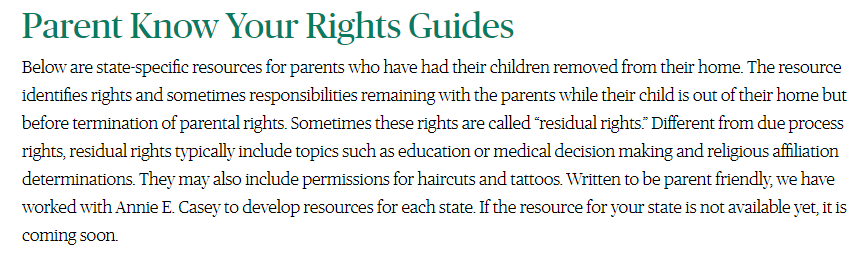
This link will direct you to a list of every state with a link to a summary sheet on the process of child protective services in your state. The ‘one sheet’ analysis is simple and not thorough but will give each parents a chance to be educated in the process before they are caught off guard in court. The Tennessee page looks like this:
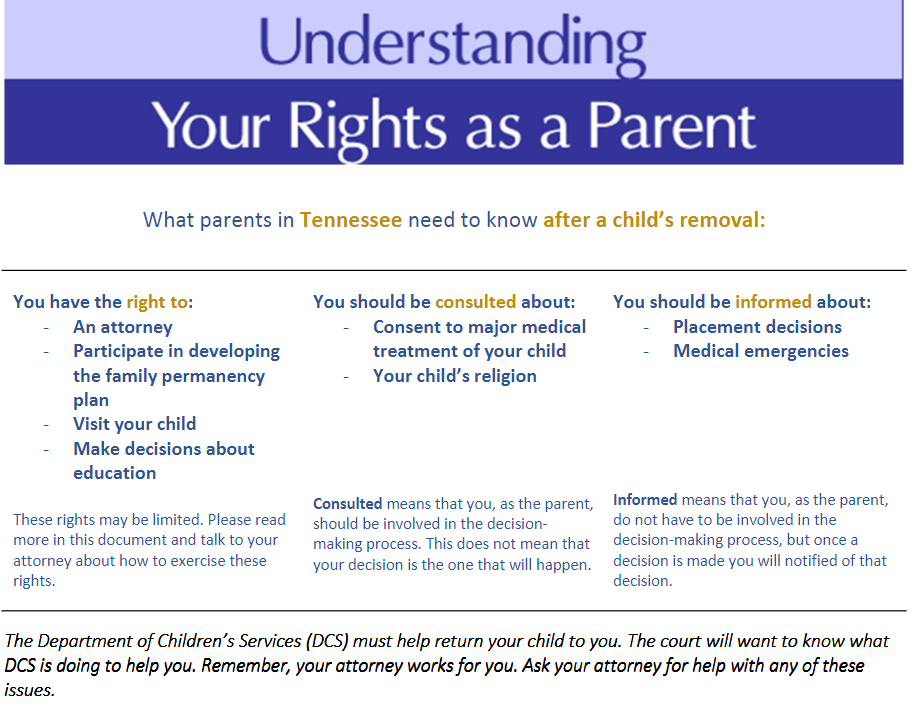
This documents will tell you that you have a right to an attorney, to review CPS/DCS records, to attend child and family team meetings, to make medical decision, to make placement recommendations, and to visit your children. HOWEVER, the language at the bottom of this document is clear: A court or judge can limit these rights.

Therein lies the problem. Even though parental ‘unfitness’ requires the high burden of proof of clear and convincing evidence, there is no such elevated burden of proof to remove your rights one by one.

STATE OF ILLINOIS – 2024 LEGISLATION SUGGESTS BETTER PEDIATRIC PRACTICES

In the State of Illinois SB378 is making significant changes which could help redirect child abuse referrals to an ‘assessment’ path instead of an ‘investigative’ path resulting in removal. This could have only happened with the hard efforts of many advocates, including Family Forward Project, who helped to move the Family First Prevention and Services Act of 2018 (now Family First Act) through Congress. This bill allowed for federal funds to assist with services prior to removal, a provision which was ignored under CAPTA (Child abuse prevention and treatment act of 1974) and subsequent legislation which created the perverted funding scheme.

The jury is still out as to how and when this will be fully implemented because Illinois is long suffering in the child welfare department. Over the last three years, its director was held in contempt of court on multiple occasions for failing to account for the incompetence of the department that left children in harm’s way.

I will review this bill closer and follow up. Have a blessed day.


The rights discussed in this document can be limited by the court. This document should not be considered legal advice and is for informational purposes only. For legal
advice talk to your attorney.
© 2018 American Bar Association Center on Children and the Law
Your Responsibilities to the Court and DCS
– Provide all relevant information to DCS.
– Attend all juvenile court hearings and team meetings.
– Cooperate with your DCS case worker. Stay in touch with your worker. Be sure that the worker always
has your current address and telephone number.
– Participate in the services that are offered and work on your child’s permanency plan, including all
activities and services the Court may order you and other family members to complete.
– Provide your DCS case worker with information about your progress towards completing your
responsibilities in your family permanency plan and any changes in your life.
– Visit and communicate with your child as agreed upon.
– Pay child support if ordered by the court.
MoreMoreMoreMore informationinformationinformationinformation ccccan be found:an be found:an be found:an be found:
American Bar Association Center on Children and the Law Parent Representation
http://www.americanbar.org/groups/child_law/what_we_do/projects/parentrepresentation.html
Rise Magazine for Parents http://www.risemagazine.org/
Birth Parent National Network http://bpnn.ctfalliance.org/
1 Tenn. Code Ann. § 37-1-126
https://www.americanbar.org/groups/public_interest/child_law/project-areas/parentrepresentation/parent-know-your-rights-resources

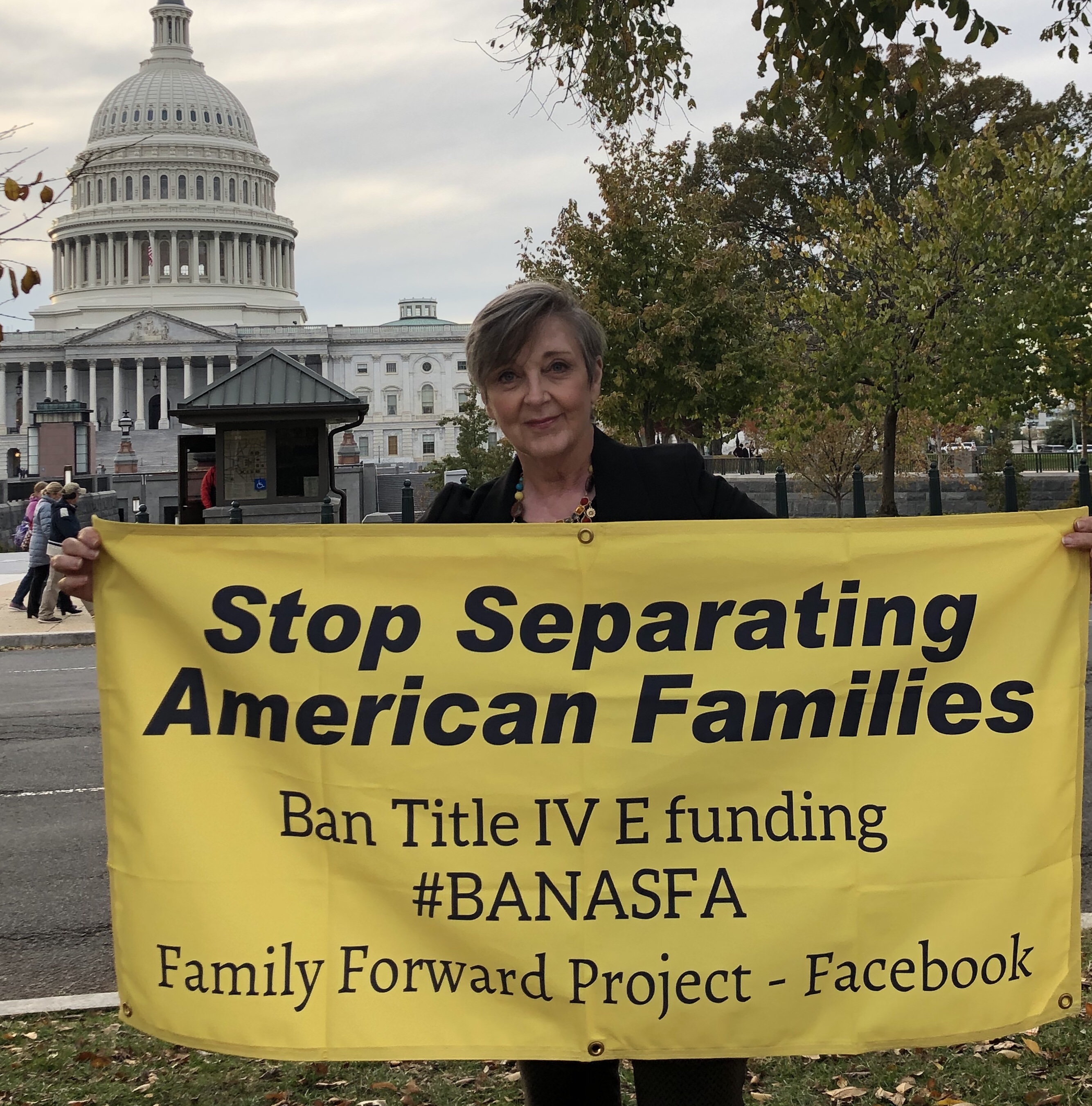
Stop Separating American Families

Connie Reguli and Catherine Wang Anderson

$$$$$$$$$$$$$$$$$$$$$$$$$$$$$$$$$$$$$$$$$$$$$$$$$$$$$

Child Welfare Statistics

Federal payments – our tax dollars – go to states to support the entire foster care and group home system. Payments begin the moment a child is taken with bonuses for “special needs” such as medication, then more bonuses to state agencies for termination of parental rights or adoption of children even if parents are still fighting for custody in Family Court. The most recent estimates are that foster care in America is a $1,000+ billion per year industry. See annual expenditures; https://www.acf.hhs.gov/cb/research-data-technology/statistics-research

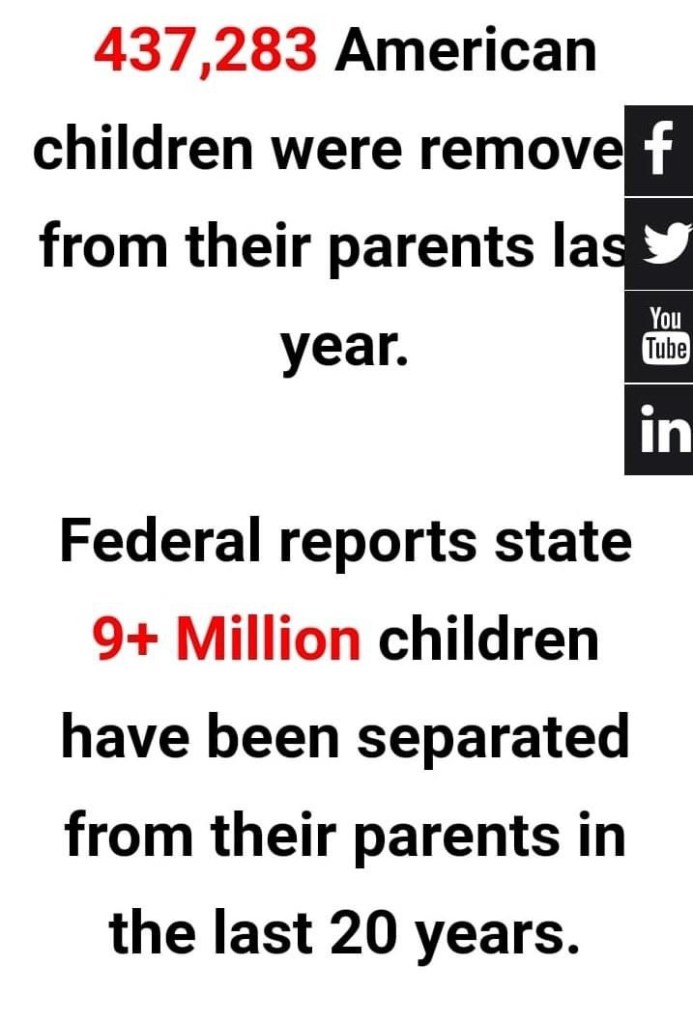
As last reported in August 2019, 437,238 children nationally were removed from their families and placed in foster homes according to the federal government Adoption and Foster Care Analysis and Reporting System. https://www.acf.hhs.gov/sites/default/files/cb/afcarsreport26.pdf

This traumatization of US children has reached epidemic proportions. According to a 10-year study by the American Public Health Association, an alarming estimate that 37.4% of all children experience a child protective services investigation by age 18 years. That results in 27.7 million children investigated based upon the current U.S. population census of approximately 75 million children under age 18 https://ajph.aphapublications.org/doi/abs/10.2105/AJPH.2016.303545 or 49 million parents being investigated according to the latest 2019 U.S. Census Bureau findings. https://www.census.gov/data/tables/2019/demo/families/cps-2019.html

What’s even more alarming is that a staggering 84% of all child removals are not related to any physical harm to the child whatsoever as reported to the US Congress in the AFCARS report above. Furthermore, 61% of the placements were considered neglect, which is based purely on social worker discretion, which basically translates to the freedom to do whatever the caseworker wants. What they see as “neglect” is often just what poverty looks like. Instead of getting help to parent, the parents get their children taken. Please see the annual U.S. Department of Health & Human Services report. https://www.acf.hhs.gov/sites/default/files/cb/cm2018.pdf

In June of 2018, the Children’s Defense League and 540 organizations from all 50 states, the District of Columbia and Puerto Rico which have well-recognized expertise in the fields of child welfare, juvenile justice and child health, development and safety, reported that the separation of children from their parents will have significant and long-lasting consequences for the safety, health, development, and well-being of children. https://www.childrensdefense.org/wp-content/uploads/2018/08/child-welfare-juvenile.pdf

Wrongful removal – Oklahoma – 2018

cases.justia.com/federal/appellate-courts/ca10/16-7079/16-7079-2018-08-27.pdf

By Connie Reguli

In this case a minor child sued for wrongful removal and violation of substantive due Process rights.
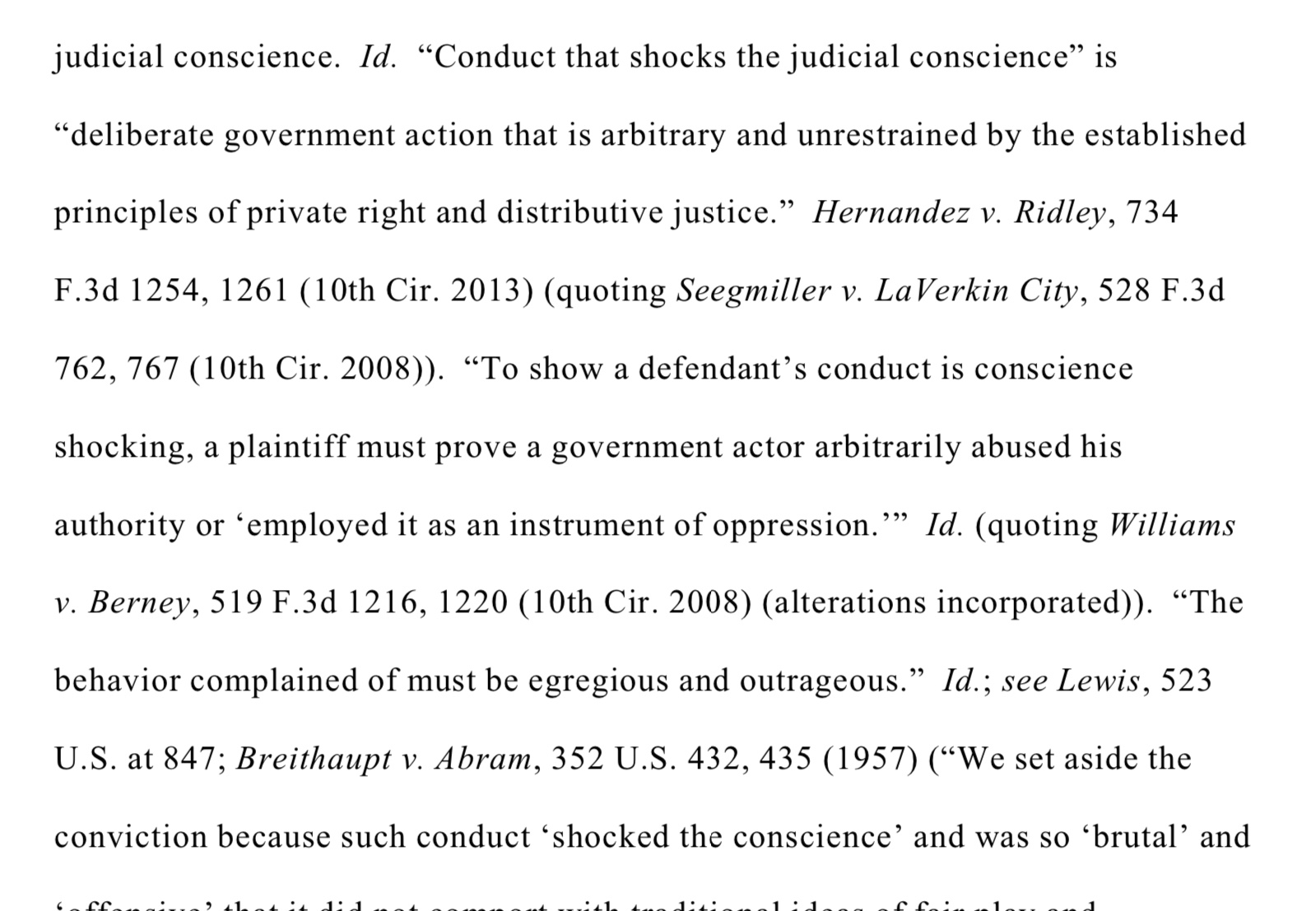
One of the most difficult aspects of a civil rights case is overcoming immunity. In this case the social workers and law enforcement officers claimed qualified immunity for violating the child’s (fourth amendment rights) and substantive due process rights of familial integrity when the child was removed from school for a forensic interview and told by the law enforcement officer that they were going to find him a better home.

In this appeal the tenth circuit court said that the case could proceed on violations of fourth amendment violations. However the court dismissed the claims for substantive due process rights stating that it was not “clearly established” that the child had the right of family integrity in this situation, that is, the fact that the officials impugned his father and damaged his relationship with him was not enough.

Note – analysis of substantive due process – the courts consideration of (1) a fundamental liberty interest vs (2) shock the conscious conduct by state actors.

Good analysis of the reasonableness standard in a claim for fourth amendment violations.

Note. The child was not removed from his home and the Interview revealed no disclosures of abuse.

Here are some excerpts:

The court compares fundamental right to the shocks the conscience standard. –

What is conscious shocking conduct?

Court says that they have implicitly used that standard before.

What you must show for violations of the substantive due process violations of family integrity.

By Connie Reguli

SHARING THE BLISS OF FAMILY LAW IN TENNESSEE

JULY 26, 2017 – Connie Reguli

I had lunch today with one of my favorite members of the Davidson County Bar who also suffers through juvenile court on a regular basis like I do. We both like to challenge the perspectives of the Juvenile Court judges, we both stand up for clients in difficult situations, and we both have watched judges in the Courtrooms do some strange things.

We always share what has been going on in our cases from the legal perspective. How we challenge the government is one our favorite topics.

Topics of discussion today:

Evidence – Rule 803(25) – the hearsay exception on allowing children's statements though other persons. The rule specifically allows this in dependency, termination, and custody proceedings. Therefore, if you are in a administrative hearing contesting an child abuse indication, this hearsay exception does not APPLY.

Termination of parental rights and Adoption – We discussed how the Court of Appeals decided this year that foster parents have the right to file for termination of parental rights and adoption. EVEN though 37-1-129 give DCS total control over placement once the child is in DCS custody and 37-1-130 gives DCS the authority to return a child to the parents. It begs the question that if foster parents file for termination why DCS doesn't go get the child and move him/her. A termination and adoption proceeding is NOT a custody proceeding. Therefore, the tpr/adoption court does NOT have jurisdiction to award custody.
In 2015, the Court of Appeals ruled that "former foster parents" have NO standing to seek termination of parental rights and adoption against a parent. But in 2016, the Court ruled that current foster parents DO have standing to file a contest termination and adoption petition against DCS.
Put this back to back with the rule that grandparents have NO standing (right) to intervene in a termination proceeding filed by DCS when children are in foster care. The Court of Appeals in Tennessee has ruled that the only relief that can be granted in a TPR is termination of parental rights and guardianship, therefore, grandparents can not intervene. Of course they do not discuss that the grandparents could be awarded guardianship in that same proceeding.
Okay, so one more twist to this. I represented a Mother who lived in Texas and the children lived in Tennessee with their Father. Father dropped dead suddenly. Stepmother rushed to Juvenile Court and got an ex parte custody order saying the Mother abandoned the children. Then, she ran over the Chancery Court and filed to termination and adoption, so she could get the survivor benefits of Social Security. Mom came to Tennessee to fight for her children. Under the abandonment statute, the stepmother was going to show that Mom did not pay child support so therefore, there were grounds for termination. I wrote three briefs that the stepmother lacked standing at the request of the Sumner County Chancery Court. The judge made us come back three times just to argue the legal standard. Finally, he agreed with me and dismissed stepmother's petition. Even after he FULLY dismissed her petition, he refused to give the kids back immediately. He said the kids needed time to say goodbye and gave the stepmother two more weeks to turn the kids over. I asked him put the exact date and time in the order. Sure enough, stepmother did not show up. At least the Mother had a court order and she was able to get law enforcement to help get them back.

ICPC – Interstate Compact for the Placement of Children. First of all, this document created by a third party is total HEARSAY. Several years ago, guardian ad litems used to file reports with the court. In Toms v. Toms, the Tennessee Supreme Court finally said that these are HEARSAY and cannot be admitted in the court file. HOWEVER, DCS and CASA continue to file ex parte hearsay reports with the juvenile court ALL THE TIME. And the ICPC report it total hearsay. Well it doesn't matter much if your client PASSES the ICPC. But if your client FAILS the ICPC, you are flat out of luck. I had a client/Mother who moved to Kentucky and her case was in Tennessee. DCS told her she had to get an ICPC passed before she could get her kids back. Okay, we say, bring it on. A Kentucky social worker shows up at her home. I told Mother to record everything. So she recorded the entire 20 minute visit by the social worker. As she walked out the door, the social worker was asked, Is everything Okay? "Y'all have nothing to worry about." She said. Then the client failed the ICPC in the report because she did not have central air conditioning and they said her boyfriend was "too controlling." I filed a petition for custody and the Juvenile Court judge in Sumner County would not even let us be heard. DCS said that the Mother did not even have the right to a hearing if she did not pass the ICPC. In 2016, the Court of Appeals told my client, a father who never harmed or abused his child, that since he failed the ICPC (because he lived with his mother) that he was not entitled to seek custody. They also said that since he was not married to the Mother, he NEVER had any custodial rights. In 2015, the Court of Appeals said the relatives who failed the ICPC were NOT entitled to seek custody even after the judge held an evidentiary hearing and found that it was in the best interest of the child to go with the relatives. Recently, the Court of Appeals has ruled that a parent does not have to comply with ICPC, but only if there are no allegations against that parent.

CHILD AS A PARTY / CHILD AS A WITNESS – Is the child a party to a dependency and neglect action in Juvenile Court under 37-1-103? Children, especially, those over 12 years old, are often the reporters of abuse and neglect against their parents. They may or may not be legitimate claims. If the child is going to testify in a hearing, the parents' attorneys should have access to the child for deposition testimony. Now how does that occur. Most Courts will allow the testimony of the child in chambers or outside of the presence of the parents. However, the attorneys and the court reporter are allowed to participate. There is no direct authority on whether or not the parents should be allowed to participate in the child's deposition. I have had the parents across the table from child for purposes of deposition without objection. I understand that Williamson County Juvenile Judge Guffee denied counsel the right to depose the minor accuser/witness.

VANDERBILT CHILDREN'S HOSPITAL AND DR. DEBORAH LOWEN – For those who don't know, Dr. Lowen is the child abuse expert at Vanderbilt – the go-to hospital for child abuse referrals. We both agreed that this doctor is the ultimate profession henchman for DCS. Everything she sees "could have only happened from abuse." I have dealt with her inflexible and unwavering opinions regarding her "medical diagnosis" of "child abuse." We also discussed the legal standard for a "reasonable degree of medical certainty." Attorney John Day recently reported that the Third Restatement on Torts has rejected the "reasonable degree of medical certainty" standard because "the reasonable-certainty standard provides no assurance of the quality of the expert’s qualifications, expertise, investigation, methodology, or reasoning."
Added to the complexity of this cliche legal standard is the contrast between the preponderance of the evidence standard and the clear and convincing standard required in a dependency proceedings.
In all cases, parents' attorneys should be requiring "child abuse experts" to provide the medial research, literature, case studies, and review articles that support their opinion. Remember that most medical opinions are formed from "medical literature" and NOT medical RESEARCH. Know the difference. Literature is just an opinion. Medical literature changes over time and so do medical opinions. It takes substantial preparation on the part of the defense attorney to understand how to defeat these medical experts.

MANY MANY PARENTS find themselves in the abyss of the family court system. And often they wonder why we can not give them black and white answers on questions related to parental rights.

The system needs a major overhaul.