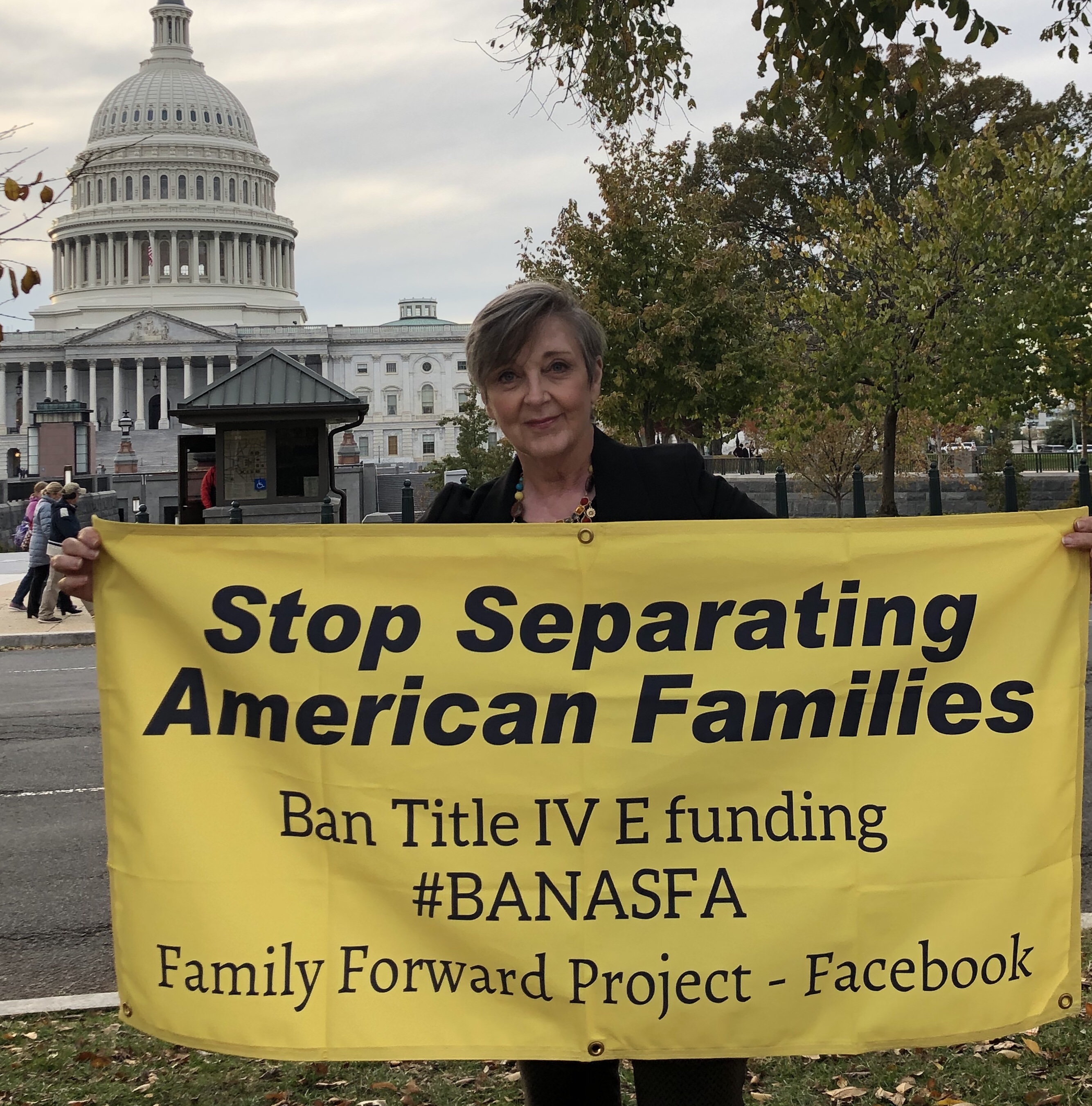
State’s Interference with Parental Medical Decision Making.

Contributors from Family Forward Project Ginnie Todd and Patty Hansen

Follow us on Family Forward Project on Facebook

Karabeika dismissed a juvenile case that had placed DHS as Kylee Dixon’s legal guardian. She will now be permitted to return to her mother’s care.

Kylee Dixon had surgery on Jan. 14 to remove a cancerous tumor from her liver. DHS said she is now cancer-free. The surgery, and the dismissal of the case, capped a months-long dispute between DHS and Christina Dixon over how to treat Kylee Dixon’s cancer diagnosis.

This is an important case for every American parent. You may be one hospital visit and one differing opinion away from the state intruding in what parental rights you think you have. Harming a child is NEVER okay but being forced into treatment is not the job of any government. What is the point of requiring patients to consent to treatment and acknowledge the risks and benefits, IF hospitals can force you into treatment under threat of removing your child and forcing you through a legal process that is not only secretive (confidential) but lacks due process and accountability. That battle will cost you upwards of $50,000 – 100,000 to defend your decision to get another opinion, or take a different treatment path, or simply honor your child’s wishes to not subject themselves to chemo or some other care. The system seems to have forgotten the practice of medicine makes no guarantees.

Feb 3 2020 Kylee Dixon returned to mother’s custody, judge dismisses DHS case. https://www.oregonlive.com/clackamascounty/2020/02/kylee-dixon-returned-to-mothers-custody-judge-dismisses-dhs-case.html

Georgia lawmakers say foster parents cannot have sex with foster children – Geez.

By Connie Reguli

“This bill simply closes the loophole in prohibiting foster parents from having inappropriate sexual contact with their foster kids.” GA state rep Ed Setzler.

On multiple occasions I have seen cases where kids in foster care are either victims of sexual assault or allowed to have sex with other kids in foster care. These kids are traumatized by abrupt removals from their homes.

2020 GA house bill 911.

HB 911 

Crimes and offenses; offenses of improper sexual conduct by a foster parent in the first and second degrees; provide

Current Status: House Passed/Adopted By Substitute

Official Summary: A BILL to be entitled an Act to amend Chapter 6 of Title 16, Article 2 of Chapter 3 of Title 35, Article 3 of Chapter 5 of Title 42, and Article 1 of Chapter 2 of Title 49 of the O.C.G.A., relating to sexual offenses, the Georgia Crime Information Center, conditions of detention generally, and general provisions regarding the Department of Human Services, respectively, so as to provide for the offenses of improper sexual conduct by a foster parent in the first and second degrees; to provide for related matters; to repeal conflicting laws; and for other purposes.

Continue reading

Constitutional Law on our rights.

By Connie Reguli

Here’s some caselaw should you want to add it to your list:

Below are excerpts of case law from state appellate and federal district courts and up to the U.S. Supreme Court, all of which affirm, from one perspective or another, the absolute Constitutional right of parents to actually BE parents to their children.

The rights of parents to the care, custody and nurture of their children is of such character that it cannot be denied without violating those fundamental principles of liberty and justice which lie at the base of all our civil and political institutions, and such right is a fundamental right protected by this amendment (First) and Amendments 5, 9, and 14. Doe v. Irwin, 441 F Supp 1247; U.S. D.C. of Michigan, (1985).

The several states have no greater power to restrain individual freedoms protected by the First Amendment than does the Congress of the United States. Wallace v. Jaffree, 105 S Ct 2479; 472 US 38, (1985).

Loss of First Amendment Freedoms, for even minimal periods of time, unquestionably constitutes irreparable injury. Though First Amendment rights are not absolute, they may be curtailed only by interests of vital importance, the burden of proving which rests on their government. Elrod v. Burns, 96 S Ct 2673; 427 US 347, (1976).

Law and court procedures that are “fair on their faces” but administered “with an evil eye or a heavy hand” was discriminatory and violates the equal protection clause of the Fourteenth Amendment. Yick Wo v. Hopkins, 118 US 356, (1886).

Even when blood relationships are strained, parents retain vital interest in preventing irretrievable destruction of their family life; if anything, persons faced with forced dissolution of their parental rights have more critical need for procedural protections than do those resisting state intervention into ongoing family affairs. Santosky v. Kramer, 102 S Ct 1388; 455 US 745, (1982).

Parents have a fundamental constitutionally protected interest in continuity of legal bond with their children. Matter of Delaney, 617 P 2d 886, Oklahoma (1980). .

The liberty interest of the family encompasses an interest in retaining custody of one’s children and, thus, a state may not interfere with a parent’s custodial rights absent due process protections. Langton v. Maloney, 527 F Supp 538, D.C. Conn. (1981).

Parent’s right to custody of child is a right encompassed within protection of this amendment which may not be interfered with under guise of protecting public interest by legislative action which is arbitrary or without reasonable relation to some purpose within competency of state to effect. Regenold v. Baby Fold, Inc., 369 NE 2d 858; 68 Ill 2d 419, appeal dismissed 98 S Ct 1598, 435 US 963, IL, (1977).

Parent’s interest in custody of her children is a liberty interest which has received considerable constitutional protection; a parent who is deprived of custody of his or her child, even though temporarily, suffers thereby grievous loss and such loss deserves extensive due process protection. In the Interest of Cooper, 621 P 2d 437; 5 Kansas App Div 2d 584, (1980).

The Due Process Clause of the Fourteenth Amendment requires that severance in the parent-child relationship caused by the state occur only with rigorous protections for individual liberty interests at stake. Bell v. City of Milwaukee, 746 F 2d 1205; US Ct App 7th Cir WI, (1984).

Father enjoys the right to associate with his children which is guaranteed by this amendment (First) as incorporated in Amendment 14, or which is embodied in the concept of “liberty” as that word is used in the Due Process Clause of the 14th Amendment and Equal Protection Clause of the 14th Amendment. Mabra v. Schmidt, 356 F Supp 620; DC, WI (1973).

“Separated as our issue is from that of the future interests of the children, we have before us the elemental question whether a court of a state, where a mother is neither domiciled, resident nor present, may cut off her immediate right to the care, custody, management and companionship of her minor children without having jurisdiction over her in personam. Rights far more precious to appellant than property rights will be cut off if she is to be bound by the Wisconsin award of custody.” May v. Anderson, 345 US 528, 533; 73 S Ct 840, 843, (1952).

A parent’s right to care and companionship of his or her children are so fundamental, as to be guaranteed protection under the First, Ninth, and Fourteenth Amendments of the United States Constitution. In re: J.S. and C., 324 A 2d 90; supra 129 NJ Super, at 489.

The Court stressed, “the parent-child relationship is an important interest that undeniably warrants deference and, absent a powerful countervailing interest, protection.” A parent’s interest in the companionship, care, custody and management of his or her children rises to a constitutionally secured right, given the centrality of family life as the focus for personal meaning and responsibility. Stanley v. Illinois, 405 US 645, 651; 92 S

FFP Parent Advocacy Guidelines – 2020

By Connie Reguli

2019 – Connie Reguli – Washington D.C. Parent Advocacy

FFP ADVOCACY GUIDELINES:

  1. BOUNDARIES
    1. Not a source of financial or legal support.  No exchange of money, no invitation into personal home unless boundaries agreed upon
    1. Advocate is not an attorney or mental health professional.  In the event a mental health emergency arises, professionals should be contacted.  In the event a legal question arises, it can be discussed and documented but should be referred to counsel.
    1. Advocate is not a substance abuse specialist.  In the event, addictive behaviors, drug use, or other drug involvement becomes an issues beyond common support and encouragement, professionals should be engaged.
    1. The relationship is confidential and should not be discussed outside of the relationship except with permission of counsel and the parent.  Advocate can disclose information to parent’s counsel if approved by FFP administrator.
  2. SUPPORT / ENCOURAGE / ACCOUNTABILITY
    1. Biggest factor is support and encouragement in the process and in the absence of children.
    1. Accountability is to help the parents track their progress.  Classes, evaluations, court preparation, etc.
    1. Parenting writing letters to children.  Keep them simple and encouraging. 
    1. Help parents prepare for visitation emotionally.
    1. Help parents stay focused on the resolution of the case. 
    1. Helping parents understand their relationship with other providers.  Courteous but not trusting.
  3. DOCUMENTATION
    1. Help parents create and keep timelines.
    1. Help parents identify and list all resources needed to court, records, witnesses, keeping provider evals and reports, keeping up with classes, evals and other requirements.
    1. Recording, obtaining court recordings, organizing and storing data, etc to assist attorney for trial.
    1. File folders for DCS, perm plans, foster care review, court docs, subpoenas, notes, calendars, classes, income and housing, etc. 
  4. CEASE AT ANY TIME
    1. At any time the advocate or parent feels that the relationship is not assisting them, they may terminate the relationship without question.
    1. At any time the advocate feels that they are unproductive, abused, or taken advantage of by the parent they can stop with no questions asked.
    1. Any notes taken by the advocate are strictly confidential and upon the termination of the relationship the notes should be turned over to the parents, Family Forward administrator, or destroyed. 
  5. COMPENSATION
    1. Advocates are not paid and are providing their time and support without compensation.  If the parent or someone in behalf of the parent wishes to provide some compensation to the advocate it should only be with the approval of FFP administrator.
    1. Likewise, the parent is not to request or receive compensation from the advocate without approval of FFP.  This does not include token appreciation or support, but any such exchange must be documented and logged in case this exchange is later questioned. 
    1. Gifts for the children are discouraged but not forbidden if they are small token gifts or activities provided to the parents to encourage the relationship such as games, activities, crafts, cuddlies.
  6. RELIGIOUS ACTIVITIES
    1. FFP is not a religious organization.  Any activities such as Bible studies, prayer, or scripture reading shall be with the consent of both parties.  At any time, if the parent or advocate deems this inappropriate it should be ceased.

Reviewed with:

          Parent: ______________________________Date: ________________

          Advocate: ___________________________ Date: _________________

Advocate: ___________________________ Date: _________________

Kentucky – and immunity

By Connie Reguli

Please listen to the legal arguments in this case

It is about a brith mom who had one positive drug test results and three negative test results. The state put the family in a safety plan.

The state dropped the safety plan.

The parents then filed a civil rights complaint for Fourth and Fourteenth procedural and substantive due process rights.

The argument is about qualified immunity.

www.courtlistener.com/mp3/2019/12/06/holly_schulkers_v._elizabeth_kammer_cl.mp3

By Connie Reguli.

SCHULKERS v. KAMMER

Kimberly Jenci Hawthorne , D. Brent Irvin , Kentucky Cabinet for Health and Family Services Office of Legal Services, Frankfort, KY, Ellen M. Houston , Michael Joseph Enzweiler , Dressman Benzinger LaVelle P.S.C., Crestview Hills, KY, for Defendants.

https://www.leagle.com/decision/infdco20190211a69

UA drug screens – not admissible – OBJECT

By Connie Reguli

Connie Reguli in Washing D.C. 2018.

DRUG SCREENS.

Connie,

No reports necessary. The information will be in the package insert for the drug test. Most say something similar to what the Redwood Toxicology Lab RediCup instert says:

•The RediCup® is used for Screening Only. Positive results obtained with this device are presumptive.

•Additional testing is necessary to confirm the presumptive positive results. Positive results should be “confirmed” by an alternate method such as GC/MS (GasChromatography/Mass Spectrometry) or LC/MS/MS (Liquid Chromatography/Tandem Mass Spectrometry).

•Professional judgment should be applied to any drug of abuse test result, particularly with preliminary positive results.

Positive point of care urine drug screens are only a presumptive positive and must be confirmed by lab testing. If a party wants to enter the results of a point of care drug screen into evidence, enter the package insert, as well.

I will add more on this later.

RECORD YOUR HEARINGS

By Connie Reguli

Connie Reguli in Washington D.C. – 2019. By Freedom Public Press

TENNESSEE FAMILIES – LET ME BE LOUD AND CLEAR ON THIS POINT. YOU HAVE A RIGHT TO RECORD ALL COURT HEARINGS. YOU DO NOT HAVE TO HAVE A COURT REPORTER AND QUITE FRANKLY, I THINK YOU HAVE THE RIGHT TO VIDEO TAPE THE HEARING.

RULE 115RECORDING HEARINGS

All hearings, except ex parte hearings, shall be audio recorded by the clerk of the court and retained for a minimum of one year from the date of the final disposition of the case.

Advisory Commission Comments. In accordance with T.C.A. §§ 37-1-124(c) and 37-1-159(a), the juvenile court is a court of record. Under this rule, all juvenile courts must create and maintain an audio recording of all hearings in juvenile court, in addition to keeping and maintaining appropriate minutes of hearings. Alternative means of recording, e.g. audio-visual equipment, are acceptable. This rule does not preclude simultaneous recording by a court reporter or other means of recording by a party. This rule is not applicable to reviews conducted by a foster care review board.

In addition, the Tennessee Code provides the attorneys can record any proceeding.

20-9-104. Tape recording of proceedings.

It is lawful for attorneys representing parties in proceedings in any of the courts of this state to use tape recorders as an aid in making notes of the proceedings.

First Amendment Rights

By Connie Reguli

Connie Reguli has practiced family law and litigation for 25 years plus. Also known as an advocate for child welfare reform.

In 1984, the United States Supreme Court entered an opinion in Garrison v. La., 379 U.S. 64, (1964) in which discussed a dispute between the district attorney and a judge.  The attorney held a press conference where he issued a statement disparaging judicial conduct.  The district attorney was arrested under the criminal sedition laws of New York.  The court stated that where the criticism is of public officials and their conduct of public business, the interest in private reputation is overborne by the larger public interest secured by the constitution, in the dissemination of truth.  Even where the utterance is false, the great principles of the Unites States Constitution which secure freedom of expression in this area preclude attaching adverse consequences to any except the knowing or reckless falsehood. Debate on public issues will not be uninhibited if the speaker must run the risk that it will be proved in court that he spoke out of hatred; even if he did speak out of hatred, utterances honestly believed contribute to the free interchange of ideas and the ascertainment of truth.  Since an erroneous statement is inevitable in free debate, it must be protected if the freedoms of expression are to have the breathing space that they need to survive, only those false statements made with the high degree of awareness of their probable falsity may be the subject of either civil or criminal sanctions.  For speech concerning public affairs is more than self-expression, it is the essence of self-government.  The First and Fourteenth Amendments embody a profound national commitment to the principle that debate on public issues should be uninhibited, robust, and wide-open, and that it may well include vehement, caustic, and sometimes unpleasantly sharp attacks on government and public officials. 

On July 29, 2019, the Sixth Circuit Court entered an opinion regarding the use of social media for the criticism of public officials.  In Novak v. City of Parma, 18-3373 (6th Cir. July 29, 2019) the Court examined the use of Facebook by a citizen to criticize and ridicule the local police department.  The page was set up to look like an official cite and ran fake news stories making the police department appear as incompetent racists.  The police department subpoenaed records from Facebook to find out the person that had caused this public harassment of law enforcement.  The police department claimed that Plaintiff had made several “material misrepresentations and omissions.”  Claiming that Plaintiff have unlawfully impaired the department’s functions, Plaintiff was criminally charged and arrested.  Plaintiff was acquitted of criminal charges when Plaintiff showed that other than twelve minutes of phone calls to the department, there was no disruption to its function.  Plaintiff sued for First Amendment violations.  The Sixth Circuit Court examined whether the state actor defendants would enjoy qualified immunity and be exempt from civil liability.  The Court denied qualified immunity and the Court’s analysis of the First Amendment rights of the plaintiff are relevant to the status to the case at bar. Novak v. City of Parma, July 29, 2019.

The Sixth Circuit stated that Plaintiff had a claim for First Amendment retaliation if (1) the plaintiff engaged in constitutionally protected activity, (2) the state actors adverse actions caused the Plaintiff to suffer an injury that would likely chill a person of ordinary firmness from continuing that activity, and (3) the state actors were motivated, at least in part, by his exercise of his constitutional rights. Pg. 6. 

The Sixth Circuit also stated that Plaintiff had a claim for First Amendment prior restraint if he could show that an administrative or judicial order forbid his protected speech in advance.  Pg. 13. In Novak, the plaintiff alleged that the police department had issued a press release threatening to prosecute him, sent a letter and an email to Facebook demanding the page be taken down, and confiscated his computer equipment.  Plaintiff claimed that this constituted an implicit threat of governmental action.  Pg. 14.  A prior restraint must raise a legal impediment to speech with the classic examples of restraining orders and court issued injunctions. But such a formality is not necessary to constitute a prior restraint.  The Sixth Circuit stated that the announcement that they had opened an investigation on Plaintiff was sufficient to make a plausible claim for First Amendment prior restraint. 

In addition to the Novak case, other First Amendment authority in his prior Motion for Recusal (Circuit Court case).  The United States Supreme Court established a broad prohibition against prior restraints of speech in Neb. Press Ass’n v. Stuart, 427 U.S. 539 (1976).  The First Amendment thus accords greater protection against prior restraints than it does against subsequent punishment for a particular speech.  A system or prior restraint is in many ways more inhibiting than a system of subsequent punishment.  It is likened to being under government scrutiny a far wider range of expression; it shuts off communication before it takes place; suppression by a stroke of the pen is more likely to be applied than suppression through a criminal process; the procedures do not require attention to the safeguards of the criminal process; the system allows less opportunity for public appraisal and criticism; the dynamics of the system drive toward excesses, as the history of all censorship shows.  It has been generally, if not universally, considered that it is the chief purpose of the First Amendment’s guaranty to prevent prior restraints upon publication.  The Nebraska Press case dealt with the Court’s attempts to suppress publication of events that happened in the courtroom and attempted to expand that limited exception to this prohibition.  The Supreme Court rejected this attempt to shut down reports of judicial proceedings, determining that the Courtroom was already in the public domain.

In 2002, the Middle District Court of Tennessee considered the government’s role in prior restraint on speech in the context of controlling a non-profit’s ability to raise charitable donations.  A prior restraint exists when the exercise of a First Amendment right depends on the prior approval of public officials.  The term prior restraint describes administrative and judicial orders that block expressive activity before it can occur.  Under a system of prior restraint, the lawfulness of speech turns on the advance approval of government officials.  Although prior restraints are not unconstitutional per se, they come to court bearing a heavy presumption against their validity.  Feed the Children, Inc. v. Metro. Gov’t of Nashville,  330 F. Supp. 2d 935, (M.D. Tenn. Mar. 21, 2002) 

The Tennessee Court of Appeals recognized the federal guidelines on prior restraint of speech in In re Conservatorship of Turner, M2013-01665-COA-R3-CV, (Tenn. Ct. App. May 9, 2014).  It acknowledged that an impermissible prior restraint exists when the exercise of First Amendment rights depends upon prior approval  of public officials.  A system of prior restraints bears a heavy presumption against its constitutional validity.  The Court did recognize the exception stated by the Sixth Circuit in which a person could be prohibited from repeating the same libelous and defamatory statements which have been judicially determined in proceedings to be false and libelous

The law in this country against prior restraints and sedition provide protection for the litigants that enter this Courtroom who seek a fair and impartial tribunal.  The restraints put on attorneys is more ambivalent.  Tenn. R. Sup. Ct. 8, Rule 8.4 prohibit attorneys from engaging in conduct prejudicial to the administration of justice.  A rule left open for broad interpretation and has included actions deemed as intending to “impugn the judiciary.”  Ward v. University of the South,  354 S.W. 2d 246 (1962).  

The right to a fair trial before an impartial tribunal is a fundamental constitutional right.” State v. Austin, 87 S.W.3d 447, 470 (Tenn. 2002). Article VI, section 11 of the Tennessee Constitution provides, “No Judge of the Supreme or Inferior Courts shall preside on the trial of any cause in the event of which he may be interested . . . .” This provision is intended “to guard against the prejudgment of the rights of litigants and to avoid situations in which the litigants might have cause to conclude that the court had reached a prejudged conclusion because of interest, partiality, or favor.” Austin, 87 S.W.3d at 470. We have recognized that it is important to preserve the public’s confidence in a neutral and impartial judiciary. Bd. of Prof’l Responsibility v. Slavin , 145 S.W.3d 538, 548 (Tenn. 2004). Bean v. Bailey, 280 S.W.3d 798, 803, 2009 Tenn. LEXIS 296, *11 (2009)

Tennessee’s post adoption contract – the new “open adoption” standard

Dec 2019

By Connie Reguli

In 2019

https://lookaside.fbsbx.com/file/Post%20Adoption%20Contact%20Agreement%20law.pdf?token=AWw2R4uSr9k8Jv-KyYr3GVDYPF1IMHVBAh0YHsuTT50J6gJ14frF5yEPAb0H2trIeoFHSvZYTrIZuWqTopU8dniXU_UuwlWQDhCBs6H-JTHvMdDW9Ku6Zm0CwWRRj-EHB2rnYJVwk88RrF5HRg4MkEvKu9NB_rW3NYpG8xQdgYsWlJ85plMAvF7Uqih6u-gtrWZgUh_-Jkrqu0xEDkZTqFSS

BAM 💥 2.7million kids in care worldwide. Told you so.

By Connie Reguli

pdf.sciencedirectassets.com/271783/1-s2.0-S0145213417X00070/1-s2.0-S0145213416302873/main.pdf

Wrongful removal – Oklahoma – 2018

cases.justia.com/federal/appellate-courts/ca10/16-7079/16-7079-2018-08-27.pdf

By Connie Reguli

In this case a minor child sued for wrongful removal and violation of substantive due Process rights.
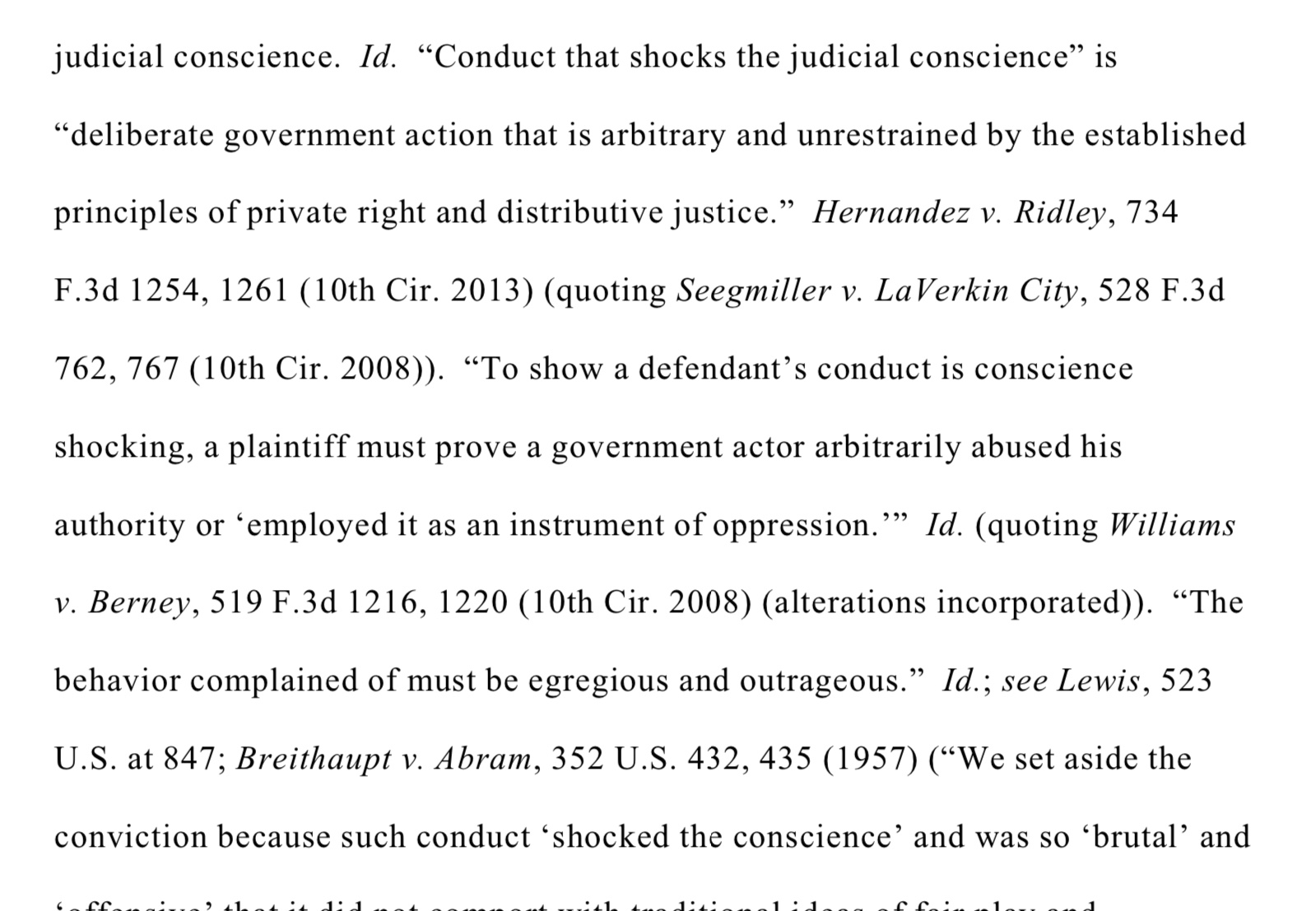
One of the most difficult aspects of a civil rights case is overcoming immunity. In this case the social workers and law enforcement officers claimed qualified immunity for violating the child’s (fourth amendment rights) and substantive due process rights of familial integrity when the child was removed from school for a forensic interview and told by the law enforcement officer that they were going to find him a better home.

In this appeal the tenth circuit court said that the case could proceed on violations of fourth amendment violations. However the court dismissed the claims for substantive due process rights stating that it was not “clearly established” that the child had the right of family integrity in this situation, that is, the fact that the officials impugned his father and damaged his relationship with him was not enough.

Note – analysis of substantive due process – the courts consideration of (1) a fundamental liberty interest vs (2) shock the conscious conduct by state actors.

Good analysis of the reasonableness standard in a claim for fourth amendment violations.

Note. The child was not removed from his home and the Interview revealed no disclosures of abuse.

Here are some excerpts:

The court compares fundamental right to the shocks the conscience standard. –

What is conscious shocking conduct?

Court says that they have implicitly used that standard before.

What you must show for violations of the substantive due process violations of family integrity.

By Connie Reguli