
cdn.media.rollcall.com/author/2019/12/2020CONGRESSIONALCALENDAR.pdf
Tag Archives: child welfare reform
FFP Parent Advocacy Guidelines – 2020
By Connie Reguli

FFP ADVOCACY GUIDELINES:
- BOUNDARIES
- Not a source of financial or legal support. No exchange of money, no invitation into personal home unless boundaries agreed upon
- Advocate is not an attorney or mental health professional. In the event a mental health emergency arises, professionals should be contacted. In the event a legal question arises, it can be discussed and documented but should be referred to counsel.
- Advocate is not a substance abuse specialist. In the event, addictive behaviors, drug use, or other drug involvement becomes an issues beyond common support and encouragement, professionals should be engaged.
- The relationship is confidential and should not be discussed outside of the relationship except with permission of counsel and the parent. Advocate can disclose information to parent’s counsel if approved by FFP administrator.
- SUPPORT / ENCOURAGE / ACCOUNTABILITY
- Biggest factor is support and encouragement in the process and in the absence of children.
- Accountability is to help the parents track their progress. Classes, evaluations, court preparation, etc.
- Parenting writing letters to children. Keep them simple and encouraging.
- Help parents prepare for visitation emotionally.
- Help parents stay focused on the resolution of the case.
- Helping parents understand their relationship with other providers. Courteous but not trusting.
- DOCUMENTATION
- Help parents create and keep timelines.
- Help parents identify and list all resources needed to court, records, witnesses, keeping provider evals and reports, keeping up with classes, evals and other requirements.
- Recording, obtaining court recordings, organizing and storing data, etc to assist attorney for trial.
- File folders for DCS, perm plans, foster care review, court docs, subpoenas, notes, calendars, classes, income and housing, etc.
- CEASE AT ANY TIME
- At any time the advocate or parent feels that the relationship is not assisting them, they may terminate the relationship without question.
- At any time the advocate feels that they are unproductive, abused, or taken advantage of by the parent they can stop with no questions asked.
- Any notes taken by the advocate are strictly confidential and upon the termination of the relationship the notes should be turned over to the parents, Family Forward administrator, or destroyed.
- COMPENSATION
- Advocates are not paid and are providing their time and support without compensation. If the parent or someone in behalf of the parent wishes to provide some compensation to the advocate it should only be with the approval of FFP administrator.
- Likewise, the parent is not to request or receive compensation from the advocate without approval of FFP. This does not include token appreciation or support, but any such exchange must be documented and logged in case this exchange is later questioned.
- Gifts for the children are discouraged but not forbidden if they are small token gifts or activities provided to the parents to encourage the relationship such as games, activities, crafts, cuddlies.
- RELIGIOUS ACTIVITIES
- FFP is not a religious organization. Any activities such as Bible studies, prayer, or scripture reading shall be with the consent of both parties. At any time, if the parent or advocate deems this inappropriate it should be ceased.
Reviewed with:
Parent: ______________________________Date: ________________
Advocate: ___________________________ Date: _________________
Advocate: ___________________________ Date: _________________
Kentucky – and immunity
By Connie Reguli
Please listen to the legal arguments in this case
It is about a brith mom who had one positive drug test results and three negative test results. The state put the family in a safety plan.
The state dropped the safety plan.
The parents then filed a civil rights complaint for Fourth and Fourteenth procedural and substantive due process rights.
The argument is about qualified immunity.
www.courtlistener.com/mp3/2019/12/06/holly_schulkers_v._elizabeth_kammer_cl.mp3
By Connie Reguli.
SCHULKERS v. KAMMER
Kimberly Jenci Hawthorne , D. Brent Irvin , Kentucky Cabinet for Health and Family Services Office of Legal Services, Frankfort, KY, Ellen M. Houston , Michael Joseph Enzweiler , Dressman Benzinger LaVelle P.S.C., Crestview Hills, KY, for Defendants.
BAM 💥 2.7million kids in care worldwide. Told you so.
Wrongful removal – Oklahoma – 2018
cases.justia.com/federal/appellate-courts/ca10/16-7079/16-7079-2018-08-27.pdf
By Connie Reguli
 In this case a minor child sued for wrongful removal and violation of substantive due Process rights.
One of the most difficult aspects of a civil rights case is overcoming immunity. In this case the social workers and law enforcement officers claimed qualified immunity for violating the child’s (fourth amendment rights) and substantive due process rights of familial integrity when the child was removed from school for a forensic interview and told by the law enforcement officer that they were going to find him a better home.
In this appeal the tenth circuit court said that the case could proceed on violations of fourth amendment violations. However the court dismissed the claims for substantive due process rights stating that it was not “clearly established” that the child had the right of family integrity in this situation, that is, the fact that the officials impugned his father and damaged his relationship with him was not enough.
Note – analysis of substantive due process – the courts consideration of (1) a fundamental liberty interest vs (2) shock the conscious conduct by state actors.
Good analysis of the reasonableness standard in a claim for fourth amendment violations.
Note. The child was not removed from his home and the Interview revealed no disclosures of abuse.
Here are some excerpts:
The court compares fundamental right to the shocks the conscience standard. –

What is conscious shocking conduct?
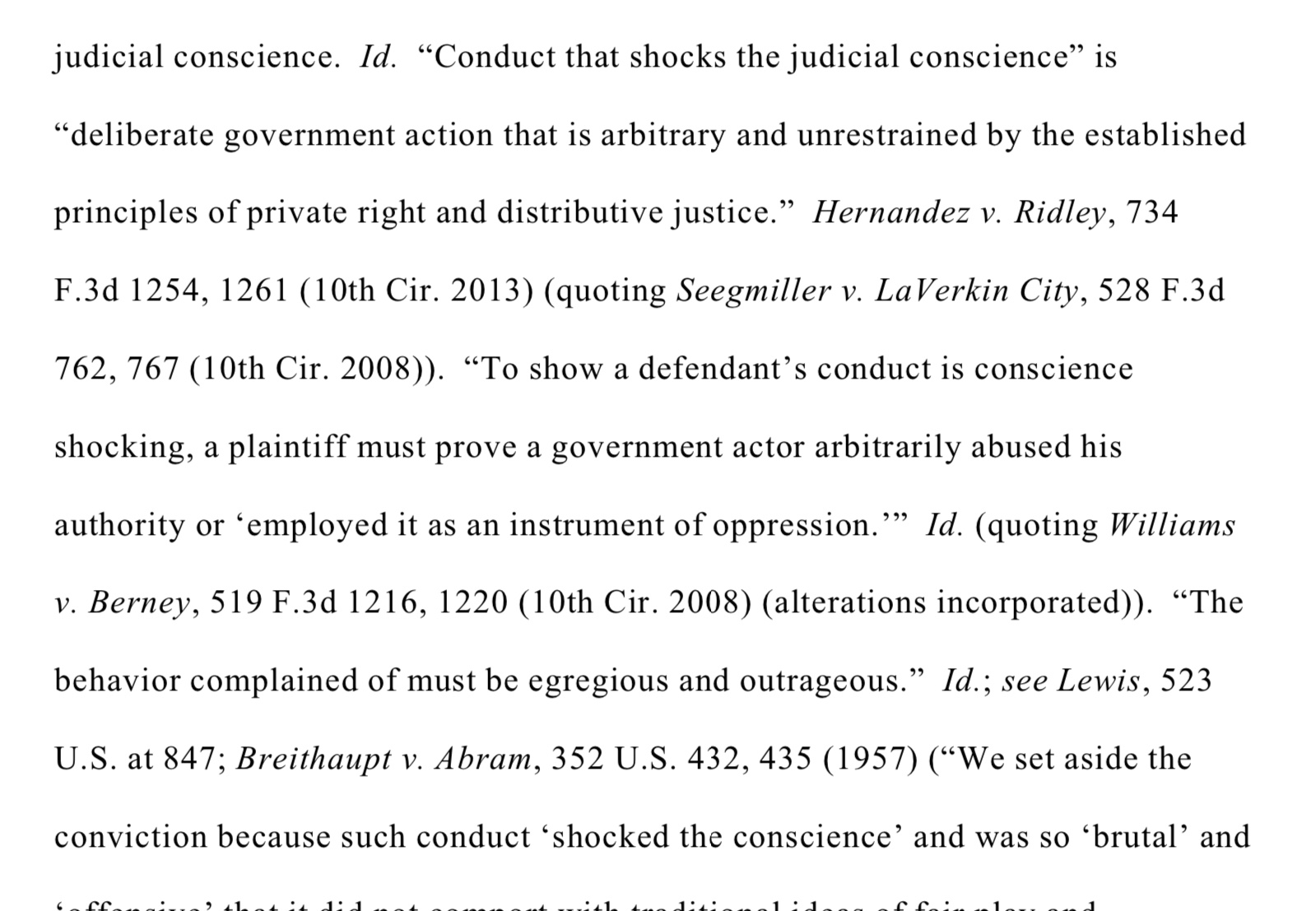
Court says that they have implicitly used that standard before.

What you must show for violations of the substantive due process violations of family integrity.

By Connie Reguli
Connie Reguli addresses the Tennessee General Assembly – March 2019 on DCS corruption and abuse of power.
After my 2019 presentation to the Tennessee General Assembly, I received this post from a member of our Family Forward Project on Facebook. It helps for you to hear the interpretations made by others so we can continue to develop our critical thinking on the problems we are facing in the child welfare reform movement.
Angie Jones
Connie, I just got a chance to thoroughly listen to you before the Tennessee General Assembly and I must say, the Chairwoman, Representative Michael Curcio, and Representative Iris Rudder’s comments and questions are disturbing.
First, the chairwoman said “I have teacher friends who say that a child with behavioral issues believe it’s the fault of the parents”. Then she goes straight into “drug use”.
Let me address Mrs. Chairwoman (sorry didn’t catch her name)..so what you’re saying is that removing a child from his or her parents is often necessary because a child has bad behavior??? Are you even serious Mrs. Chairwoman ?? Should your children have been removed from YOU because a teacher “thinks” that YOU are the cause of behavior that’s not suitable to a teacher’s classroom?? Mrs. CHAIRWOMAN….I’m APPALLED that you even asked such a question as a member of the legislative body of Tennessee. Let me ask you…What is the line in the sand where a parent is FIT to UNFIT based on the behavioral issues of ANY American child?? Please tell me the line of demarcation.
To Representative Michael Curcio: When you addressed Mrs. Reguli, you asked if she was a medical expert in a condescending way to discredit her; this gives me great pause about you and your ability to govern. Mrs. Reguli is an “expert” in dealing with the juvenile and family court issues which include the broken Foster system and Child Protective Services. To insinuate one has to be a “medical expert” to properly quantify a problem teeters on ridiculous, closer to absurd. The truth of the matter is…these medical “experts” are part of the problem which Mrs. Reguli did not have time to expound on, but if she did, I’m certain her “expertise” in these issues would confirm this. One not need be an expert in any field to determine the broken, kids for cash system. Speaking of medical experts…why don’t you call the Cabinet and ask how much TRAINING a social worker gets in the MEDICAL FIELD??? Because when a social worker comes into the home of a citizen, they count and handle prescription medicines WITHOUT SANITARY GLOVES…and 4 out of 4 social workers I’ve dealt with could not do SIMPLE MATH to count the prescription meds. Also, this borders on a NATIONAL HEALTH CRISIS because of all people, the DEPARTMENT OF HEALTH just happens to NOT WEAR GLOVES to count these meds. Think of how much hand to disease contact these workers deal with out in the field each day. THIS IS UNACCEPTABLE. So Mr. CURCIO, when you asked Mrs. REGULI if she was a “medical expert”…..you should have asked if SOCIAL WORKERS are being trained properly to handle playing the role of God, doctor, psychiatrist, and so on. Perhaps you should learn the FACTS.
To Representative Iris Rudder: Boy, you just had me FLOORED with your comments. Did I hear you correctly say that a child “never deserves to be reunited with a parent if they use drugs”??? Is that what I heard you say?? And right here is where CPS is getting the majority of children. …👉prove the parent a drug user and the public will agree that the child doesn’t deserve to be with his or her family. And this is what happens. Well let me tell you Mrs. RUDDER…I’ve known many people who “used” drugs whom you would NEVER know they’re using. Should we take those kids too?? So a parent who smokes marijuana is UNFIT to parent?? If you believe that Mrs. RUDDER, I question your own mental fortitude. The question should be…why is the state TAKING CHILDREN because a parent uses drugs??? There’s plenty of fully functional drug users and abusers, I dare say they may be sitting right next to you in the legislative body. The “DRUG USE” excuse to separate parents from children is getting old, and the scheme is being told to the masses. That’s why only 3% of child removals are for actual ABUSE Mrs. RUDDER…that’s because NEGLECT needs NO PROOF. I’m APPALLED at your comments.
I’m sorry Connie, I think these representatives HAD to be addressed and I hope each and every one reads it.
My letter is on the way to you. I hope it makes it in time and thank you very much for advocating for the rights of children…AND parents across this nation.
When Parents Speak Out
By Connie Reguli
In many child welfare and child custody cases, the Parents want to reach out on social media. Sometimes for comfort and encouragement; sometimes to rant about the injustice; and sometimes to point out irregularities in the judicial process and express a legitimate concern.
Too often parents are “gagged” by the Courts who cite many reasons, most of which are nonsense. In my experience, most of the means to silence a parent are intended to prohibit them from making valid complaints about the process.
I have been an attorney for 25 years. The judicial process is flawed and the players are human. The fact that a judge gets mad at a parent or an attorney is unprepared happens. However, to the litigant/parent these things interfere with THEIR CASE. They have a right to be frustrated.
Judicial GAG orders are mostly unconstitutional.
Here is why:
THE PROHIBITION AGAINST PRIOR RESTRAINTS
The United States Supreme Court established a broad prohibition against prior restraints of speech in Neb. Press Ass’n v. Stuart, 427 U.S. 539 (1976). The First Amendment thus accords greater protection against prior restraints than it does against subsequent punishment for a particular speech. A system or prior restraint is in many ways more inhibiting than a system of subsequent punishment. It is likened to being under government scrutiny a far wider range of expression; it shuts off communication before it takes place; suppression by a stroke of the pen is more likely to be applied than suppression through a criminal process; the procedures do not require attention to the safeguards of the criminal process; the system allows less opportunity for public appraisal and criticism; the dynamics of the system drive toward excesses, as the history of all censorship shows. It has been generally, if not universally, considered that it is the chief purpose of the First Amendment’s guaranty to prevent prior restraints upon publication.
The Nebraska Press case dealt with the Court’s attempts to suppress publication of events that happened in the courtroom and attempted to expand that limited exception to this prohibition. The Supreme Court rejected this attempt to shut down reports of judicial proceedings, determining that the Courtroom was already in the public domain.
In 2002, the Middle District Court of Tennessee considered the government’s role in prior restraint on speech in the context of controlling a non-profit’s ability to raise charitable donations. A prior restraint exists when the exercise of a First Amendment right depends on the prior approval of public officials. The term prior restraint describes administrative and judicial orders that block expressive activity before it can occur. Under a system of prior restraint, the lawfulness of speech turns on the advance approval of government officials. Although prior restraints are not unconstitutional per se, they come to court bearing a heavy presumption against their validity. Feed the Children, Inc. v. Metro. Gov’t of Nashville, 330 F. Supp. 2d 935, (M.D. Tenn. Mar. 21, 2002) SEE ATTACHED.
The Tennessee Court of Appeals recognized the federal guidelines on prior restraint of speech in In re Conservatorship of Turner, M2013-01665-COA-R3-CV, (Tenn. Ct. App. May 9, 2014). It acknowledged that an impermissible prior restraint exists when the exercise of First Amendment rights depends upon prior approval of public officials. A system of prior restraints bears a heavy presumption against its constitutional validity. The Court did recognize the exception stated by the Sixth Circuit in which a person could be prohibited from repeating the same libelous and defamatory statements which have been judicially determined in proceedings to be false and libelous.
THANK YOU FOR PROVIDING A REVIEW.

THE PROHIBITION AGAINST CRIMINAL SEDITION
In 1984, the United States Supreme Court entered an opinion in Garrison v. La., 379 U.S. 64, (1964) in which discussed a dispute between the district attorney and a judge. The attorney held a press conference where he issued a statement disparaging judicial conduct. The district attorney was arrested under the criminal sedition laws of New York. The court stated that where the criticism is of public officials and their conduct of public business, the interest in private reputation is overborne by the larger public interest secured by the constitution, in the dissemination of truth. Even where the utterance is false, the great principles of the Unites States Constitution which secure freedom of expression in this area preclude attaching adverse consequences to any except the knowing or reckless falsehood. Debate on public issues will not be uninhibited if the speaker must run the risk that it will be proved in court that he spoke out of hatred; even if he did speak out of hatred, utterances honestly believed contribute to the free interchange of ideas and the ascertainment of truth. Since an erroneous statement is inevitable in free debate, it must be protected if the freedoms of expression are to have the breathing space that they need to survive, only those false statements made with the high degree of awareness of their probable falsity may be the subject of either civil or criminal sanctions. For speech concerning public affairs is more than self-expression, it is the essence of self-government. The First and Fourteenth Amendments embody a profound national commitment to the principle that debate on public issues should be uninhibited, robust, and wide-open, and that it may well include vehement, caustic, and sometimes unpleasantly sharp attacks on government and public officials.
IS CPS OVERREACH GONE TOO FAR?
However it is a great op-ed on the government’s intrusion into family life.
Connie Reguli
Posted by Connie Reguli
 Radical Tennessee - Radically Accountable and Radically Free