Another civil rights lawsuit has emerged over privatized probation. The reporter is clear and succinct. Probationers are kept on perpetual probation to keep the fees flowing. Now they are clever enough to use names that sound like official government offices but they are all a human cash scheme.
In West Tennessee Judge Bell wa sanctioned for setting up his in-law (let’s see brother in law maybe) in the probate probation business and then putting more misdemeanants on probation.
Of course Judge Bell was also the one overseeing compliance with probation.
In Rutherford County Tenn a more egregious scheme was uncovered with Providence probation. Overcharging thousands of citizens without oversight.
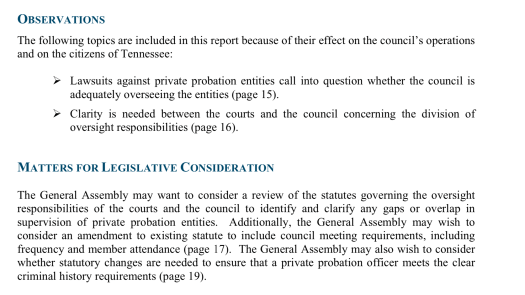
The 2018 Tenn Comptrollers report is found here. Finding inadequate oversight, policies, and supervision:
I will supplement this report with some additional information later.
Connie Reguli has practiced family law and litigation for 25 years plus. Also known as an advocate for child welfare reform.
In 1984, the United States Supreme Court entered an opinion in Garrison v. La., 379 U.S. 64, (1964) in which discussed a dispute between the district attorney and a judge. The attorney held a press conference where he issued a statement disparaging judicial conduct. The district attorney was arrested under the criminal sedition laws of New York. The court stated that where the criticism is of public officials and their conduct of public business, the interest in private reputation is overborne by the larger public interest secured by the constitution, in the dissemination of truth. Even where the utterance is false, the great principles of the Unites States Constitution which secure freedom of expression in this area preclude attaching adverse consequences to any except the knowing or reckless falsehood. Debate on public issues will not be uninhibited if the speaker must run the risk that it will be proved in court that he spoke out of hatred; even if he did speak out of hatred, utterances honestly believed contribute to the free interchange of ideas and the ascertainment of truth. Since an erroneous statement is inevitable in free debate, it must be protected if the freedoms of expression are to have the breathing space that they need to survive, only those false statements made with the high degree of awareness of their probable falsity may be the subject of either civil or criminal sanctions. For speech concerning public affairs is more than self-expression, it is the essence of self-government. The First and Fourteenth Amendments embody a profound national commitment to the principle that debate on public issues should be uninhibited, robust, and wide-open, and that it may well include vehement, caustic, and sometimes unpleasantly sharp attacks on government and public officials.
On July 29, 2019, the Sixth Circuit Court entered an opinion regarding the use of social media for the criticism of public officials. In Novak v. City of Parma, 18-3373 (6th Cir. July 29, 2019) the Court examined the use of Facebook by a citizen to criticize and ridicule the local police department. The page was set up to look like an official cite and ran fake news stories making the police department appear as incompetent racists. The police department subpoenaed records from Facebook to find out the person that had caused this public harassment of law enforcement. The police department claimed that Plaintiff had made several “material misrepresentations and omissions.” Claiming that Plaintiff have unlawfully impaired the department’s functions, Plaintiff was criminally charged and arrested. Plaintiff was acquitted of criminal charges when Plaintiff showed that other than twelve minutes of phone calls to the department, there was no disruption to its function. Plaintiff sued for First Amendment violations. The Sixth Circuit Court examined whether the state actor defendants would enjoy qualified immunity and be exempt from civil liability. The Court denied qualified immunity and the Court’s analysis of the First Amendment rights of the plaintiff are relevant to the status to the case at bar. Novak v. City of Parma, July 29, 2019.
The Sixth Circuit stated that Plaintiff had a claim for First Amendment retaliation if (1) the plaintiff engaged in constitutionally protected activity, (2) the state actors adverse actions caused the Plaintiff to suffer an injury that would likely chill a person of ordinary firmness from continuing that activity, and (3) the state actors were motivated, at least in part, by his exercise of his constitutional rights. Pg. 6.
The Sixth Circuit also stated that Plaintiff had a claim for First Amendment prior restraint if he could show that an administrative or judicial order forbid his protected speech in advance. Pg. 13. In Novak, the plaintiff alleged that the police department had issued a press release threatening to prosecute him, sent a letter and an email to Facebook demanding the page be taken down, and confiscated his computer equipment. Plaintiff claimed that this constituted an implicit threat of governmental action. Pg. 14. A prior restraint must raise a legal impediment to speech with the classic examples of restraining orders and court issued injunctions. But such a formality is not necessary to constitute a prior restraint. The Sixth Circuit stated that the announcement that they had opened an investigation on Plaintiff was sufficient to make a plausible claim for First Amendment prior restraint.
In addition to the Novak case, other First Amendment authority in his prior Motion for Recusal (Circuit Court case). The United States Supreme Court established a broad prohibition against prior restraints of speech in Neb. Press Ass’n v. Stuart, 427 U.S. 539 (1976). The First Amendment thus accords greater protection against prior restraints than it does against subsequent punishment for a particular speech. A system or prior restraint is in many ways more inhibiting than a system of subsequent punishment. It is likened to being under government scrutiny a far wider range of expression; it shuts off communication before it takes place; suppression by a stroke of the pen is more likely to be applied than suppression through a criminal process; the procedures do not require attention to the safeguards of the criminal process; the system allows less opportunity for public appraisal and criticism; the dynamics of the system drive toward excesses, as the history of all censorship shows. It has been generally, if not universally, considered that it is the chief purpose of the First Amendment’s guaranty to prevent prior restraints upon publication. The Nebraska Press case dealt with the Court’s attempts to suppress publication of events that happened in the courtroom and attempted to expand that limited exception to this prohibition. The Supreme Court rejected this attempt to shut down reports of judicial proceedings, determining that the Courtroom was already in the public domain.
In 2002, the Middle District Court of Tennessee considered the government’s role in prior restraint on speech in the context of controlling a non-profit’s ability to raise charitable donations. A prior restraint exists when the exercise of a First Amendment right depends on the prior approval of public officials. The term prior restraint describes administrative and judicial orders that block expressive activity before it can occur. Under a system of prior restraint, the lawfulness of speech turns on the advance approval of government officials. Although prior restraints are not unconstitutional per se, they come to court bearing a heavy presumption against their validity. Feed the Children, Inc. v. Metro. Gov’t of Nashville, 330 F. Supp. 2d 935, (M.D. Tenn. Mar. 21, 2002)
The Tennessee Court of Appeals recognized the federal guidelines on prior restraint of speech in In re Conservatorship of Turner, M2013-01665-COA-R3-CV, (Tenn. Ct. App. May 9, 2014). It acknowledged that an impermissible prior restraint exists when the exercise of First Amendment rights depends upon prior approval of public officials. A system of prior restraints bears a heavy presumption against its constitutional validity. The Court did recognize the exception stated by the Sixth Circuit in which a person could be prohibited from repeating the same libelous and defamatory statements which have been judicially determined in proceedings to be false and libelous.
The law in this country against prior restraints and sedition provide protection for the litigants that enter this Courtroom who seek a fair and impartial tribunal. The restraints put on attorneys is more ambivalent. Tenn. R. Sup. Ct. 8, Rule 8.4 prohibit attorneys from engaging in conduct prejudicial to the administration of justice. A rule left open for broad interpretation and has included actions deemed as intending to “impugn the judiciary.” Ward v. University of the South, 354 S.W. 2d 246 (1962).
The right to a fair trial before an impartial tribunal is a fundamental constitutional right.” State v. Austin, 87 S.W.3d 447, 470 (Tenn. 2002). Article VI, section 11 of the Tennessee Constitution provides, “No Judge of the Supreme or Inferior Courts shall preside on the trial of any cause in the event of which he may be interested . . . .” This provision is intended “to guard against the prejudgment of the rights of litigants and to avoid situations in which the litigants might have cause to conclude that the court had reached a prejudged conclusion because of interest, partiality, or favor.” Austin, 87 S.W.3d at 470. We have recognized that it is important to preserve the public’s confidence in a neutral and impartial judiciary. Bd. of Prof’l Responsibility v. Slavin , 145 S.W.3d 538, 548 (Tenn. 2004). Bean v. Bailey, 280 S.W.3d 798, 803, 2009 Tenn. LEXIS 296, *11 (2009)


 Radical Tennessee - Radically Accountable and Radically Free