Kentucky – and immunity

By Connie Reguli

Please listen to the legal arguments in this case

It is about a brith mom who had one positive drug test results and three negative test results. The state put the family in a safety plan.

The state dropped the safety plan.

The parents then filed a civil rights complaint for Fourth and Fourteenth procedural and substantive due process rights.

The argument is about qualified immunity.

www.courtlistener.com/mp3/2019/12/06/holly_schulkers_v._elizabeth_kammer_cl.mp3

By Connie Reguli.

SCHULKERS v. KAMMER

Kimberly Jenci Hawthorne , D. Brent Irvin , Kentucky Cabinet for Health and Family Services Office of Legal Services, Frankfort, KY, Ellen M. Houston , Michael Joseph Enzweiler , Dressman Benzinger LaVelle P.S.C., Crestview Hills, KY, for Defendants.

https://www.leagle.com/decision/infdco20190211a69

UA drug screens – not admissible – OBJECT

By Connie Reguli

Connie Reguli in Washing D.C. 2018.

DRUG SCREENS.

Connie,

No reports necessary. The information will be in the package insert for the drug test. Most say something similar to what the Redwood Toxicology Lab RediCup instert says:

•The RediCup® is used for Screening Only. Positive results obtained with this device are presumptive.

•Additional testing is necessary to confirm the presumptive positive results. Positive results should be “confirmed” by an alternate method such as GC/MS (GasChromatography/Mass Spectrometry) or LC/MS/MS (Liquid Chromatography/Tandem Mass Spectrometry).

•Professional judgment should be applied to any drug of abuse test result, particularly with preliminary positive results.

Positive point of care urine drug screens are only a presumptive positive and must be confirmed by lab testing. If a party wants to enter the results of a point of care drug screen into evidence, enter the package insert, as well.

I will add more on this later.

RECORD YOUR HEARINGS

By Connie Reguli

Connie Reguli in Washington D.C. – 2019. By Freedom Public Press

TENNESSEE FAMILIES – LET ME BE LOUD AND CLEAR ON THIS POINT. YOU HAVE A RIGHT TO RECORD ALL COURT HEARINGS. YOU DO NOT HAVE TO HAVE A COURT REPORTER AND QUITE FRANKLY, I THINK YOU HAVE THE RIGHT TO VIDEO TAPE THE HEARING.

RULE 115RECORDING HEARINGS

All hearings, except ex parte hearings, shall be audio recorded by the clerk of the court and retained for a minimum of one year from the date of the final disposition of the case.

Advisory Commission Comments. In accordance with T.C.A. §§ 37-1-124(c) and 37-1-159(a), the juvenile court is a court of record. Under this rule, all juvenile courts must create and maintain an audio recording of all hearings in juvenile court, in addition to keeping and maintaining appropriate minutes of hearings. Alternative means of recording, e.g. audio-visual equipment, are acceptable. This rule does not preclude simultaneous recording by a court reporter or other means of recording by a party. This rule is not applicable to reviews conducted by a foster care review board.

In addition, the Tennessee Code provides the attorneys can record any proceeding.

20-9-104. Tape recording of proceedings.

It is lawful for attorneys representing parties in proceedings in any of the courts of this state to use tape recorders as an aid in making notes of the proceedings.

BAM 💥 2.7million kids in care worldwide. Told you so.

By Connie Reguli

pdf.sciencedirectassets.com/271783/1-s2.0-S0145213417X00070/1-s2.0-S0145213416302873/main.pdf

Wrongful removal – Oklahoma – 2018

cases.justia.com/federal/appellate-courts/ca10/16-7079/16-7079-2018-08-27.pdf

By Connie Reguli

In this case a minor child sued for wrongful removal and violation of substantive due Process rights.

One of the most difficult aspects of a civil rights case is overcoming immunity. In this case the social workers and law enforcement officers claimed qualified immunity for violating the child’s (fourth amendment rights) and substantive due process rights of familial integrity when the child was removed from school for a forensic interview and told by the law enforcement officer that they were going to find him a better home.

In this appeal the tenth circuit court said that the case could proceed on violations of fourth amendment violations. However the court dismissed the claims for substantive due process rights stating that it was not “clearly established” that the child had the right of family integrity in this situation, that is, the fact that the officials impugned his father and damaged his relationship with him was not enough.

Note – analysis of substantive due process – the courts consideration of (1) a fundamental liberty interest vs (2) shock the conscious conduct by state actors.

Good analysis of the reasonableness standard in a claim for fourth amendment violations.

Note. The child was not removed from his home and the Interview revealed no disclosures of abuse.

Here are some excerpts:

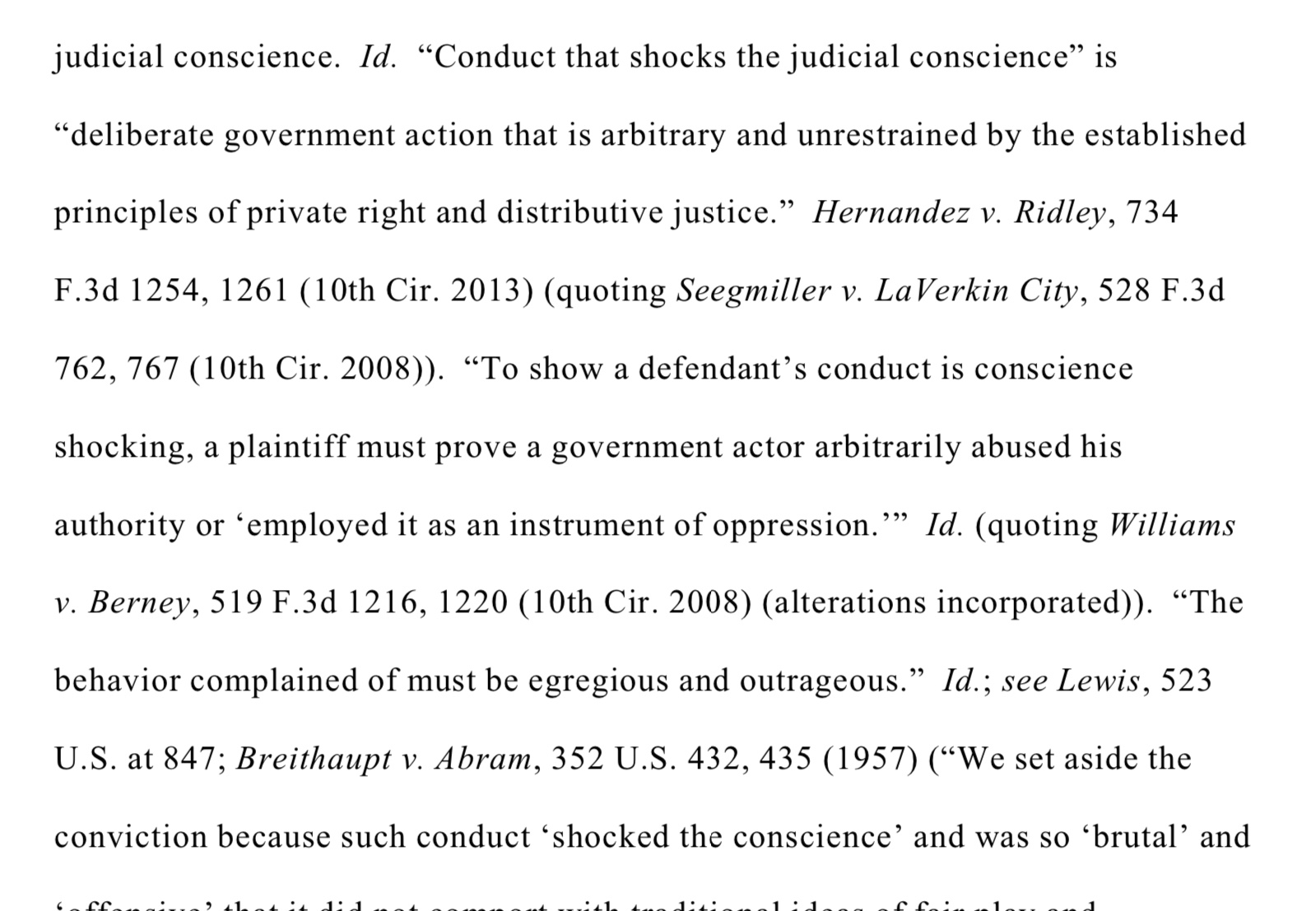
The court compares fundamental right to the shocks the conscience standard. –

What is conscious shocking conduct?

Court says that they have implicitly used that standard before.

What you must show for violations of the substantive due process violations of family integrity.

By Connie Reguli

DCS Case recordings as evidence – Application of the Business Records exception.

By Connie Reguli

Are DCS records admissible as business records in a court hearing?

I have located five cases in Tennessee directly addressing this question.  

Hearsay is a statement, other than one made by the declarant while testifying at the trial or hearing, offered in evidence to prove the truth of the matter asserted.  TRE 801(c). Such a statement is inadmissible unless it is shown to be admissible as provided by the rules of evidence or otherwise by law. TRE 802. TRE 803(6) covers the hearsay exception for records of regularly conducted activity.  The party proffering the records under TRE 803(6) has the burden to establish (and must lay a foundation) that the records are admissible meeting the five elements of admissibility identified below.  

The following cases in Tennessee discuss the admissibility of DCS case recordings.  

State v. B.F., E2004-00338-COA-R3-PT, (Tenn. App. 12/2/2004) – In this termination of parental rights (TPR) case the case worker was allowed to testify regarding facts in the child’s case file about which she had no personal knowledge but which were documented (or she said were documented) on the case file which was not made an exhibit.  The trial court (Sevier County Judge Stokes) allowed the case worker to testify under the business records exception of Tenn. R. Evid (TRE) 803(6). The appellate Court reversed the trial court stating the TRE 803(6) specifically refers to “records” and indicates that a “record” consists of a memorandum, report, record or data compilation, in any form.  It is clear from this language that this exception pertains solely to the admission of information in the form of tangible documentation. The rule provides for the admission of “records.” It does not provide for the admission of testimony of a witness as to his or her memory of what the record stated. The ground for this exception to the hearsay rule is the fact that regularly kept records typically have a high degree of accuracy.  It is not reasonable to assume that a witness testifying from memory exhibits the high degree of accuracy attributed to regularly kept record. This case does not specifically address any other objections as to the source of information in the records. However, the Court relied on Perlberg v. Brencor Asset Management, Inc. 63 S.W. 3d 390 (Tenn. App. 2001) in which the Court found that a letter in the employment record that referred to a letter from a doctor (but did not contain the doctor’s letter) was inadmissible and not a business record.  Therefore, two questions are considered in this case (1) it is clear that testimony alone from a person who claims to have reviewed the business record is NOT admissible under TRE 803(6); (2) it is also clear that a business record that refers to or incorporates outside information is ALSO NOT a admissible under TRE 803(6) as a business record.  

State Dep’t of Children’s Services v. Stinson, W2006-00749-COA-R3-PT, (Tenn. App. 2006) (McNairy County – Judge Danny Smith) – In this termination of parental rights case Mother objected to the admissibility of the DCS case recordings asserting that the records contained hearsay, however, she did not object to any specific content within the records.  Therefore, the Court ruled that they were admissible under the business records exception to hearsay TRE 803(6). Since the MOther had not objected to any specific entry in the records, the Court did not make an independent assessment of whether the records contained in admissible hearsay. In this case, there was overwhelming evidence of substance abuse and criminal conduct by the parents and the Court stated that even if the records were inadmissible that there was ample evidence to meet the clear and convincing standard for the TPR.  

State Dep’t of Children’s Servs v. C.M.B., E2006-00841-COA-R3-PT, (Tenn. App. 12/13/2006) (Knox County Judge Timothy Irwin) – In this TPR case, the DCS caseworker read into evidence the records created by a previous DCS case management agent.  Mother’s attorney made a faint-hearted objection, saying we would like to have the direct testimony of the witness rather than referring to something I can’t cross-examine. (This is hardly an appropriate objection.)  The Court overruled the objection saying it fell under the hearsay exception. The Judge allowed the reading of the records and asked several questions about where the people were that made those entries. In particular, Mother argued that the trial Court’s conclusion that “cocaine was found within the reach of the children” came ONLY from the hearsay in the DCS records.  On appeal, Mother’s attorney argued that DCS had to demonstrate that the records were made at or near the time of the incidents reported in the records, and that the records were created by someone with the business duty to record or transmit the records during the court of a regularly conducted business activity. The Court found that the records were hearsay and that DCS failed to lay a proper foundation for the admission of these records.  The Court, however, found that it was harmless error (TRAP 36(b)) considering the record as a whole because even striking the complained of evidence, it did not affect the correctness of the judgement. (Note: The problem is that the “fact” recorded in the judgment becomes the law of the case and may be used against the parents in the future.)  

In re Demitrus M.T., E2009-02349-COA–R3-CV (Tenn. App. 3/14/2011) (Claims Commission) – In this wrongful death case, the case recordings were the subject of a motion in limine to exclude inadmissible hearsay by the plaintiff.  The commissioner admitted the case recordings with limited redaction of content that was hearsay within hearsay. The case recordings include an “event date” and “completed date” which is the date that the entry in the record was made.  In this case there was a lapse of time between the event date and the completed date. The DCS employee that was present to testify (not the one that made the record entries) stated that she did not know why there was a delay in the entry of the record and that there is no requirement for the case recording to be made within a certain time. (which is not true)  She testified that sometimes case workers make handwritten notes and then put them in the system later. The case recordings were treated as admissible under TRE 803(6). The commissioner found that the reports were typical of reports regularly prepared by DCS case workers in the fulfillment of their job responsibilities. And that preparing such reports clearly appear to be a proper exercise and implementation of the powers granted DCS under TCA 37-5-106(1) to attain the purpose for which it was created under TCA 37-5-102.  There was no hearsay exception for hearsay within hearsay that was redacted from the records. The Court examined the elements necessary for a record to be admissible under TRE 803(6): (1) The document must be made at or near the time of the event recorded: (2) The person providing the information in the documents must have first hand knowledge of the recorded events or facts; (3) The person providing the information in the document must be under a business duty to record or transmit the information; (4) The business involved must have a regular practice of making such documents; and (5) The manner in which the information was provided or the document was prepared must not indicate that the document lacks trustworthiness.  Arias v. Duro Standard Prods., 3030 S.W. 3d 256 (Tenn. 2010). The COA examined whether element (1) and (5) had been satisfied. As to element (1) the Court said that the key element is whether the lapse of time between the event and the record of the event interferes with the likely accuracy of the business record. The Court found that the lapse of a few days was acceptable, but the lapse of five weeks was not. The absence of proof that the case worker has some phenomenal memory, or interim notes that captured the events and allowed him to record them later, or some explanation of why the records were accurate despite the lapse of over a month, the State failed to make the required showing that they were made at or near the time of the occurrence.  In this case, the Court also analyzed whether or not the records could be admissible under the public records exception, TRE 803(8) which states, “Unless the source of information or the method or circumstances of preparation indicate lack of trustworthiness, records, reports, statements, or data compilations in any form of public offices of agencies setting forth the activities of the office or agency or matters observed pursuant to a duty imposed by law as to which matters there was a duty to report, excluding however, matters observed by police officers and other law enforcement personnel.” The Court said that the same time lapse in the entry of the record would make the records untrustworthy under the public records exception. The Court, however, made an interesting note stating that the fact that the records were not “open to the public” and had been “produced under a protective order” did not disqualify the case recordings from the public records exception.  

In re Melanie T., 352 S.W.3d 687 (Tenn. App. 2011) (Coffee County Judge Vanessa Jackson) – In this dependent and neglect action, the State offered the case recordings made by a case worker who died before the trial into evidence.  The records were admitted into evidence under the hearsay exception of TRE 803(6) – business records. The COA went through the same analysis of the elements and found that the significant delay between the event date and the completed dated rendered the record inadmissible and they lacked trustworthiness.  DCS argued that the court only relied on the records for a timeline and not for the truth of the matter. The COA found that the substantive and material evidence in the records was testified to by other witnesses. Therefore, although is was an error to admit the records, it was harmless error. 

There is no case on point in DCS case recordings to address the hearsay within hearsay, such as statements DCS workers take from third parties, additions to the case recordings made by third-party contractors who are outside of the agency, references in the records to other outside materials (such as medical, dental, or other reports), opinions of the case worker without supporting facts (such as statements that a parent is uncooperative), or conclusions/concerns that are not supported by facts.  

The business records exception clearly requires the recorder to have first hand knowledge of the information contained in the record.  

Additional case law, i.e., other business records opinions may add to this context. 

Please Join Us on Family Forward Project on Facebook. Find Connie Reguli on YouTube. Follow us on Twitter and Instagram


Additional case law in Business Records exception to Hearsay.

Business records

Courts have consistently viewed hearsay evidence with suspicion because of concerns about its trustworthiness. Accordingly, hearsay is not admissible in judicial proceedings unless it fits within one of the recognized exceptions to the hearsay rule. This common-law rule is now embodied in Tenn. R. Evid. 802, which states that hearsay is not admissible except as provided by these rules or otherwise by law.

While the Tennessee Rules of Evidence govern proceedings in the state trial courts, they do not necessarily apply with the same force to other nonjudicial proceedings. Tenn. Code Ann. § 4-5-313(1) (1991) provides: The agency shall admit and give probative effect to evidence admissible in a court, and when necessary to ascertain facts not reasonably susceptible to proof under the rules of court, evidence not admissible thereunder may be admitted if it is of a type commonly relied upon by reasonably prudent men in the conduct of their affairs.This provision applies only to facts not reasonably susceptible to proof under the rules of court and does not permit substituting hearsay for the testimony of otherwise available witnesses.

Tenn. R. Evid. 803(6) embodies the hearsay exception commonly known as the “business records” exception. It replaces the Uniform Business Records as Evidence Act, Tenn. Code Ann. § 24-7-111 (repealed 1991).

Records regularly kept in the regular course of business are viewed as trustworthy and reliable. Thus, the purpose of Tenn. R. Evid. 803(6), like its predecessor, is to enable litigants to introduce and use business records without the expense and inconvenience of calling the numerous witnesses involved in preparation and maintenance of the records.

Tenn. R. Evid. 803(6) does not render all business records admissible. The trial court, or in the case of an administrative hearing the administrative law judge or hearing officer, has the discretion to determine whether a particular record is sufficiently trustworthy to be admissible. In the final analysis, the trustworthiness of a business record depends upon the source of the information contained in the record as well as the time and manner in which the record was prepared.

Documents must satisfy five prerequisites in order to qualify as a record of a regularly conducted activity under Tenn. R. Evid. 803(6). First, the person providing the facts recorded in the document must be acting under a business duty. Second, the person providing the information must have firsthand knowledge of the facts or events. Third, the document must be made at or near the time of the event recorded. Fourth, the document must be one that is regularly made or kept in the normal course of business. Fifth, the document must be introduced through its custodian or some other qualified witness who has knowledge of the manner in which the record was made or prepared.

Business records often contain information provided by others and, accordingly, present multiple hearsay problems. Because Tenn. R. Evid. 803(6) was not intended to shield the contents of business records from the rules of evidence, hearsay statements contained in a business record do not become admissible simply because they have found their way into a business‘s files.

The courts resolve the multiple hearsay problems presented by business records using a two-tier approach. First, they determine whether the primary statement – the record itself – qualifies as a business record or fits within some other exception to the hearsay rule. Second, they determine whether the secondary statement – the one contained in the record – fits within a hearsay exception in its own right. Hearsay statements in business records are admissible only if both the record and the statement contained in the record fit within an exception to the hearsay rule.

Among the due process rights under Tenn. Const. art. I, § 8 and the due process clause of the Fourteenth Amendment to the United States Constitution is the right to be afforded an effective opportunity to defend by confronting any adverse witness.

Rayder v. Grunow, 1993 Tenn. App. LEXIS 261, (Tenn. Ct. App. Apr. 2, 1993)

See Tenn. R. Evid. 803(6) (2011).

Under Tenn. R. Evid. 902(11) (2011), a business record may be authenticated through an accompanying affidavit, with the following requirements: The original or a duplicate of a domestic record of regularly conducted activity that would be admissible under Tenn. R. Evid. 803(6) (2011) if accompanied by an affidavit of its custodian or other qualified person certifying that the record: (A) was made at or near the time of the occurrence of the matters set forth by, or from information transmitted by, a person with knowledge of and a business duty to record or transmit those matters; (B) was kept in the course of the regularly conducted activity; and (C) was made by the regularly conducted activity as a regular practice. A party intending to offer a record into evidence under this paragraph must provide written notice of that intention to all adverse parties, and must make the record and declaration available for inspection sufficiently in advance of their offer into evidence to provide an adverse party with a fair opportunity to challenge them.

The rationale underlying the business records exception is that records regularly kept in the normal course of business are inherently trustworthy and reliable.

The business records exception is intended to facilitate the use of business records by eliminating the expense and inconvenience of calling numerous witnesses involved in the preparation and maintenance of the records and unduly disrupting the business‘s activities.

An extraordinary report prepared for an irregular purpose, particularly when prepared with litigation in mind, may not be made in the regular course of business and may be inadmissible as a business record under Tenn. R. Evid. 803(6) (2011).

Documents prepared specifically for the subject litigation are properly excluded because of motivational concerns arising from the fact that they were generated for litigation purposes, as opposed to records generated for business purposes.

The routine of modern affairs, mercantile, financial, and industrial, is conducted with so extreme a division of labor that the transactions cannot be proved at first hand without the concurrence of persons, each of whom can contribute no more than a slight part, and that part not dependent on his memory of the event. Records, and records alone, are their adequate repository, and are in practice accepted as accurate upon the faith of the routine itself.

A compilation of business records, compiled for specific litigation, may be admissible as a summary of voluminous writings under Tenn. R. Evid. 1006, so long as the data included in a compilation otherwise satisfies the business records exception.

Tennessee courts have broadly defined the term “qualified witness” as a witness with personal knowledge of a business‘s record-keeping methods and can explain same to the court, and is not required to have personal knowledge of the facts recorded, nor to have been personally involved in preparing the documents or even know who did.

This appeal concerns the collection of credit card debt. The plaintiff, a subsequent purchaser of the debt, filed this collection action against the appellant debtor. On appeal, the appellant debtor argues, inter alia, that the trial court erred in admitting into evidence various documents from a previous owner of the debt, pursuant to the hearsay exception for business records under Tenn. R. Evid. Rule 803(6). We hold that two of the exhibits were not appropriately admitted into evidence under the business records exception. Without those exhibits, we find that the evidence preponderates against the trial court’s judgment in favorof the creditor, and reverse.LVNV Funding, LLC v. Mastaw, 2012 Tenn. App. LEXIS 282, (Tenn. Ct. App. Apr. 30, 2012)

When Parents Speak Out

By Connie Reguli

In many child welfare and child custody cases, the Parents want to reach out on social media. Sometimes for comfort and encouragement; sometimes to rant about the injustice; and sometimes to point out irregularities in the judicial process and express a legitimate concern.

Too often parents are “gagged” by the Courts who cite many reasons, most of which are nonsense. In my experience, most of the means to silence a parent are intended to prohibit them from making valid complaints about the process.

I have been an attorney for 25 years. The judicial process is flawed and the players are human. The fact that a judge gets mad at a parent or an attorney is unprepared happens. However, to the litigant/parent these things interfere with THEIR CASE. They have a right to be frustrated.

Judicial GAG orders are mostly unconstitutional.

Here is why:

THE PROHIBITION AGAINST PRIOR RESTRAINTS

            The United States Supreme Court established a broad prohibition against prior restraints of speech in Neb. Press Ass’n v. Stuart, 427 U.S. 539 (1976).  The First Amendment thus accords greater protection against prior restraints than it does against subsequent punishment for a particular speech.  A system or prior restraint is in many ways more inhibiting than a system of subsequent punishment.  It is likened to being under government scrutiny a far wider range of expression; it shuts off communication before it takes place; suppression by a stroke of the pen is more likely to be applied than suppression through a criminal process; the procedures do not require attention to the safeguards of the criminal process; the system allows less opportunity for public appraisal and criticism; the dynamics of the system drive toward excesses, as the history of all censorship shows.  It has been generally, if not universally, considered that it is the chief purpose of the First Amendment’s guaranty to prevent prior restraints upon publication. 

            The Nebraska Press case dealt with the Court’s attempts to suppress publication of events that happened in the courtroom and attempted to expand that limited exception to this prohibition.  The Supreme Court rejected this attempt to shut down reports of judicial proceedings, determining that the Courtroom was already in the public domain.

            In 2002, the Middle District Court of Tennessee considered the government’s role in prior restraint on speech in the context of controlling a non-profit’s ability to raise charitable donations.  A prior restraint exists when the exercise of a First Amendment right depends on the prior approval of public officials.  The term prior restraint describes administrative and judicial orders that block expressive activity before it can occur.  Under a system of prior restraint, the lawfulness of speech turns on the advance approval of government officials.  Although prior restraints are not unconstitutional per se, they come to court bearing a heavy presumption against their validity.  Feed the Children, Inc. v. Metro. Gov’t of Nashville,  330 F. Supp. 2d 935, (M.D. Tenn. Mar. 21, 2002)  SEE ATTACHED. 

            The Tennessee Court of Appeals recognized the federal guidelines on prior restraint of speech in In re Conservatorship of Turner, M2013-01665-COA-R3-CV, (Tenn. Ct. App. May 9, 2014).  It acknowledged that an impermissible prior restraint exists when the exercise of First Amendment rights depends upon prior approval  of public officials.  A system of prior restraints bears a heavy presumption against its constitutional validity.  The Court did recognize the exception stated by the Sixth Circuit in which a person could be prohibited from repeating the same libelous and defamatory statements which have been judicially determined in proceedings to be false and libelous

THANK YOU FOR PROVIDING A REVIEW.

THE PROHIBITION AGAINST CRIMINAL SEDITION

            In 1984, the United States Supreme Court entered an opinion in Garrison v. La., 379 U.S. 64, (1964) in which discussed a dispute between the district attorney and a judge.  The attorney held a press conference where he issued a statement disparaging judicial conduct.  The district attorney was arrested under the criminal sedition laws of New York.  The court stated that where the criticism is of public officials and their conduct of public business, the interest in private reputation is overborne by the larger public interest secured by the constitution, in the dissemination of truth.  Even where the utterance is false, the great principles of the Unites States Constitution which secure freedom of expression in this area preclude attaching adverse consequences to any except the knowing or reckless falsehood. Debate on public issues will not be uninhibited if the speaker must run the risk that it will be proved in court that he spoke out of hatred; even if he did speak out of hatred, utterances honestly believed contribute to the free interchange of ideas and the ascertainment of truth.  Since an erroneous statement is inevitable in free debate, it must be protected if the freedoms of expression are to have the breathing space that they need to survive, only those false statements made with the high degree of awareness of their probable falsity may be the subject of either civil or criminal sanctions.  For speech concerning public affairs is more than self-expression, it is the essence of self-government.  The First and Fourteenth Amendments embody a profound national commitment to the principle that debate on public issues should be uninhibited, robust, and wide-open, and that it may well include vehement, caustic, and sometimes unpleasantly sharp attacks on government and public officials. 

IS CPS OVERREACH GONE TOO FAR?

Is CPS overreach a racial issue? I think not. The stats show that about the same percentage of children in care are “white” as are “black”.
However it is a great op-ed on the government’s intrusion into family life.
Connie Reguli

Posted by Connie Reguli

SHARING THE BLISS OF FAMILY LAW IN TENNESSEE

JULY 26, 2017 – Connie Reguli

I had lunch today with one of my favorite members of the Davidson County Bar who also suffers through juvenile court on a regular basis like I do. We both like to challenge the perspectives of the Juvenile Court judges, we both stand up for clients in difficult situations, and we both have watched judges in the Courtrooms do some strange things.

We always share what has been going on in our cases from the legal perspective. How we challenge the government is one our favorite topics.

Topics of discussion today:

Evidence – Rule 803(25) – the hearsay exception on allowing children's statements though other persons. The rule specifically allows this in dependency, termination, and custody proceedings. Therefore, if you are in a administrative hearing contesting an child abuse indication, this hearsay exception does not APPLY.

Termination of parental rights and Adoption – We discussed how the Court of Appeals decided this year that foster parents have the right to file for termination of parental rights and adoption. EVEN though 37-1-129 give DCS total control over placement once the child is in DCS custody and 37-1-130 gives DCS the authority to return a child to the parents. It begs the question that if foster parents file for termination why DCS doesn't go get the child and move him/her. A termination and adoption proceeding is NOT a custody proceeding. Therefore, the tpr/adoption court does NOT have jurisdiction to award custody.
In 2015, the Court of Appeals ruled that "former foster parents" have NO standing to seek termination of parental rights and adoption against a parent. But in 2016, the Court ruled that current foster parents DO have standing to file a contest termination and adoption petition against DCS.
Put this back to back with the rule that grandparents have NO standing (right) to intervene in a termination proceeding filed by DCS when children are in foster care. The Court of Appeals in Tennessee has ruled that the only relief that can be granted in a TPR is termination of parental rights and guardianship, therefore, grandparents can not intervene. Of course they do not discuss that the grandparents could be awarded guardianship in that same proceeding.
Okay, so one more twist to this. I represented a Mother who lived in Texas and the children lived in Tennessee with their Father. Father dropped dead suddenly. Stepmother rushed to Juvenile Court and got an ex parte custody order saying the Mother abandoned the children. Then, she ran over the Chancery Court and filed to termination and adoption, so she could get the survivor benefits of Social Security. Mom came to Tennessee to fight for her children. Under the abandonment statute, the stepmother was going to show that Mom did not pay child support so therefore, there were grounds for termination. I wrote three briefs that the stepmother lacked standing at the request of the Sumner County Chancery Court. The judge made us come back three times just to argue the legal standard. Finally, he agreed with me and dismissed stepmother's petition. Even after he FULLY dismissed her petition, he refused to give the kids back immediately. He said the kids needed time to say goodbye and gave the stepmother two more weeks to turn the kids over. I asked him put the exact date and time in the order. Sure enough, stepmother did not show up. At least the Mother had a court order and she was able to get law enforcement to help get them back.

ICPC – Interstate Compact for the Placement of Children. First of all, this document created by a third party is total HEARSAY. Several years ago, guardian ad litems used to file reports with the court. In Toms v. Toms, the Tennessee Supreme Court finally said that these are HEARSAY and cannot be admitted in the court file. HOWEVER, DCS and CASA continue to file ex parte hearsay reports with the juvenile court ALL THE TIME. And the ICPC report it total hearsay. Well it doesn't matter much if your client PASSES the ICPC. But if your client FAILS the ICPC, you are flat out of luck. I had a client/Mother who moved to Kentucky and her case was in Tennessee. DCS told her she had to get an ICPC passed before she could get her kids back. Okay, we say, bring it on. A Kentucky social worker shows up at her home. I told Mother to record everything. So she recorded the entire 20 minute visit by the social worker. As she walked out the door, the social worker was asked, Is everything Okay? "Y'all have nothing to worry about." She said. Then the client failed the ICPC in the report because she did not have central air conditioning and they said her boyfriend was "too controlling." I filed a petition for custody and the Juvenile Court judge in Sumner County would not even let us be heard. DCS said that the Mother did not even have the right to a hearing if she did not pass the ICPC. In 2016, the Court of Appeals told my client, a father who never harmed or abused his child, that since he failed the ICPC (because he lived with his mother) that he was not entitled to seek custody. They also said that since he was not married to the Mother, he NEVER had any custodial rights. In 2015, the Court of Appeals said the relatives who failed the ICPC were NOT entitled to seek custody even after the judge held an evidentiary hearing and found that it was in the best interest of the child to go with the relatives. Recently, the Court of Appeals has ruled that a parent does not have to comply with ICPC, but only if there are no allegations against that parent.

CHILD AS A PARTY / CHILD AS A WITNESS – Is the child a party to a dependency and neglect action in Juvenile Court under 37-1-103? Children, especially, those over 12 years old, are often the reporters of abuse and neglect against their parents. They may or may not be legitimate claims. If the child is going to testify in a hearing, the parents' attorneys should have access to the child for deposition testimony. Now how does that occur. Most Courts will allow the testimony of the child in chambers or outside of the presence of the parents. However, the attorneys and the court reporter are allowed to participate. There is no direct authority on whether or not the parents should be allowed to participate in the child's deposition. I have had the parents across the table from child for purposes of deposition without objection. I understand that Williamson County Juvenile Judge Guffee denied counsel the right to depose the minor accuser/witness.

VANDERBILT CHILDREN'S HOSPITAL AND DR. DEBORAH LOWEN – For those who don't know, Dr. Lowen is the child abuse expert at Vanderbilt – the go-to hospital for child abuse referrals. We both agreed that this doctor is the ultimate profession henchman for DCS. Everything she sees "could have only happened from abuse." I have dealt with her inflexible and unwavering opinions regarding her "medical diagnosis" of "child abuse." We also discussed the legal standard for a "reasonable degree of medical certainty." Attorney John Day recently reported that the Third Restatement on Torts has rejected the "reasonable degree of medical certainty" standard because "the reasonable-certainty standard provides no assurance of the quality of the expert’s qualifications, expertise, investigation, methodology, or reasoning."
Added to the complexity of this cliche legal standard is the contrast between the preponderance of the evidence standard and the clear and convincing standard required in a dependency proceedings.
In all cases, parents' attorneys should be requiring "child abuse experts" to provide the medial research, literature, case studies, and review articles that support their opinion. Remember that most medical opinions are formed from "medical literature" and NOT medical RESEARCH. Know the difference. Literature is just an opinion. Medical literature changes over time and so do medical opinions. It takes substantial preparation on the part of the defense attorney to understand how to defeat these medical experts.

MANY MANY PARENTS find themselves in the abyss of the family court system. And often they wonder why we can not give them black and white answers on questions related to parental rights.

The system needs a major overhaul.