How the American the court system was weaponized in different parts of the country against women (both septuagenarians with no criminal history) and the parallels of abuse by the court system to silence, make a mockery, and discredit these citizens that spoke out for truth

By Connie Reguli

Two women in their seventies. No criminal history. No violent past. No cartel ties or organized‑crime connections. Just grandmothers who dared to ask hard questions about what their government was doing—and the system came down on them like they were enemies of the state.

That is what happened to Tina Peters in Colorado and to me, Connie Reguli, in Tennessee. And conservatives across the country need to understand what these cases really show: the justice system is being weaponized to make examples of dissenters, especially women who refuse to sit down and shut up.

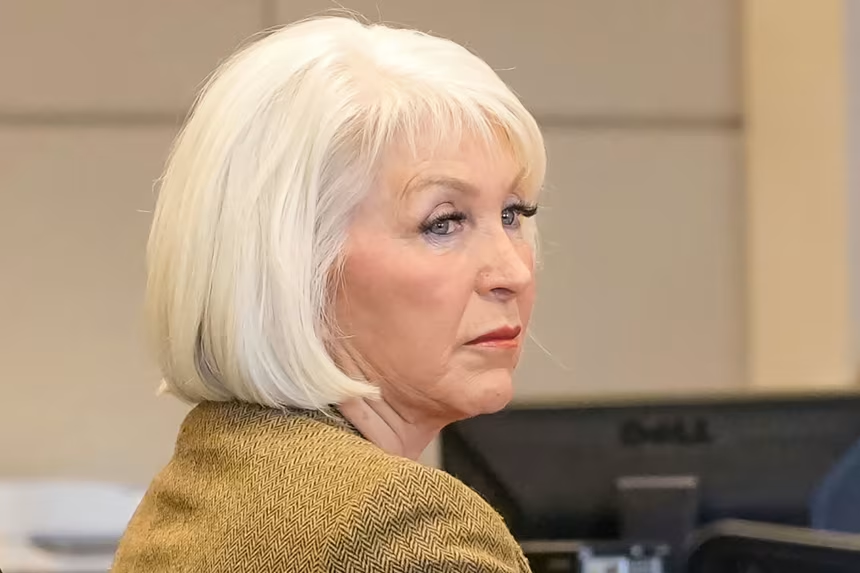
Tina Peters listens during her trial in Grand Junction, Colorado, on March 3, 2023. 
Scott Crabtree/The Grand Junction Daily Sentinel/Pool/AP/File

When “wrongthink” becomes a factor in a Court’s punitive actions

In Colorado, Tina Peters was prosecuted for alleged conduct related to election‑system data. But the most chilling part of her case wasn’t the charges—it was how the court talked about her after the conviction.

Instead of confining itself to the actual offenses, the sentencing judge fixated on her speech: her public statements about election integrity, her continuing activism, her refusal to renounce her beliefs about the 2020 election. In other words, her politics. Her voice.

The message from the bench was unmistakable: if you keep talking like this, if you keep rallying people, if you won’t recant, we will make you pay. The court took what should be core First Amendment activity—political speech, organizing, advocacy—and treated it as if it were an aggravating factor, as if her ideas themselves made her more dangerous.

That is not how a free country behaves. That is how a regime behaves when it wants to scare others into silence.

When public records become a threat

In Tennessee, my “crime” was asking for public records and using the courts to enforce the law that gives citizens the right to see how their government is spending their money. The trial court dismissed my case, fined me 5,000 dollars, and went even further: it tried to restrict my ability to file future cases without bringing in another lawyer.

Think about that: a sitting judge using sanctions not just to punish a particular filing, but to put a long‑term block on a citizen’s access to the courts.

Why? Not because I assaulted anyone. Not because I threatened anyone. But because I was using public records to expose how officials were spending taxpayer money and to challenge what I believed were wrongful government actions. My motives—my intention to speak, to criticize, to advocate—were treated as evidence of “improper purpose.”

In plain terms: the court didn’t like what I was doing with the truth once I got it.

Parallel abuses, different zip codes

Look at the pattern:

·      In Colorado, a woman in her seventies is effectively punished for her political beliefs and for continuing to speak them out loud.

·      In Tennessee, a woman in her seventies is punished for seeking public records and using them to challenge government conduct, with the court trying to close the courthouse doors behind her.

Different states, different issues, same underlying message: if you push too hard against the official narrative—about elections, about government spending, about public institutions—we will make an example out of you.

This is not just about one election or one county commission. It is about the state using the immense power of courts not to neutrally apply law, but to police thought and punish disfavored activism. It is about judges stepping out of their role as referees and becoming enforcers of “acceptable” opinions.

Silencing, humiliating, and discrediting

Weaponized justice doesn’t always look like secret police or midnight raids. Sometimes it wears a black robe and uses respectable language.

It looks like:

·      Turning political speech into a justification for harsher punishment.

·      Treating lawful public‑records requests as “bad faith” because the requester plans to expose government misconduct.

·      Imposing massive fines on ordinary citizens to send a message: don’t try this again.

·      Placing special restrictions on a disfavored litigant’s ability to even enter a courtroom.

And it doesn’t stop with the penalties. The public narrative is part of the punishment. Label the person “conspiracy theorist.” Call her “vexatious.” Paint her as “dangerous to democracy.” Make her a punchline in the media. Then, when she is dragged through the system, the public has already been taught to laugh or look away.

That is how you make a mockery of citizens who speak up for what they believe is true. That is how you discredit them so thoroughly that other people say, “I’m not putting my family through that. I’ll just keep my head down.”

WHY AMERICANS SHOULD CARE ABOUT TWO GRANDMOTHERS WHO SPOKE OUT…..

You don’t have to agree with every word Tina Peters has ever said about elections. You don’t have to support every argument I’ve made about child welfare or county spending. The question is more basic: do you believe the state should be allowed to punish citizens for what they say, what they investigate, and what they plan to expose?

Today it is two women in their seventies—grandmothers, professionals, with no criminal history—hauled into court, sanctioned, threatened, and publicly smeared for refusing to abandon their convictions. Tomorrow it can be you, your pastor, your school‑board candidate, your local activist who dares to ask the wrong questions.

If we allow courts to become tools of political and bureaucratic retaliation, we will lose not just cases, but our country’s character.

The justice system is not supposed to be a weapon wielded against inconvenient citizens. It is supposed to be a shield for their rights—even when those citizens are loud, persistent, and unwilling to bow to the approved narrative.

The question for conservatives is simple: will we defend that principle only in campaign speeches, or will we demand it in courtrooms—where it matters most?

Join and Follow:

Connie Reguli on Facebook,

familyforward on TikTok,

Family Forward Project on Facebook,

@conniereguli on X

Connie Reguli on Substack

CALL TO ACTION FOR TENNESSEE VOTERS

By Connie Reguli, J.D. – April 3, 2025

CALL TO ACTION – TENNESSEE PARENTS

Last year, the Tenn. Gen. Assembly passed the “Parental Rights Bill”.

Connie Reguli, J.D. lobbied against this bill. She argued that parents already had protected parental rights under the 14th Amendment. These rights were confirmed by the United States Supreme Court. Reguli further warned, ‘if you let the state legislators put parental rights in the state code, they can revise them at any time. They can slice away at your rights.’

…AND THEY HAVE. This year Faison (HB 0826) and Haile (SB 0895) filed a new bill changing the parental rights law of 2024.

This bill was filed as a ‘caption bill’ initially. This means the bill was filed with one simple sentence. It asked the courts to report on how many parental rights bills were filed. Then the bill was secretly ‘amended’ to slice away parental rights. The bill added:

1 – A parent can remove a child for religious purposes. If it’s more than 20 days in a school year, the school can force the parent to meet “to discuss the child’s educational future”.

2 – The school no longer needs parental consent to audio record a child. It also doesn’t require consent to video record a child at school or during activities.

3 – A healthcare provider does not need parental consent to examine a child. This is applicable under ‘reasonable suspicion’ of neglect or abuse.

You might not be moved by these new limitations to parental rights. Still, it is just a matter of time. The amendments to this bill will continue to limit the rights of parents. For instance ‘reasonable suspicion’ is not the legal standard under our Fourth Amendment protections, it is exigent circumstances. That means an immediate emergency.

This bill has passed committees and is headed to the floor on April 7th.

Email or call your legislators to vote no.

The bill is here: https://wapp.capitol.tn.gov/apps/BillInfo/Default.aspx…

Find your legislator is here:

https://wapp.capitol.tn.gov/Apps/fml2022/search.aspx

Federal lawsuit over fake felonies will go to trial.

By Connie Reguli

When Connie Reguli turned herself in to the Williamson County Sheriff’s Department in August 2022 on a felony indictment for aggravated perjury, she was already litigation weary. She had already been put through a three day jury trial for accessory to a felony, a sentencing hearing, and a motion for a new trial. The convictions for accessory to a felony were the result of Judge Joseph A. Woodruff manipulating the jury instructions, removing an essential element of the crime, and causing a fake conviction. Although Reguli (and most likely Judge Woodruff) knew that the fake felonies would not stand scrutiny on review, she instantly lost her law license, her entire business model law practice, three employees, dozens of clients, and a juvenile Court judicial election. Nevertheless, she was never required to serve a sentence of incarceration or probation.

Just days after the motion for a new trial in August 2022, Reguli was called by her attorney and told that Williamson County DA Kim Helper had a new indictment on her for aggravated perjury.

The new felony echoed from the chambers of Judge Joseph A. Woodruff as well. While Reguli was in the midst of the first round of fake felonies, Woodruff was shutting Reguli down from obtaining her public records request in another courtroom. After this hearing concluded, Woodruff fined Reguli $5,000 and shut down her request for records. Woodruff would then order that Reguli was prohibited from filing anything pro se without hiring another attorney, and threatened Reguli not to file an appeal. Reguli appealed.

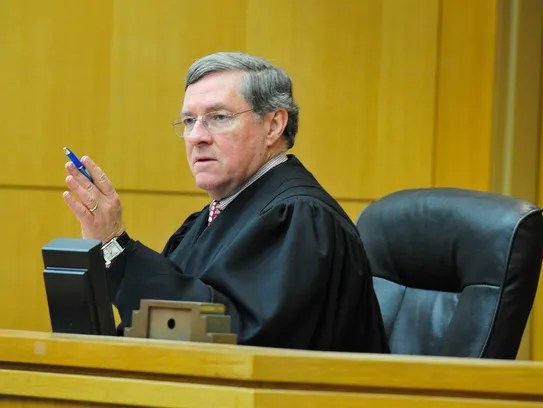
Judge Joseph A. Woodruff, Franklin, TN

What Reguli did not know is that Woodruff initiated his own little private investigation just days after that hearing, sending a private letter to CASA director Emily Layton and Attorney Dana McLendon stating that he was attempting to determine if Reguli made a false statement in the courtroom and asked Layton to respond if Reguli had paid an eight-year-old sanction. Reguli knew none of this, Judge Woodruff’s secret investigation would result in the indictment for aggravated perjury in August 2022.

Reguli represented herself in that case. Although the battleground for justice includes alot more detail and demonstrates a very focused Reguli, the result was that the district attorney dropped the case ten months later.

The case against Reguli had been brought on a false affidavit and withholding exculpatory evidence by CASA director Layton and Attorney McLendon.

EMILY LAYTON – CASA DIRECTOR

Reguli filed a lawsuit against all of the bad actors: Judge Joseph A. Woodruff, DA Kim Helper, DA John Stevens, Atty Dana McLendon, Emily Layton, and CASA. She alleged civil rights violations for malicious prosecution and fabricated evidence and stated claims for abuse of process, intentional infliction of emotional distress, and civil conspiracy.

McLendon’s social media post.

In the typical course of events in federal litigation, all defendants filed motions to dismiss the case. On March 28, 2025, Middle District Judge Traugher entered an order. This order gave Judge Woodruff, DA Helper, and DA Stephens immunity on civil rights claims. The district court permitted the civil rights claims to continue on McLendon and Layton. Afterall, they conspired with state actor Woodruff to conjure up the fake crimes.

In 2024, Reguli’s first round of fake felonies were reversed, and Woodruff’s $5,000 fine against Reguli was also vacated.  

This chart shows the claims that will move ahead in the United States District Court.

We will keep you updated on the progress.

Alabama’s embryo decision is contrary to Tennessee law where would-be babies can be destroyed.

By Connie Reguli, J.D. – Family Policy Specialist and Activist

Image from FreePix – 2024

In the wake of the Alabama Supreme Court’s recent opinion that frozen embryos are human life and therefore subject to the wrongful death of a minor laws in the state, there has been a stir of political comments, a suspension of IVF (in vitro fertilization) services, and a general nervousness about the future of this reproductive technology.  

As soon as the Alabama decision circulated in national headlines, Tennessee Senator Jack Johnson made an inquiry to Attorney General Jonathan Skrmetti who opined that the destruction of embryos from IVF would not come under the Tennessee abortion ban law that passed in 2019.  Skrmetti said that disposing of a human embryo that has not been transferred to a woman’s uterus is not punishable as a ‘criminal abortion’. 

Skrmetti’s position is consistent with Tennessee case law.  The case of Davis v. Davis reached the highest court in Tennessee in 1992.  The couple had married and had determined to resolve their inability to conceive a child with in vitro fertilization.  The medical procedure successfully produced eight embryos.  Two embryos were implanted in the womb of Mary Sue Davis, but the transplant was not successful.  Six frozen embryos remained when the parties became embroiled in divorce proceedings.  While many divorcing couples fight over retirement accounts and toasters, the Davis’ were conflicted on what to do with the embryos.  Junior Davis (the husband) wanted the embryos destroyed.  Mary Sue wanted to keep the embryos for future implantation or donation to someone else.  The Courts struggled to find the appropriate resolution.  

The Tennessee trial Court ruled that it was in the best interest of the unborn children that they be awarded to Mary Sue.  Junior appealed arguing that it was unconstitutional to force him to become a father.  The Court of Appeals awarded the couple joint custody of the embryos and said that they could be implanted for full development only if both parents agreed.  Mary Sue appealed to the Supreme Court. 

The Tennessee Supreme Court provided an extensive argument, discussing whether the embryos were property or whether their pre-embryo state made them something less than a person.  In fact, the Court said that pre-embryos “lack legal personhood”.  They concluded that the Davis’ lacked a property interest in the embryos, but since they both contributed genetic material, they retained joint decision making authority over the outcome.  In its June 1992 decision, the court decided that Junior’s burden of enduring unwanted parenthood outweighed Mary Sue’s burden of being unable to donate the pre-embryos to another couple.  If there is a dispute between those who contribute gametes to the creation of the embryos, they will be destroyed unless both parties agree to maintain them or dispose of them by giving them away. 

The Alabama Court concluded in its opinion that: 

This Court has long held that unborn children are “children” for purposes of Alabama’s Wrongful Death of a Minor Act, 6-5-391, Ala. Code 1975, a statute that allows parents of a deceased child to recover punitive damages for their child’s death. The central question presented is whether the Act contains an unwritten exception to that rule for extrauterine children — that is,unborn children who are located outside of a biological uterus at the time they are killed. Under existing black-letter law, the answer to that question is no: the Wrongful Death of a Minor Act applies to all unborn children,regardless of their location.

The conservative outcry is that the Alabama court opinion is detrimental for persons suffering from infertility and who turn to IVF in hopes of completing the cycle of procreation with the assistance of science.  Alabama legislators are scrambling to find a legislative remedy.  The Alabama Attorney General announced that the State had no intention of prosecuting IVF clinics for the destruction of embryos.  And Eagle Forum agreed that this decision should not limit IVF reproduction. 

A bill already filed in Alabama by Democratic legislators says the fertilized human egg or human embryo outside of a human uterus “under any circumstances” would not be considered “an unborn child, a minor child, a natural person, or any other term that connotes a human being for any purpose under state law.”  Rep. Tim Melson said, “We all know that conception is a big argument that it’s life…I won’t argue that point, but it’s not going to form into a life until it’s put into the uterus.”

This battle is a slippery slope whose unintended consequences are vast.  Knee-jerk reactions by state legislators without a policy position are bound to set up a supply of human fetal tissue to the dark side.  

Project Veritas produced an expose on the fetal tissue industry in 2015 showing undercover videos discussing the transactions of aborted body parts.  His production was attacked by liberal media who relied on Planned Parenthood remarks to discredit the report.  

Flashback to April 2016 when the House Select Investigative Panel on Infant Lives held a hearing on “The Pricing of Fetal Tissue”.  Three former U.S. prosecutors on the panel testified that there was sufficient evidence to launch a federal grand jury investigation based on the exhibits provided.

By 2017, the Department of Justice initiated an investigation into the sale and transfer of fetal body parts.  In 2019, the NIH (National Institutes of Health) published an article on the importance of providing fetal tissue to science. The article said that the Trump administration has effectively banned government-funded research on fetal tissue. The article goes on to describe in detail various biomedical experiments that depend on fetal cells.  By 2021, another Congressman called for an investigation.  It remains an unresolved problem.  

Since the reversal of Roe v. Wade in 2022, twenty-one states have bans on abortions.  Liberal media claims that abortion rates continue to rise, but the Center for Disease Control (CDC) statistics stop in 2021.  

IVF is another source of fetal tissue full stop.  If the medical magic of IVF creates eight embryos and only one is permitted to reach “personhood” by full gestation, the lab is left with seven embryos of human tissue.  IVF is rarely a case in which a single embryo is transplanted into the intended mother. After multiple embryos are transferred and begin to grow,  fetal reduction surgery is used to rip growing embryos from the womb, just another variety of abortion. 

If Alabama passes a law that states that the embryo is not human, the participants in IVF and clinics will have free reign to sell tissue or even incubate the embryos in artificial wombs for market distribution as babies for sale or as valuable research tissue.  

So state legislatures are faced with the dilemma of protecting living tissue versus harboring embryos as property which can be bargained to the highest bidder.  They must either police the destruction of tissue that they deem as “non-human” or they must control the production of the living tissue in the first place.  

Conservatives must be preemptive and acknowledge that voluntary participation in reproductive science with the purpose of producing a living organism is procreation.  It is no different from sexual intercourse.  Those who participate in procreation have a duty of care to what they create.  There is no viable option for controlling the disposition of embryos.  If we let this proverbial cat out-of-the-bag it will be decades before we acknowledge the damage.  We should revisit the 1940’s invasion into the body of Henrietta Lacks for scientific research. It is still debated. 

Our Tennessee legislators must take a stand for public policy that promotes conservative values and craft a careful remedy.   

Connie Reguli, J.D. has a law degree and worked the trenches of the legal landmines in Tennessee for three decades traveling for half of Tennessee’s 95 counties.  She has worked over 40 appeals in the state courts; she is responsible for two significant Tenn. Sup. Ct. developments, and she has carved out civil rights for families and children in the Sixth Circuit.  Her area of emphasis is the integrity of the family unit, the perverted federal funding behind programs that affect the family, and abolishing the current child welfare system.  She wears the battle scars from fighting for liberties in the Tennessee courts, but wants to share her knowledge and analysis with other God-fearing conservatives.  She can be found on Facebook, TikTok, Instagram, X, and YouTube.  

More articles 

https://abcnews.go.com/amp/US/wireStory/alabama-ivf-ruling-puts-spotlight-state-plans-tax-107512073

In Indiana, activists where quick to act. They believe access to health care, birth control and abortions play a key role in women’s health. “We know that the people of Indiana want this access,” said Haley Bougher, of Indiana Planned Parenthood. “They’re not giving it a chance.”

Activists in Iowa

Explosive device in Alabama