Op Ed by Connie Reguli, J.D.
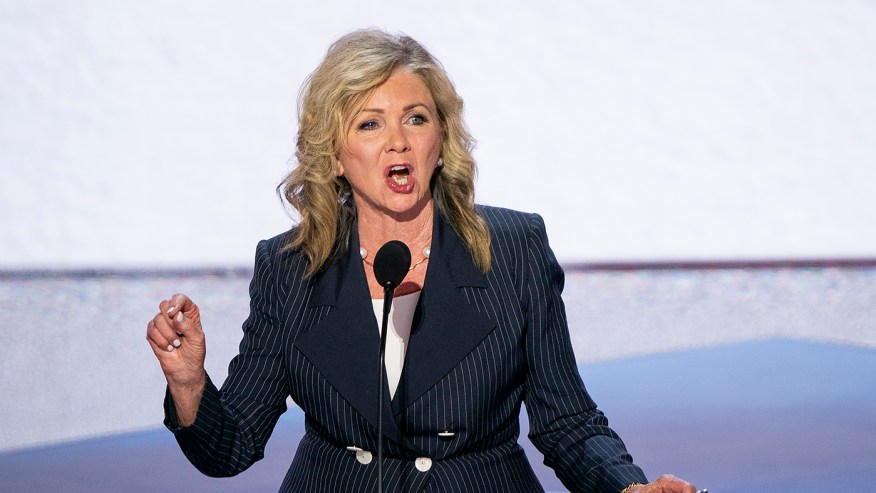
Photo by Greg Nash – The Hill
Marsha Blackburn’s governor campaign rests on a simple brand: long conservative experience, Tennessee toughness, anti-tax credibility, and a history of taking on insiders. Her campaign biography says she “led a successful statewide grassroots campaign to defeat a proposed state income tax,” took on Democrats and members of her own party, and built a reputation as a champion of anti-tax and government-accountability issues (Marsha Blackburn for Governor). Her campaign issues page reinforces that frame with broad promises to cut taxes, cut wasteful spending, keep communities safe, back President Trump’s America First agenda, and make Tennessee a conservative leader (Marsha Blackburn for Governor issues).
However, Blackburn’s record does not cleanly match the brand she is selling. In Tennessee, she opposed a broad-based state income tax in 2002, but her own sponsored legislation included local debt authorization, local taxing authority, municipal charter rewrites, and relaxed purchasing oversight thresholds for local governments (SB0478, SB0839, SB1970, SB1932). In Washington, her primary-sponsored enacted legislation is thin and heavily weighted toward creating post offices and naming/designation bills. One of her most consequential federal actions was her 2016 leadership role in opioid-distribution legislation that critics, former DEA officials, and PolitiFact concluded weakened DEA enforcement during the opioid crisis (Congress.gov S.483, PolitiFact, CBS News / 60 Minutes).
The reality is that Marsha Blackburn built her career as a grassroots anti-tax fighter, then spent decades in office becoming a Washington insider whose actual record is thinner, more industry-aligned, and less protective of Tennessee citizens than her conservative branding suggests.
So when Blackburn sells “experience,” voters should ask: experience doing what? Her record shows experience campaigning as with a conservative-narrative, collecting national special-interest money, and making Washington arguments, but not a strong record of delivering substantive, citizen-centered governance for Tennessee.
Blackburn’s campaign messaging falters when you look at her record.
| Blackburn claim | Evidence-based response |
| “I fought the state income tax.” | True, but her state record also includes authorizing local debt, local tax authority, charter rewrites, and looser local procurement thresholds (SB0478, SB0839, SB1932). |
| “Experience matters.” | Her federal enacted-sponsored record is limited; several enacted measures were naming or designation bills, while the opioid/DEA legislation is one of the most consequential and controversial pieces of her record (Congress.gov H.R.6197, Congress.gov S.483, PolitiFact). |
| “I fight for the people.” | Her career fundraising profile includes large sums from health, finance, real estate, pharmaceutical/health products, oil and gas, leadership PACs, lobbyists, telecom/media, and other regulated interests (OpenSecrets). |
| “I keep communities safe.” | She played a lead role in legislation that raised the DEA’s burden before immediate suspension of suspicious controlled-substance shipments, and PolitiFact rated “Mostly True” the claim that she weakened DEA opioid enforcement (Congress.gov S.483, PolitiFact). |
| “I’m a conservative outsider fighter.” | Blackburn has held elected office for roughly 25 years, moved from state Senate to U.S. House to U.S. Senate, and is now running for governor as a embedded national political figure who is relying on her alignment with Trump and generalized conservative messaging (NBC News). |
Blackburn’s Anti-Tax Brand Does Not Tell the Whole Fiscal Story
Blackburn’s best politically conservative theater was the Tennessee state income-tax fight in 2001-2002, and her efforts, along with numerous other conservative activists, have held the state income tax issue at bay. Her campaign says she led a successful statewide grassroots campaign to defeat the proposed state income tax while serving in the Tennessee State Senate (Marsha Blackburn for Governor). Even that fight did not end with a total victory for Tennessee taxpayers. The $800 million gap in the $9 billion budget still needed funding and in lieu of an income tax. The sales tax jumped by a percentage point to 9.4 percent (among the highest in the country) and additional taxes were collected on alcohol and tobacco.
Blackburn’s comprehensive Tennessee legislative record is more complicated than her anti-tax story. She sponsored SB0478, which authorized the Franklin Special School District to issue and fund $32.5 million in bonds at the request of the district board of education (SB0478). She sponsored SB3217, which authorized the Franklin Special School District to issue up to $3 million in additional bonds or notes for school buildings and facilities (SB3217). She sponsored SB1932 and SB3311, which authorized adequate-facilities-tax authority for Marshall County, a local tax power tied to new development (SB1932, SB3311).
Blackburn also sponsored local-government measures that reduced competitive bidding for taxpayer funded services and shifted authority to insiders with the municipal government. Her legislation increased from $5,000 to $10,000 the maximum amount a municipal governing body could set for purchases not requiring public advertising and competitive bidding (SB0839) (SB0840). SB1970 rewrote the Chapel Hill charter empowering a new local government to create taxes, and SB3237 later revised the Chapel Hill charter on elections, town-court jurisdiction, and other matters (SB1970, SB3237).
While Blackburn looked like a conservative twenty-five years ago by opposing one high-profile statewide income tax effort, her actual governing record included enabling local taxes, local debt, and reduced local procurement oversight. That contrast undercuts a simplistic “taxpayer watchdog” narrative.
Senator Blackburn may respond that her state legislative activity was driven by requests made by local governments, not state-level tax hikes. But as governor, she would be in a position to control state policy, oversight, fiscal structure, and local-government authority, so voters are entitled to examine whether Blackburn’s record reflects strict fiscal conservatism or simply a one-time selective anti-tax branding.
“Experience” Has Not Produced a Strong Conservative Legislative Record
Blackburn’s campaign is leaning into experience, name recognition, and conservative leadership. NBC reported that she entered the 2026 governor race as a major Tennessee Republican figure with roughly 25 years in elected positions, a relationship with Donald Trump, and a message of making Tennessee “America’s conservative leader” (NBC News). Her campaign biography highlights her path through the Tennessee Film, Entertainment, and Music Commission, Tennessee Senate, U.S. House, and U.S. Senate (Marsha Blackburn for Governor).
Her vulnerability is that longevity is not the same as achievement. In the federal sponsored-legislation dataset previously compiled from GovInfo Bill Status records, only seven of Blackburn’s 508-sponsored measures became public law across her House and Senate service, and several were naming/designation measures rather than broad policy reforms (GovInfo Bill Status bulk data). Examples include naming the Pickwick Post Office Building, the John S. Wilder Post Office Building, the Fred D. Thompson Federal Building and United States Courthouse, and the James D. Todd United States Courthouse (Congress.gov H.R.6197, Congress.gov H.R.1817, Congress.gov H.R.375, Congress.gov S.4017). Her single substantive Federal legislation is the REPORT Act, which requires online platforms to report certain child exploitation crimes involving sex trafficking, grooming, or enticement to NCMEC’s CyberTipline (Congress.gov S.474, Blackburn Senate technology page).
The Opioid Epidemic and DEA Law Is a Direct “People vs. Special Interests” Problem
The opioid epidemic did not just appear and crush the population of American. It was nurtured by politicians who failed to recognize the need for high regulation of a dangerous drug. Blackburn’s choice to protect drug manufacturers over protection of American health directly conflicts with a “protect Tennessee families” posture. The law Ensuring Patient Access and Effective Drug Enforcement Act of 2016 became Public Law 114-145 (Congress.gov S.483). This law narrowed the definition of “imminent danger to the public health and safety” which was the threshold for immediate registration suspensions by the DEA. The law required an immediate threat of death, serious bodily harm, or abuse of a controlled substance due to a registrant’s failure to maintain effective controls against diversion (Congress.gov S.483). If the DEA could not meet this strict requirement they were prohibited from initiating a suspension against the distributor. The result was a wild and uncontrolled distribution of addictive opioid medications.
The Washington Post and 60 Minutes reported that the bill was introduced in the House by Tom Marino and Marsha Blackburn, passed by unanimous consent, and was signed into law by President Obama in April 2016 (CBS News / 60 Minutes). CBS reported that former DEA officials said the law stripped or sharply reduced the DEA’s ability to immediately freeze suspicious narcotics shipments, and DEA Chief Administrative Law Judge John J. Mulrooney wrote that the legislation would make it “all but impossible” to prosecute unscrupulous distributors (CBS News / 60 Minutes).
Others, including then Governor Phil Bredesen, claimed that Blackburn weakened DEA opioid enforcement, finding that Blackburn was an original cosponsor of the first version of the bill, signed her name to two versions, took the lead during House-floor debate at one point, and was a vocal critic of prior DEA enforcement methods (PolitiFact). PolitiFact also reported that the drug distribution industry spent just shy of $1.3 million lobbying between 2014 and 2016 to get Blackburn’s ideas into law, and that distribution-company donations to Blackburn rose from $6,000 in 2012 to $22,000 after the bill became law. (PolitiFact). An Associated Press report quoted former DEA official Joe Rannazzisi saying staff connected to Blackburn were warned in July 2014 that the bill would hamper DEA enforcement. (Clarksville Now / AP).
When Tennessee families needed protection from pill flooding and rogue distribution, Blackburn’s Washington experience helped make DEA enforcement harder, then she called the consequences “unintended.”
If confronted, Blackburn will likely respond that this devastating legislation was bipartisan, passed both chambers without objection, was signed by President Obama, and was framed as protecting legitimate patient access to pain medication (The Tennessean). She will also argue that she supported later fixes and other anti-opioid measures, including prescription limits and treatment-related proposals (Clarksville Now / AP). But bipartisan passage does not erase leadership responsibility, and later fixes do not erase the fact that she helped champion weakening enforcement while Tennesseans were already deep in the opioid crisis.
Blackburn’s Special-Interest Funding Undermines the Grassroots Brand
Blackburn’s career fundraising profile is a major contrast to her grassroots origin story. OpenSecrets reports that her top career industry categories from 1991 to 2024 include health professionals at $2,314,392, securities and investment at $2,008,855, real estate at $1,771,187, pharmaceuticals/health products at $1,382,192, oil and gas at $1,164,006, leadership PACs at $1,152,842, lawyers/law firms at $1,055,544, and lobbyists at $986,312 (OpenSecrets). OpenSecrets also reports sector totals of $6,185,778 from finance, insurance, and real estate; $5,164,117 from health; $2,568,450 from communications/electronics; and $2,041,856 from lawyers and lobbyists (OpenSecrets).
The telecom/media contributions require another special-interest inquiry. Center for Responsive Politics data found that Blackburn had received more than $350,000 from phone and cable companies and trade groups, $374,100 from film, television, and recording industries, and more than $750,000 from communications and media lobbies while holding financial investments related to those industries. (Free Press Action).
Blackburn talks like a grassroots outsider, but her career fundraising looks like a Washington insider’s portfolio of PACs, regulated industries, lobbyists, and national ideological money.
Campaign Issues Are Broad Labels, Not a Governing Plan
Blackburn’s issues page lists familiar Republican slogans: economic growth, tax cuts, cutting wasteful spending, public safety, illegal immigration, modern infrastructure, conservative leadership, China, elections, crypto, farmers, veterans, women’s sports, parental rights, education, protecting children, life, and the Second Amendment (Marsha Blackburn for Governor issues). The page provides issue headers but little concrete detail, data, implementation language, budget explanation, or Tennessee-specific administrative plan (Marsha Blackburn for Governor issues).
That matters because governor is an executive office, not a cable-news or congressional messaging post. Tennessee’s next governor will have to manage agencies, budgets, procurement, public safety coordination, education administration, Medicaid/TennCare issues, corrections, infrastructure, disaster response, and local-government relations. Blackburn’s current message is heavy on identity and ideology, but comparatively light on state-executive specifics.
Blackburn is running a Washington-style conservative message campaign for a Tennessee executive job. Voters should ask for concrete plans, not just labels.
Issue-Specific Evidence Contradicting Blackburn’s Messaging.
Lack of fiscal conservatism
- Franklin Special School District debt: SB0478 authorized issuance and funding of $32.5 million in bonds for the Franklin Special School District (SB0478).
- Additional Franklin school debt: SB3217 authorized up to $3 million in additional bonds or notes for Franklin Special School District construction and facilities (SB3217).
- Marshall County adequate-facilities tax: SB1932 authorized an adequate-facilities tax reasonably related to new development in Marshall County (SB1932).
- Marshall County adequate-facilities tax private act: SB3311 enacted the “Marshall County Adequate Facilities Tax” subject to local approval (SB3311).
Relaxation of oversight and granting insider municipal authority
- Procurement threshold: SB0839 increased from $5,000 to $10,000 the amount a municipal governing body could set for purchases not requiring public advertising and competitive bidding (SB0839).
- City-manager contracting authority: SB0840 allowed commissioners to authorize a city manager to enter routine contracts where fiscal-year expenditures were under $10,000 (SB0840).
Lack of substantive Federal legislative productivity
- Designation-heavy enacted record: Several Blackburn-sponsored enacted bills designated public buildings or post offices, including H.R.6197, H.R.1817, H.R.375, and S.4017 (Congress.gov H.R.6197, Congress.gov H.R.1817, Congress.gov H.R.375, Congress.gov S.4017).
- Lots of noise, little results: Out of the 508 sponsored bills while serving Tennesseans in Washington, only seven became public law. Most were mere administrative changes to names of federal buildings or designating new post offices.
- Substantive enacted bill: S.474, the REPORT Act, became Public Law 118-59 and is a substantive child-online-safety reporting measure (Congress.gov S.474).
- Official law: S.483 became Public Law 114-145, the Ensuring Patient Access and Effective Drug Enforcement Act of 2016 (Congress.gov S.483).
- Enforcement change: Congress.gov says the law defined the “imminent danger” standard for immediate suspension and provided for corrective-action-plan procedures in show-cause cases (Congress.gov S.483).
- Investigative criticism: DEA officials said the law reduced DEA’s ability to freeze suspicious narcotics shipments (CBS News / 60 Minutes).
- Warning evidence: DEA Rannazzisi said staff connected to Blackburn were warned in 2014 that the bill would hamper DEA enforcement (Clarksville Now / AP).
Suggested Questions for Forums and Reporters.
- “Senator Blackburn, you say your experience matters. Can you name the most significant Tennessee-specific law you personally authored and passed in Congress that materially improved the lives of Tennessee families?”
- “You built your brand fighting a state income tax, but in the Tennessee Senate you sponsored bills authorizing local debt, local adequate-facilities taxes, and looser procurement thresholds. How should voters reconcile that record?”
- “Did you make a mistake in 2016 when you limited DEA enforcement of opiod distribution and what are your feelings about that today?
- “If former DEA officials warned congressional staff in 2014 that the bill would hamper enforcement, why did you continue pushing it?”
- “Your campaign says you will cut wasteful spending, but your issues page offers headings rather than a budget plan. Which Tennessee agencies or programs would you cut, and by how much?”
- “After decades in Washington and millions in contributions from regulated industries, why should voters believe you are still the same grassroots taxpayer advocate you claim to be?”
Marsha Blackburn wants Tennesseans to believe that “experience” is enough. But experience doing what? Her record shows a politician who fought the state income tax twenty-five years ago, then spent decades in office collecting Washington money, passing one substantive piece of substantive legislation, enabling local debt and local taxing authority in Tennessee, and helping weaken DEA enforcement during the opioid crisis. Tennessee does not need a career Washington brand. Tennessee needs a governor whose record matches the message.