CALL TO ACTION FOR TENNESSEE VOTERS

By Connie Reguli, J.D. – April 3, 2025

CALL TO ACTION – TENNESSEE PARENTS

Last year, the Tenn. Gen. Assembly passed the “Parental Rights Bill”.

Connie Reguli, J.D. lobbied against this bill. She argued that parents already had protected parental rights under the 14th Amendment. These rights were confirmed by the United States Supreme Court. Reguli further warned, ‘if you let the state legislators put parental rights in the state code, they can revise them at any time. They can slice away at your rights.’

…AND THEY HAVE. This year Faison (HB 0826) and Haile (SB 0895) filed a new bill changing the parental rights law of 2024.

This bill was filed as a ‘caption bill’ initially. This means the bill was filed with one simple sentence. It asked the courts to report on how many parental rights bills were filed. Then the bill was secretly ‘amended’ to slice away parental rights. The bill added:

1 – A parent can remove a child for religious purposes. If it’s more than 20 days in a school year, the school can force the parent to meet “to discuss the child’s educational future”.

2 – The school no longer needs parental consent to audio record a child. It also doesn’t require consent to video record a child at school or during activities.

3 – A healthcare provider does not need parental consent to examine a child. This is applicable under ‘reasonable suspicion’ of neglect or abuse.

You might not be moved by these new limitations to parental rights. Still, it is just a matter of time. The amendments to this bill will continue to limit the rights of parents. For instance ‘reasonable suspicion’ is not the legal standard under our Fourth Amendment protections, it is exigent circumstances. That means an immediate emergency.

This bill has passed committees and is headed to the floor on April 7th.

Email or call your legislators to vote no.

The bill is here: https://wapp.capitol.tn.gov/apps/BillInfo/Default.aspx…

Find your legislator is here:

https://wapp.capitol.tn.gov/Apps/fml2022/search.aspx

Federal lawsuit over fake felonies will go to trial.

By Connie Reguli

When Connie Reguli turned herself in to the Williamson County Sheriff’s Department in August 2022 on a felony indictment for aggravated perjury, she was already litigation weary. She had already been put through a three day jury trial for accessory to a felony, a sentencing hearing, and a motion for a new trial. The convictions for accessory to a felony were the result of Judge Joseph A. Woodruff manipulating the jury instructions, removing an essential element of the crime, and causing a fake conviction. Although Reguli (and most likely Judge Woodruff) knew that the fake felonies would not stand scrutiny on review, she instantly lost her law license, her entire business model law practice, three employees, dozens of clients, and a juvenile Court judicial election. Nevertheless, she was never required to serve a sentence of incarceration or probation.

Just days after the motion for a new trial in August 2022, Reguli was called by her attorney and told that Williamson County DA Kim Helper had a new indictment on her for aggravated perjury.

The new felony echoed from the chambers of Judge Joseph A. Woodruff as well. While Reguli was in the midst of the first round of fake felonies, Woodruff was shutting Reguli down from obtaining her public records request in another courtroom. After this hearing concluded, Woodruff fined Reguli $5,000 and shut down her request for records. Woodruff would then order that Reguli was prohibited from filing anything pro se without hiring another attorney, and threatened Reguli not to file an appeal. Reguli appealed.

Judge Joseph A. Woodruff, Franklin, TN

What Reguli did not know is that Woodruff initiated his own little private investigation just days after that hearing, sending a private letter to CASA director Emily Layton and Attorney Dana McLendon stating that he was attempting to determine if Reguli made a false statement in the courtroom and asked Layton to respond if Reguli had paid an eight-year-old sanction. Reguli knew none of this, Judge Woodruff’s secret investigation would result in the indictment for aggravated perjury in August 2022.

Reguli represented herself in that case. Although the battleground for justice includes alot more detail and demonstrates a very focused Reguli, the result was that the district attorney dropped the case ten months later.

The case against Reguli had been brought on a false affidavit and withholding exculpatory evidence by CASA director Layton and Attorney McLendon.

EMILY LAYTON – CASA DIRECTOR

Reguli filed a lawsuit against all of the bad actors: Judge Joseph A. Woodruff, DA Kim Helper, DA John Stevens, Atty Dana McLendon, Emily Layton, and CASA. She alleged civil rights violations for malicious prosecution and fabricated evidence and stated claims for abuse of process, intentional infliction of emotional distress, and civil conspiracy.

McLendon’s social media post.

In the typical course of events in federal litigation, all defendants filed motions to dismiss the case. On March 28, 2025, Middle District Judge Traugher entered an order. This order gave Judge Woodruff, DA Helper, and DA Stephens immunity on civil rights claims. The district court permitted the civil rights claims to continue on McLendon and Layton. Afterall, they conspired with state actor Woodruff to conjure up the fake crimes.

In 2024, Reguli’s first round of fake felonies were reversed, and Woodruff’s $5,000 fine against Reguli was also vacated.  

This chart shows the claims that will move ahead in the United States District Court.

We will keep you updated on the progress.

The Right to Defend Oneself in Court. Kansas Sup. Ct. calls out the kangaroo court for what it is. And why is matters.

By Connie Reguli, J.D.

As a family law attorney defending parents against over aggressive state agencies for three decades, I have always worked with parents on how to defend themselves in court. These days, parents contact me from all over the country and say that their court-appointed attorneys are not preparing them for court and are not even allowing them to speak in the courtroom. Parents, sadly, do not have all of the constitutional protections that are provided to criminals, like Miranda rights and the right to confront their accuser, however, the ability to speak and be heard in dependency cases is precious and paramount to winning for parents.

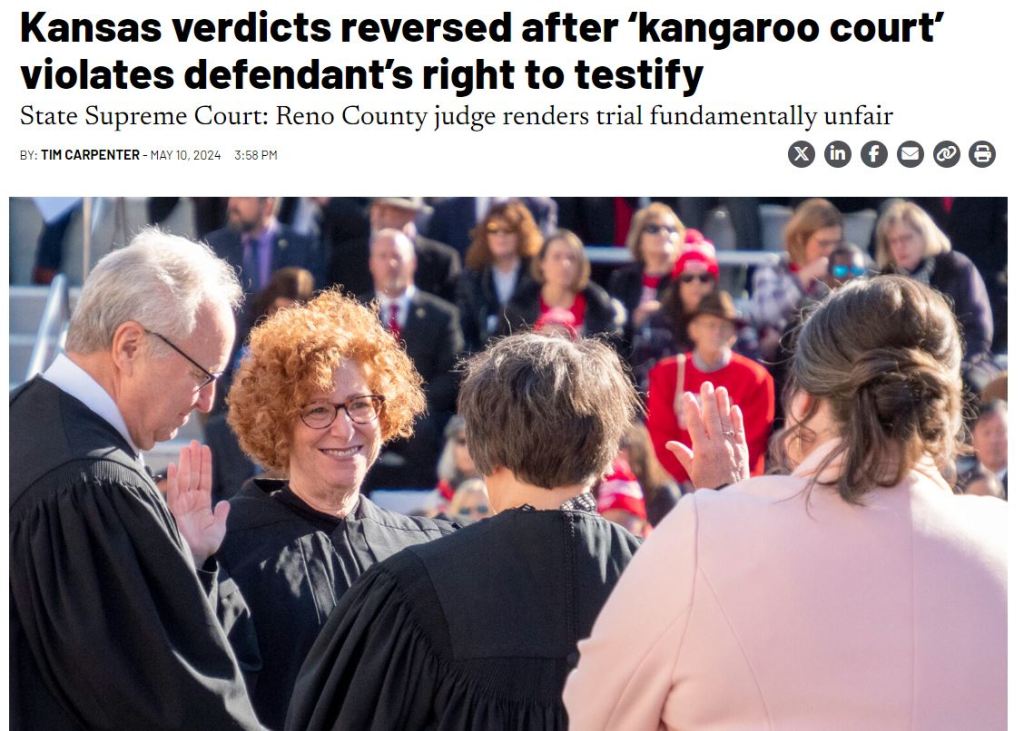
On May 10, 2024, the Kansas Supreme Court released an opinion in the criminal case of State of Kansas v. John R. Cantu which found that the trial court judge had denied the constitutional rights of criminal defendant Cantu by removing him from the witness stand and striking his testimony. Cantu’s convictions were reversed.

This case is worth the read, and begins like this:

Cantu was convicted by the jury and sentenced to 24 months in prison. Thankfully, Cantu and a brave attorney filed on appeal raising the issue that “the court’s decision to strike his entire testimony from the record deprived him of his constitutional right to testify, which was structural error requiring automatic reversal.”

The Cantu opinion explains the right to testify and provides a history of precedential opinions:

The right to testify on one’s own behalf at a criminal trial is a fundamental right grounded in multiple provisions of the United States Constitution. Rock v. Arkansas, 483 U.S. 44, 49-55, 107 S. Ct. 2704, 97 L. Ed. 2d 37 (1987); Ferguson v. Georgia, 365 U.S. 570, 582, 81 S. Ct. 756, 5 L. Ed. 2d 783 (1961). In Rock v. Arkansas, the United States Supreme Court found this right is guaranteed by the Due Process Clause of the Fourteenth Amendment and the Compulsory Process Clause of the Sixth Amendment, and necessarily implied by the Fifth Amendment privilege against self-incrimination. 483 U.S. at 51-53. These constitutional provisions apply to state proceedings through the Fourteenth Amendment. See Washington v. Texas, 388 U.S. 14, 17-19, 87 S. Ct. 1920, 18 L. Ed. 2d 1019 (1967) (incorporating the Sixth Amendment Compulsory Process Clause); Malloy v. Hogan, 378 U.S. 1, 6, 84 S. Ct. 1489, 12 L. Ed. 2d 653 (1964) (incorporating the Fifth Amendment’s protection against compelled self-incrimination).

At its most basic level, the right to testify allows a defendant to respond directly to the State’s charges by “present[ing] his own version of events in his own words.” Rock, 483 U.S. at 52. Thus, the Court has identified the right to testify as one in a bundle of minimum due process rights guaranteed by the Fourteenth Amendment that are essential to a fair trial. Rock, 483 U.S. at 51 (listing a criminal defendant’s basic due process rights at trial as including, at a minimum, the right to confront witnesses, to offer testimony, and to be represented by counsel) (quoting In re Oliver, 333 U.S. 257, 273, 68 S. Ct. 499, 92 L. Ed. 682 [1948]).

The Court has also found the right to testify derives from the Sixth Amendment’s Compulsory Process Clause, which grants a defendant the right to call favorable, material witnesses. Rock, 483 U.S. at 52 (noting “the most important witness for the defense in many criminal cases is the defendant himself”). In this way, the Court recognized the right to testify is part of the broader personal right to present a defense, designating it as even more fundamental than the right of self-representation. 483 U.S. at 52 (citing Faretta v. California, 422 U.S. 806, 819, 95 S. Ct. 2525, 45 L. Ed. 2d 562 [1975]).

Finally, the Court has interpreted the Fifth Amendment’s privilege against self-incrimination as implying an affirmative right to testify. Rock, 483 U.S. at 52-53 (“’Every criminal defendant is privileged to testify in his own defense, or to refuse to do so.’”) (quoting Harris v. New York, 401 U.S. 222, 230, 91 S. Ct. 643, 28 L. Ed. 2d 1 [1971]).

FOR CANTU, THIS WAS NOT A HARMLESS ERROR.

The appellate court held that denying the right to testify was a constitutional error, but it was harmless. The Kansas Supreme Court said that “structural errors” occur where the error at issue compromised the fundamental fairness of the trial mechanism, both from the perspective of the court’s function and the defendant’s right to due process. In this case, the judge’s decision to remove Cantu from the witness stand and strike his entire testimony was a structural and reversible error.

The Court largely relied on the analysis provided by the United States Supreme Court in Illinois v. Allen, 397 U.S. 337, 343 (1970) which permitted the removal of the defendant from the courtroom for disruptive behavior, but cautioned that even “once lost, the right to be present can, of course, be reclaimed as soon as the defendant is willing to conduct himself consistently with the decorum and respect inherent in the concept of courts and judicial proceedings.” The Cantu opinion concluded that courts are to ‘indulge every reasonable presumption against the loss of a defendant’s constitutional rights.” Citing Allen.

WHY IT MATTERS

This case provides a detailed analysis of the constitutional right to testify in order to defend oneself, however, there is an element of the jury trial process that is ignored in this opinion. That is the effect on the jury of the judge’s arrogant and corporal treatment of the defendant in the courtroom. The jury enters into the criminal justice process believing that it will be fair and honest and that the judge is the person in the room with the greatest intelligence, the most deference to the constitutional rights of the defendant, and the most empowered by the people. In many ways this is incorrect and often the judges are NOT the most intelligent in the room, however that is not the point today. When the jury experiences a judge criticizing a witness or defendant in the courtroom, it makes a distinct negative psychological impact on their impression of the person testifying. Judges know this. You can see it in your observations of them. I have seen it myself.

Cantu is important and the ruling here should race across the country to apply to criminal and dependency cases. After all, dependency cases are quasi-criminal and each parent is facing allegations that are also defined in the criminal code. The results are similar. While a criminal court can take away your freedom, a dependency court can separate you from your children forever, remove their lineage, and take away their birth name. Both are devastating.

Connie Reguli, J.D. worked with families for three decades in Tennessee until falsely charged with a fake crime invented by a corrupt judge and district attorney. Those charges were reversed and a civil rights lawsuit has been filed. Reguli et al, v. Hetzel, et al, Case No. 3:24-cv-00541. Follow on Facebook, YouTube, TikTok, LinkedIn, and Instagram for more. Facebook. Connie Reguli and Family Forward Project.

Tennessee’s Family Bondage Law 2024

By Connie Reguli, J.D

Sign the petition to reject the Family Rights and Responsibilities Act of 2024 – no matter where you are.

Protect parental rights in Tennessee.  We need your support to STOP the Tennessee General Assembly from slicing and dicing parental rights with HB2936 sponsored by Rep. Jeremy Faison (HB2936) and Sen. Ferrell Haile (SB2749) Find the language here

EVERY PARENT IN TENNESSEE MUST STEP UP TO PROTECT THEIR FAMILY. 

Rep. Faison has in his mind that this bill is necessary to protect parental rights, but the United State Supreme Court has already established that parents have the right to raise their children, obtain medical treatment, and more.  (See below)

What the parental rights bill does is enumerate parental rights and then provides multiple exceptions for the government to block parents from protecting those rights.  The bill includes the word “unless” five times and then provides a slippery slope of exceptions like when a parent provides “blanket consent” or when any person represents themselves has having authority to consent to to waive parental rights (you correct, this is very scary).  

Let’s talk about UNLESS.  The word unless is used five times and gives reasons for parental rights to be subverted by the government.  Like, the government’s right to interrogate to your child without your knowledge or consent.  This bill allows for a complete absence of consent when there is  “law enforcement interaction”…..  So the SRO (school resource officer) can stop your child at school and isolate them to interrogate them? YES.  And of course DCS (Dept. of Children’s Services) can do the same.  The bill DOES NOT require government officials to establish probable cause with credible evidence.  The Fourth Amendment protects persons from search and seizure unless probable cause has been established.  Federal case law is clear on this.  However, children have no protection from Fourth Amendment seizure and interrogation under this bill.  Probable cause is not required.  

Are you seeing the problem? 

Then we get into a very slippery and the barely comprehensible clause when parental rights do not apply like for “a minor participating in a program for which the minor’s parent has consented to the child’s participation by an employee of the institution of higher education OR OTHER SCHOOL OFFICIAL.”   If your reaction is “I totally do not understand when this applies” you are correct that it is confusing and likely has a broader scope of application than it appears on its face.  

So who is giving consent….the parent or the employee or other school official.  And what is the participation……in a program of higher education?…for minors.  I have a feeling that this is more than college attendance.  What if the college has a summer program for high school student on creative writing, coding, or any subject?  Now the enrollment in this program is a waiver of all of your parental rights? YES 

Let’s go back to “blanket consent“.  Now school admission papers, or perhaps any other activity for minors, will include a “blanket consent” clause.  Parents will need to read the FINE print on everything associated with their child.  Years ago, I sued a kids jumping facility because they allowed someone other than the parent to sign the waiver.  I won.  Now those facilities are very careful about waivers. 

Another section of gobble-gook language says that there are no parental rights when “a government entity or any other person reasonably relies in good faith on an individual’s representations that the individual is the parent of a minor child or has otherwise been granted authority to make decisions regarding a minor’s care under state law.”   In layman’s terms this means that a person providing medical or mental health treatment for your child can avoid any liability by saying … OOPS I MADE A MISTAKE.  THAT OTHER PERSON GAVE ME PERMISSION (whomever that other person may be).  This provides for complete exoneration for any who when they rely on someone else’s representation.  

Can you see where this is going? 

Under the medical decision-making section, the law defines a PERSON as “an individual, corporation, or any other legal or commercial entity, whether or not a citizen or domiciliary of this state and whether or not organized under the laws of this state.”  

And a PERSON under this bill can administer EMERGENCY care to your child without your consent.  Please note that it DOES NOT SAY – LIFE SAVING CARE.  So what is an emergency?  Is the governor’s executive order calling for a State of Emergency giving any commercial entity the right to treat your child?  YES IT DOES.  Is your child’s gender dysphoria an emergent situation for your child?  It depends on who is asking.   

Although this bill pretends to give parents a legal right of action to sue anyone who violates their parental rights, the bill is so perverted and packed with exceptions that NO ATTORNEY will touch a case.  And what parent can afford 30, 40, 50 thousand dollars to sue a government or commercial entity who has dozens of attorneys to protect them from liability?  Any school or other other entity will include an ‘indemnity‘ clause, which means, if you allow your child to participate or receive treatment you will NOT sue us.  

An organization called ADF (Americans for Defending Freedom) sent a representative to try to convince the General Assembly to pass this bill on March 5, 2024, claiming that 17 other states have passed “substantially similar” bills.  But this is not true.  After researching the parental rights bills across the country, nineteen states have parental rights bills but only five of the more recent bills have plugged in this type of “exception” list which, by law, gives the government the right to ignore parental rights.  

Many states, like Michigan, Nevada, Virginia, and Montana have set forth a very clear statement that parental rights are fundamental rights and the government must show a compelling interest to interfere.  Any government interference must be narrowly drawn to set the least restrictive environment.  

ParentalRights.org is working on establishing a federal law protecting parental rights that is simple and direct and it is not filled with exceptions and tricky language to exonerate those who continue to try to interfere with these rights.  

That proposed Parental Rights Amendment says this: 

  • Section 1. The liberty of parents to direct the upbringing,
    education, and care of their children is a fundamental right.
  • Section 2. The parental right to direct education includes the right to choose, as an alternative to public education, private, religious, or home schools, and the right to make reasonable choices within public schools for one’s child.
  • Section 3. Neither the United States nor any State shall infringe these rights without demonstrating that its governmental interest as applied to the person is of the highest order and not otherwise served.
  • Section 4. The parental rights guaranteed by this article shall not be denied or abridged on account of disability

One state, ALABAMA, enacted a similar simple parental rights act last year and now seeks to include these rights in their constitution.  

BOTTOM LINE – Tennessee parents, grandparents, and other concerned citizens must stop the Tennessee General Assembly from passing this parental bondage bill.  

Please sign this petition to be presented to the sponsor and committee members. 

HERE ARE THE LINKS TO MEMBERS OF THE GENERAL ASSEMBLY THAT YOU CAN CONTACT DIRECTLY: (Click on the link and there is an “Email Legislator” button or use the email address below. 

Tell them to vote NO on HB2936 – the parental rights bill 

Sponsor:  JEREMY FAISON                            rep.jeremy.faison@capitol.tn.gov 

Committee Chair: MARY LITTLETON            rep.mary.littleton@capitol.tn.gov 

Committee Co-Chair:  ANDREW FARMER    rep.andrew.farmer@capitol.tn.gov

Other members: 

RUSH BRICKEN    rep.rush.bricken@capitol.tn.gov

RON M. GANT   rep.ron.gant@capitol.tn.gov

JOHNNY GARRETT   rep.johnny.garrett@capitol.tn.gov

TORREY HARRIS    rep.torrey.harris@capitol.tn.gov

DARREN JERNIGAN   rep.darren.jernigan@capitol.tn.gov

JASON POWELL   rep.jason.powell@capitol.tn.gov

ROBERT STEVENS     rep.robert.stevens@capitol.tn.gov

This petition is sponsored by Family Forward Project – Building Better Stronger Families. 

Follow Family Forward Project on Facebook. 

Follow Connie on Youtube, TikTok, Instagram, and LinkedIn

Connie Reguli, J.D. Tennessee 

For curious minds….

It is well established by the United States Supreme Court that parents have fundamental interest to parent their children.  The state may not interfere in child rearing decisions when a fit parent is available.  Troxel v. Granville, 530 U.S. 57 (2000), Prince v. Massachusetts, 321 U.S. 158 (1944), Pierce v. Society of Sisters, 268 U.S. 510 (1925), Meyer v. Nebraska, 262 U.S. 390 (1923).   A child also has a constitutionally protected interest in the companionship and society of his or her parents.  Ward v. San Jose, 967 F. 2d 280  (9th Cir. 1992) A state employee who withholds a child from her family may infringe on the family’s liberty of familial association.  Murphy v. Morgan 914 F. 2d 846  (7th Cir. 1990)  The forced separation of parent from child, even for a short time; represent a serious infringement upon the rights of both.  J.B. v. Washington County, 127 F. 3d 919  (10th Cir. 1997)  Absent extraordinary circumstances, a parent has a liberty interest in familial association and privacy that cannot be violated without adequate pre-deprivation procedures. Malik v. Arapahoe Cty. Dept. of Social Services 91 F. 3d 1306  (10th Cir. 1999)  Parent’s interest is of “the highest order,” and the court recognizes “the vital importance of curbing overzealous suspicion and intervention on the part of healthcare professionals and government officials.  Thomason v. Scan Volunteer Services, Inc.  787 F. 2d 403  (8th Cir. 1996) 

Alabama’s embryo decision is contrary to Tennessee law where would-be babies can be destroyed.

By Connie Reguli, J.D. – Family Policy Specialist and Activist

Image from FreePix – 2024

In the wake of the Alabama Supreme Court’s recent opinion that frozen embryos are human life and therefore subject to the wrongful death of a minor laws in the state, there has been a stir of political comments, a suspension of IVF (in vitro fertilization) services, and a general nervousness about the future of this reproductive technology.  

As soon as the Alabama decision circulated in national headlines, Tennessee Senator Jack Johnson made an inquiry to Attorney General Jonathan Skrmetti who opined that the destruction of embryos from IVF would not come under the Tennessee abortion ban law that passed in 2019.  Skrmetti said that disposing of a human embryo that has not been transferred to a woman’s uterus is not punishable as a ‘criminal abortion’. 

Skrmetti’s position is consistent with Tennessee case law.  The case of Davis v. Davis reached the highest court in Tennessee in 1992.  The couple had married and had determined to resolve their inability to conceive a child with in vitro fertilization.  The medical procedure successfully produced eight embryos.  Two embryos were implanted in the womb of Mary Sue Davis, but the transplant was not successful.  Six frozen embryos remained when the parties became embroiled in divorce proceedings.  While many divorcing couples fight over retirement accounts and toasters, the Davis’ were conflicted on what to do with the embryos.  Junior Davis (the husband) wanted the embryos destroyed.  Mary Sue wanted to keep the embryos for future implantation or donation to someone else.  The Courts struggled to find the appropriate resolution.  

The Tennessee trial Court ruled that it was in the best interest of the unborn children that they be awarded to Mary Sue.  Junior appealed arguing that it was unconstitutional to force him to become a father.  The Court of Appeals awarded the couple joint custody of the embryos and said that they could be implanted for full development only if both parents agreed.  Mary Sue appealed to the Supreme Court. 

The Tennessee Supreme Court provided an extensive argument, discussing whether the embryos were property or whether their pre-embryo state made them something less than a person.  In fact, the Court said that pre-embryos “lack legal personhood”.  They concluded that the Davis’ lacked a property interest in the embryos, but since they both contributed genetic material, they retained joint decision making authority over the outcome.  In its June 1992 decision, the court decided that Junior’s burden of enduring unwanted parenthood outweighed Mary Sue’s burden of being unable to donate the pre-embryos to another couple.  If there is a dispute between those who contribute gametes to the creation of the embryos, they will be destroyed unless both parties agree to maintain them or dispose of them by giving them away. 

The Alabama Court concluded in its opinion that: 

This Court has long held that unborn children are “children” for purposes of Alabama’s Wrongful Death of a Minor Act, 6-5-391, Ala. Code 1975, a statute that allows parents of a deceased child to recover punitive damages for their child’s death. The central question presented is whether the Act contains an unwritten exception to that rule for extrauterine children — that is,unborn children who are located outside of a biological uterus at the time they are killed. Under existing black-letter law, the answer to that question is no: the Wrongful Death of a Minor Act applies to all unborn children,regardless of their location.

The conservative outcry is that the Alabama court opinion is detrimental for persons suffering from infertility and who turn to IVF in hopes of completing the cycle of procreation with the assistance of science.  Alabama legislators are scrambling to find a legislative remedy.  The Alabama Attorney General announced that the State had no intention of prosecuting IVF clinics for the destruction of embryos.  And Eagle Forum agreed that this decision should not limit IVF reproduction. 

A bill already filed in Alabama by Democratic legislators says the fertilized human egg or human embryo outside of a human uterus “under any circumstances” would not be considered “an unborn child, a minor child, a natural person, or any other term that connotes a human being for any purpose under state law.”  Rep. Tim Melson said, “We all know that conception is a big argument that it’s life…I won’t argue that point, but it’s not going to form into a life until it’s put into the uterus.”

This battle is a slippery slope whose unintended consequences are vast.  Knee-jerk reactions by state legislators without a policy position are bound to set up a supply of human fetal tissue to the dark side.  

Project Veritas produced an expose on the fetal tissue industry in 2015 showing undercover videos discussing the transactions of aborted body parts.  His production was attacked by liberal media who relied on Planned Parenthood remarks to discredit the report.  

Flashback to April 2016 when the House Select Investigative Panel on Infant Lives held a hearing on “The Pricing of Fetal Tissue”.  Three former U.S. prosecutors on the panel testified that there was sufficient evidence to launch a federal grand jury investigation based on the exhibits provided.

By 2017, the Department of Justice initiated an investigation into the sale and transfer of fetal body parts.  In 2019, the NIH (National Institutes of Health) published an article on the importance of providing fetal tissue to science. The article said that the Trump administration has effectively banned government-funded research on fetal tissue. The article goes on to describe in detail various biomedical experiments that depend on fetal cells.  By 2021, another Congressman called for an investigation.  It remains an unresolved problem.  

Since the reversal of Roe v. Wade in 2022, twenty-one states have bans on abortions.  Liberal media claims that abortion rates continue to rise, but the Center for Disease Control (CDC) statistics stop in 2021.  

IVF is another source of fetal tissue full stop.  If the medical magic of IVF creates eight embryos and only one is permitted to reach “personhood” by full gestation, the lab is left with seven embryos of human tissue.  IVF is rarely a case in which a single embryo is transplanted into the intended mother. After multiple embryos are transferred and begin to grow,  fetal reduction surgery is used to rip growing embryos from the womb, just another variety of abortion. 

If Alabama passes a law that states that the embryo is not human, the participants in IVF and clinics will have free reign to sell tissue or even incubate the embryos in artificial wombs for market distribution as babies for sale or as valuable research tissue.  

So state legislatures are faced with the dilemma of protecting living tissue versus harboring embryos as property which can be bargained to the highest bidder.  They must either police the destruction of tissue that they deem as “non-human” or they must control the production of the living tissue in the first place.  

Conservatives must be preemptive and acknowledge that voluntary participation in reproductive science with the purpose of producing a living organism is procreation.  It is no different from sexual intercourse.  Those who participate in procreation have a duty of care to what they create.  There is no viable option for controlling the disposition of embryos.  If we let this proverbial cat out-of-the-bag it will be decades before we acknowledge the damage.  We should revisit the 1940’s invasion into the body of Henrietta Lacks for scientific research. It is still debated. 

Our Tennessee legislators must take a stand for public policy that promotes conservative values and craft a careful remedy.   

Connie Reguli, J.D. has a law degree and worked the trenches of the legal landmines in Tennessee for three decades traveling for half of Tennessee’s 95 counties.  She has worked over 40 appeals in the state courts; she is responsible for two significant Tenn. Sup. Ct. developments, and she has carved out civil rights for families and children in the Sixth Circuit.  Her area of emphasis is the integrity of the family unit, the perverted federal funding behind programs that affect the family, and abolishing the current child welfare system.  She wears the battle scars from fighting for liberties in the Tennessee courts, but wants to share her knowledge and analysis with other God-fearing conservatives.  She can be found on Facebook, TikTok, Instagram, X, and YouTube.  

More articles 

https://abcnews.go.com/amp/US/wireStory/alabama-ivf-ruling-puts-spotlight-state-plans-tax-107512073

In Indiana, activists where quick to act. They believe access to health care, birth control and abortions play a key role in women’s health. “We know that the people of Indiana want this access,” said Haley Bougher, of Indiana Planned Parenthood. “They’re not giving it a chance.”

Activists in Iowa

Explosive device in Alabama